
Your Parent Needs a Different Level of Care. Kansas Makes You Clear Two Gatekeepers to Get It.
The hospital discharge planner just told you Mom can't go home. Or it's slower — the missed medications, the falls, the call from a neighbor who found Dad confused in the yard. Either way, you're suddenly responsible for a decision that will determine your parent's safety, dignity, and financial future.
And Kansas adds a twist most families don't discover until it's too late: getting state help for care at home means clearing two separate assessments — the Maximus functional eligibility interview and the CARE pre-admission screening — and as of July 6, 2026, the Frail Elderly waiver has a waitlist. Families who don't understand the rules wait months. Families who do understand them know about the Crisis Exception and the 60-day Institutional Transitions bypass.
The Kansas Care Decision System
This isn't a generic "how to choose a nursing home" pamphlet. It's a complete decision-making system built specifically for Kansas families — covering the dual-gatekeeper assessment model, the 2026 waitlist workarounds, KanCare's financial rules, and the KDADS licensing databases that apply only here.
While free referral services steer you toward the facilities that pay them commissions, and state websites bury critical information across KDADS, KDHE, and eleven regional Area Agencies on Aging, this guide consolidates everything into a clear sequence of decisions with the tools to execute each one.
What's Inside
- Decline Journal (printable worksheet) — a structured log to document the physical, cognitive, and safety decline indicators that determine which level of care your parent actually needs (not which level a facility wants to sell you) — and the dated evidence the state assessors score
- Kansas Care Settings Comparison with Real Costs — home care ($6,435/month for 44 hrs/wk), assisted living ($5,975/month median), memory care ($7,500/month), nursing home ($8,669/month semi-private) — including the Kansas-specific "Home Plus" option for smaller residential settings, plus the printable Care Cost Comparison Worksheet to compute the true all-in monthly cost of up to three options side by side
- The Dual-Gatekeeper Assessment Playbook — how the Maximus MFEI interview and the CARE program screening actually work, what the minimum threshold score of 26 measures, and the printable Dual-Assessment Prep Worksheet to document your parent's daily limitations so they qualify on the first try
- 2026 Frail Elderly Waiver Waitlist Survival Guide — plain-language rules for the July 2026 waitlist, the exact Crisis Exception criteria, and how the 60-day Institutional Transitions program lets eligible families skip the waitlist entirely
- KanCare Financial Eligibility Worksheet (printable) — inventory income and assets against the $2,982/month Protected Income Level and the $2,000 applicant asset limit, spend-down rules, and what the three KanCare MCOs (including new entrant Healthy Blue) actually do for your parent's care coordination
- Spousal Protection Calculator (printable) — step-by-step Community Spouse Resource Allowance and Monthly Maintenance Needs Allowance ($2,705–$4,066.50/month) calculations so the healthy spouse isn't impoverished paying for care
- 60-Month Look-Back Audit Worksheet (printable) — a structured financial review that identifies penalty-triggering transfers before you file, with the $308.25/day penalty math, plus how Kansas Medicaid estate recovery works after your parent passes
- DPOA vs. Guardianship Decision Guide — how to execute financial and healthcare powers of attorney while your parent still has capacity, and what Kansas's reformed guardianship process costs when they don't. Plus the self-direction catch: under the FE waiver, a paid caregiver can't be a spouse, guardian, or activated DPOA agent
- Facility Research Worksheet (printable) — step-by-step instructions for pulling any Kansas facility's survey history and licensing violations from the KDADS Adult Care Home Directory, reading CMS Care Compare federal ratings, and reviewing ombudsman complaint records — with room to record findings for three facilities
- Provider Tour Scorecard (printable) — the structured touring questions that reveal staffing ratios, turnover rates, and care quality indicators behind the brochure
- Kansas Elder Care Contact Tracker (printable) — every office in the process and its portal: the statewide ADRC (Liberty Healthcare), your regional Area Agency on Aging, the KanCare Clearinghouse, KDADS licensing, the ombudsman, and the Senior Care Act program for Kansans 60+ who don't qualify for KanCare — plus a call log to track who you reached
Who This Is For
- Adult children in Kansas facing an immediate care placement decision after a hospitalization or safety incident
- Families noticing gradual decline who want to plan before a crisis forces a bad decision — especially with the 2026 waitlist now in effect
- Long-distance caregivers coordinating Kansas care from out of state who need to understand local programs and licensing
- Families trying to protect the family home and a healthy spouse's financial security from Medicaid spend-down and estate recovery
Why Not Just Google It?
You can. The information exists — scattered across the KDADS portal, the Maximus assessment site, CMS Care Compare, eleven Area Agencies on Aging, and pages of Kansas administrative regulations written for providers, not families.
The problem isn't access. It's sequence and timing. The FE waiver waitlist changed the rules in 2026 — the old advice ("just apply for the waiver") now costs families months of unpaid care. Which assessment comes first? What qualifies for a Crisis Exception? How do you verify a facility's record when the state database uses deficiency codes instead of plain language?
An elder law attorney charges $300–$500/hour to walk you through this. A geriatric care manager charges $150–$250/hour. This guide gives you the same structured decision framework — the worksheets, the audit tools, the evaluation criteria — so when you do hire a professional, you spend one session executing instead of three sessions learning the basics.
The Free Checklist vs. The Full Guide
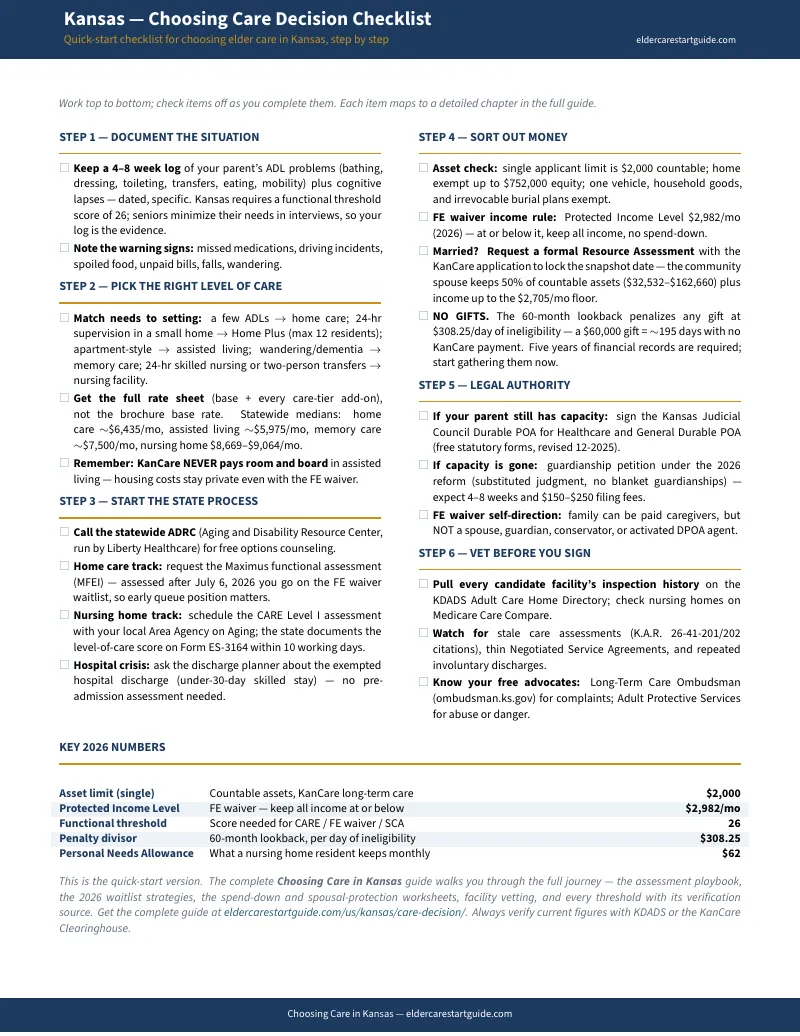
The free checklist gives you the 20 essential steps in sequence — what to do and in what order. The full guide gives you the how: the dual-assessment preparation strategy, the 2026 waitlist workarounds, the financial worksheets, the provider scorecards, and the Kansas-specific regulatory context that turns each checklist item into an executable action.
Get the Kansas Care Decision System →
Your parent's safety and financial security depend on getting this sequence right — and in 2026 Kansas, the sequence changed. The guide costs — less than 30 minutes of an elder law attorney's time — and it prepares you to use that attorney's time effectively instead of burning it on orientation.