
Iowa Is an Income-Cap State — And Most Medicaid Guides Don't Tell You What That Means
Your parent needs long-term care. Nursing homes in Iowa cost over $8,000 a month. Medicare's skilled nursing benefit runs out after 100 days — then the private-pay bills start piling up. You've been researching Iowa Medicaid, but the guides you're finding either quote generic national rules or bury the details that matter most: Iowa has a hard income cap at $2,982 a month, it counts IRAs and 401(k)s as resources, it runs one of the broadest estate recovery programs in the country, and the state just eliminated its consumer-directed attendant care program — leaving thousands of family caregivers scrambling to understand a new system.
Iowa's Medicaid rules are specific and unforgiving. If your parent's monthly income exceeds $2,982 by even one dollar, they are disqualified from long-term care Medicaid unless you first establish a Medical Assistance Income Trust — commonly called a Miller Trust. The countable asset limit is $2,000 for a single applicant. Retirement accounts that other states treat as exempt? Iowa counts them. Any gift or transfer within the past five years triggers a penalty period. And after your parent passes, Iowa's Estate Recovery Program reaches beyond probate into joint tenancies, life estates, and living trusts — further than most families realize.
National Medicaid guides are written for a generic version of the system that doesn't exist in Iowa. They skip the Miller Trust because not every state requires one. They don't mention that Iowa counts IRAs. They gloss over estate recovery because most states only pursue probate assets. Following that advice in Iowa means families miss the Miller Trust deadline, leave countable retirement accounts exposed, and get blindsided by estate recovery claims they thought only applied to the probate estate.
The Iowa Medicaid Navigation System
This guide maps the complete financial, clinical, and legal pathway through Iowa's Medicaid long-term care system — from the first financial assessment through Miller Trust establishment, spend-down execution, the application process, in-home care authorization, and post-death estate recovery defense. Every dollar figure, form, agency phone number, and deadline is specific to Iowa's 2026 regulatory framework.
What separates this from Iowa HHS fact sheets and elder law firm blog posts: it connects the systems that Iowa treats as separate processes. Your parent's income assessment, the Miller Trust funding flow, the asset snapshot date for married couples, spousal impoverishment protections, Elderly Waiver authorization through LifeLong Links, the transition from ICDAC to Consumer Choices Option for family caregivers, and the estate recovery claim that arrives after death — all of these interact. Filing one step out of sequence, missing the Miller Trust deposit in one month, or failing to transition your care agreement before the ICDAC sunset means gaps in coverage that cost families thousands. The guide shows how these pieces connect so you can sequence each decision correctly.
What's Inside
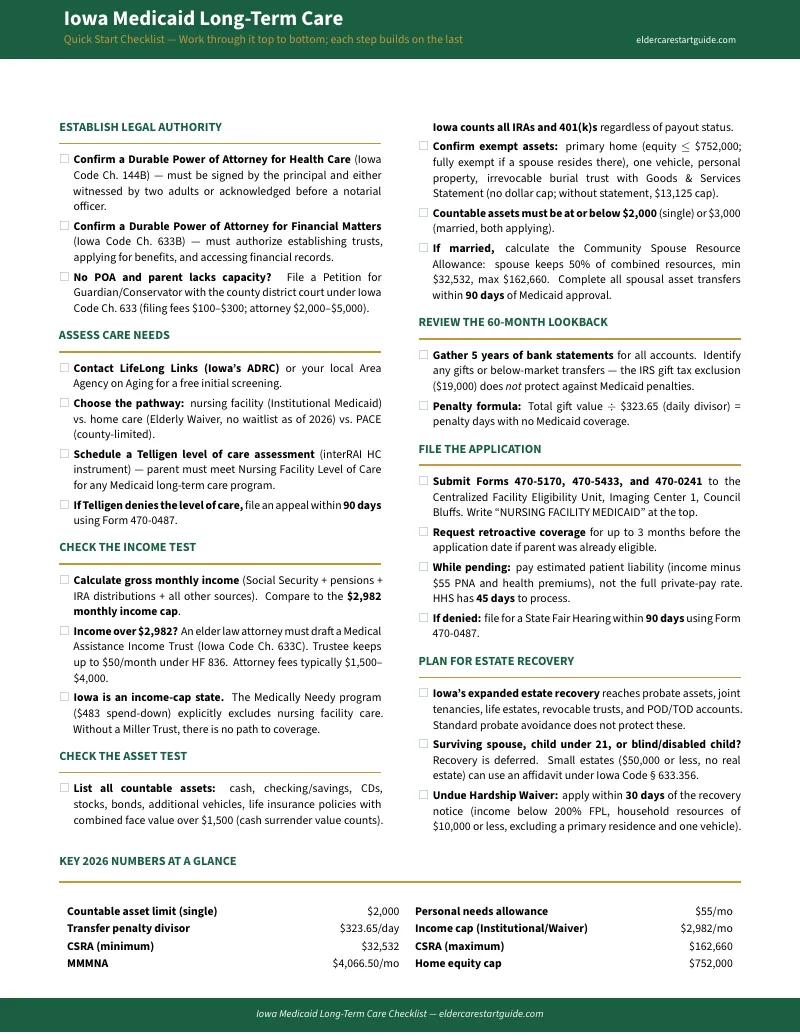
- The Complete Guide (14 chapters) — walks through the 2026 Iowa Medicaid eligibility rules, the $2,982 income cap and Miller Trust mechanics, asset classification (including the IRA trap), the five-year lookback, strategic spend-down, spousal impoverishment protections, the Elderly Waiver and Consumer Choices Option, PACE, the application process, essential legal documents, appeals, expanded estate recovery defense, and when to hire a professional
- 25-Item Quick-Start Checklist (free download) — the most urgent action items in priority order, from gathering five years of financial records to establishing a Miller Trust and filing the application
- 6 Printable Planning Worksheets — Financial Asset Inventory, Five-Year Transaction Audit Log, Monthly Income & Patient Liability Tracker, Agency Communication Log, Appeal Preparation Checklist, and Spend-Down Decision Matrix
Who This Is For
- Adult children whose parent is facing a hospital discharge with Medicare about to end and no plan for the nursing home's $8,000+/month private rate
- Families who were told their parent "makes too much" for Medicaid — without anyone mentioning that a Miller Trust exists specifically to solve the income-cap problem in Iowa
- Community spouses terrified of losing the family home, their retirement savings, or their monthly income when a partner enters a nursing facility — and unsure how the Community Spouse Resource Allowance and Minimum Monthly Maintenance Needs Allowance actually work in Iowa
- Family caregivers who were paid under Iowa's now-eliminated ICDAC program and need to transition to the Consumer Choices Option before losing their compensation and care authorization
- Families exploring the Elderly Waiver or PACE who need to understand how financial eligibility, clinical assessments, and service authorization work together — and how to start the process through LifeLong Links or their local Area Agency on Aging
- Proactive planners whose parent is still healthy and want to organize financial records, identify exempt vs. countable assets, and set up burial trusts before a crisis forces rushed decisions under the five-year lookback
- Siblings who need a neutral reference to resolve disagreements about spend-down, whether to pay a caregiving sibling, or when to transition from home care to facility care
Why Free Resources Leave You Stuck
Iowa's Department of Health and Human Services publishes eligibility charts and program descriptions. LifeLong Links offices provide options counseling. But state staff cannot advise you on asset protection strategy, spend-down sequencing, Miller Trust structuring, or estate planning. They can hand you an application form. They cannot tell you whether your parent's IRA is countable, how to restructure assets for the spousal resource allowance, or how to defend against an estate recovery claim on a jointly held property.
National publishers like AARP and Paying for Senior Care write their Iowa pages from templates designed for medically needy states without income caps. Iowa is an income-cap state. Following advice that doesn't account for the Miller Trust requirement, Iowa's treatment of retirement accounts, or the expanded scope of estate recovery creates real financial risk: families leave money on the table, miss mandatory trust requirements, and get caught by recovery claims on assets they thought were protected.
Elder law attorneys in Iowa navigate all of this — at an average of $254 per hour, with comprehensive Medicaid planning packages running $3,000 to $8,000. Using this guide to organize your documents, understand the rules, and map your parent's specific pathway before that first consultation can save significant billable hours. And for families with straightforward situations — income just above the cap, modest assets, no lookback violations — the guide itself walks you through every step.
Satisfaction Guarantee
If the guide doesn't help you identify at least one eligibility pathway, asset protection strategy, or application step you weren't already aware of, email us for a full refund, no time limit. No forms, no waiting period.
Start Protecting Your Parent's Care and Savings Today
Download the free checklist to get the eligibility overview — or get the full guide for and have every chapter, planning worksheet, and filing reference you need to navigate Iowa's Medicaid long-term care system from first crisis to approved application.