
Your Parent Needs Help at Home. Iowa's Elderly Waiver Can Pay for It — If You Know How to Navigate the System.
Your parent fell last week. Or maybe they didn't fall — they just stopped cooking, stopped bathing, stopped remembering which pills are which. Either way, you're now the person figuring out what comes next.
You called LifeLong Links. They gave you a phone number and told you to contact your Area Agency on Aging. You searched for "Iowa Medicaid home care" and found out the program is called the Elderly Waiver, that it runs through Managed Care Organizations, and that your parent needs something called a "Nursing Facility Level of Care" — but nobody told you what that actually means or how to prove your parent qualifies.
Meanwhile, you priced out private home care. At $25 to $35 an hour for nonmedical care in Iowa, full-time help runs over $50,000 a year. And your parent's savings won't last twelve months at that rate.
The Iowa Care Navigation System
This is not a list of eligibility limits you can find on the Iowa HHS website. It is the process around the limits — the part that $254/hour elder law attorneys explain in billable consultations and that the LifeLong Links intake call never covers.
The guide walks you through every step from the first crisis call to securing state-funded home care, establishing legal authority, choosing the right MCO, funding home modifications, and shielding the family home from estate recovery — organized in the order you will actually need them.
Iowa has a structural advantage most families never learn about: the Elderly Waiver has no waiting list. Once your parent qualifies, services start. No lottery, no multi-year queue — unlike Iowa's disability waivers, which have years-long backlogs. But qualifying requires navigating an income cap of $2,982/month (Iowa is an income-cap state with no spend-down), an asset limit of $2,000, and a clinical assessment — and one wrong step can bury your application in the wrong Medicaid queue for weeks.
What's Inside
- Home Care vs. Home Health — The Distinction That Wastes Weeks — Families waste critical time calling clinical home health agencies when they need nonmedical personal care, or contacting home care companies when they need skilled nursing. Chapter 1 maps the two systems side by side: who provides what, who pays for what, and which intake path to take so you don't spend two weeks in the wrong pipeline.
- The Elderly Waiver Eligibility Walkthrough — The clinical and financial requirements explained in plain language. How the Level of Care assessment works, what Activities of Daily Living the state evaluates, the exact income cap ($2,982/month for 2026), the $2,000 asset limit, and the specific exemptions for the primary home (up to $752,000 in equity), one vehicle, and prepaid burial trusts.
- Miller Trust Setup — Step by Step — Iowa is an income-cap state. If your parent's Social Security and pension exceed $2,982 by even one dollar, they are denied — period. No spend-down, no deductible, no sliding scale. The guide walks through establishing the Qualified Income Trust (Miller Trust) that Iowa requires: what the trust does, who the trustee is, how excess income flows through the restricted account, and naming the State of Iowa as remainder beneficiary.
- The 2026 CDAC-to-CCO Transition — Getting Paid to Care — Individual CDAC ended on December 31, 2025. The primary self-directed pathway for 2026 is the Consumer Choices Option (CCO), where the care recipient acts as employer of record and Veridian Fiscal Solutions handles payroll. Adult children qualify as paid attendants (spouses do not) at a transition rate of $4.03 per 15-minute unit under billing code T1019. The guide covers the full enrollment path and budget-building process with Veridian.
- The Elderly Waiver Application — Step by Step — The complete process from gathering documents through submission. How to download the Iowa Application for Health Coverage, navigate to Appendix A, check the correct boxes for "Services to remain in your home," and write "Elderly Waiver" clearly at the top to prevent processing errors. How to request the clinical assessment through your AAA. What the MCO assignment means and how to choose between Iowa's managed care plans.
- Spousal Protections — CSRA and MMMNA — For married couples where only one spouse needs care: the Community Spouse Resource Allowance (up to $162,660 in retained assets), the Minimum Monthly Maintenance Needs Allowance (up to $4,066.50/month shifted to the at-home spouse), and the Personal Needs Allowance. How to calculate what the community spouse keeps so one parent's care doesn't impoverish the other.
- Every Elderly Waiver Service Explained — Homemaker, chore, adult day care, consumer-directed attendant care, personal emergency response systems, home-delivered meals, home modifications, assisted transportation, and respite. What each service covers, how it's authorized by your case manager, and how it's delivered through your MCO.
- Home Modification Funding Map — The Elderly Waiver funds ramps, grab bars, walk-in showers, and other safety adaptations — but Iowa Medicaid requires three competitive bids from enrolled Medicaid contractors before project approval. The guide covers the bid process, alternative funding through USDA Section 504 grants and Local Housing Trust Funds, and a room-by-room fall-prevention assessment.
- Legal Authority Chapter — The Medical and Financial Powers of Attorney your parent needs to sign while they still have capacity — local Iowa firms package them for approximately $275 (individual) or $425 (couples). If that window closes, you're facing probate court guardianship or conservatorship: 5 to 6 hours of attorney time plus 10 to 15 hours of paralegal work, all billed hourly. The guide covers the documents, the differences, and the emergency options.
- Estate Recovery Shield — Iowa's Medicaid Estate Recovery program seeks repayment after a recipient dies — but never while your parent is alive in the home, and never when a surviving spouse resides there. The guide walks through the exemptions, the $752,000 home equity protection during the recipient's lifetime, and the hardship waiver process for families who need to challenge a recovery claim.
- The Six Iowa Area Agencies on Aging — Who You Actually Call — LifeLong Links routes families through Iowa's six regional AAAs, each covering a different part of the state. The guide maps every agency to its service area, provides direct intake numbers that bypass automated queues, and explains how to request Options Counseling — the free, non-biased service where a counselor reviews both public and private care routes with you.
Plus: 11 Standalone Printable Tools
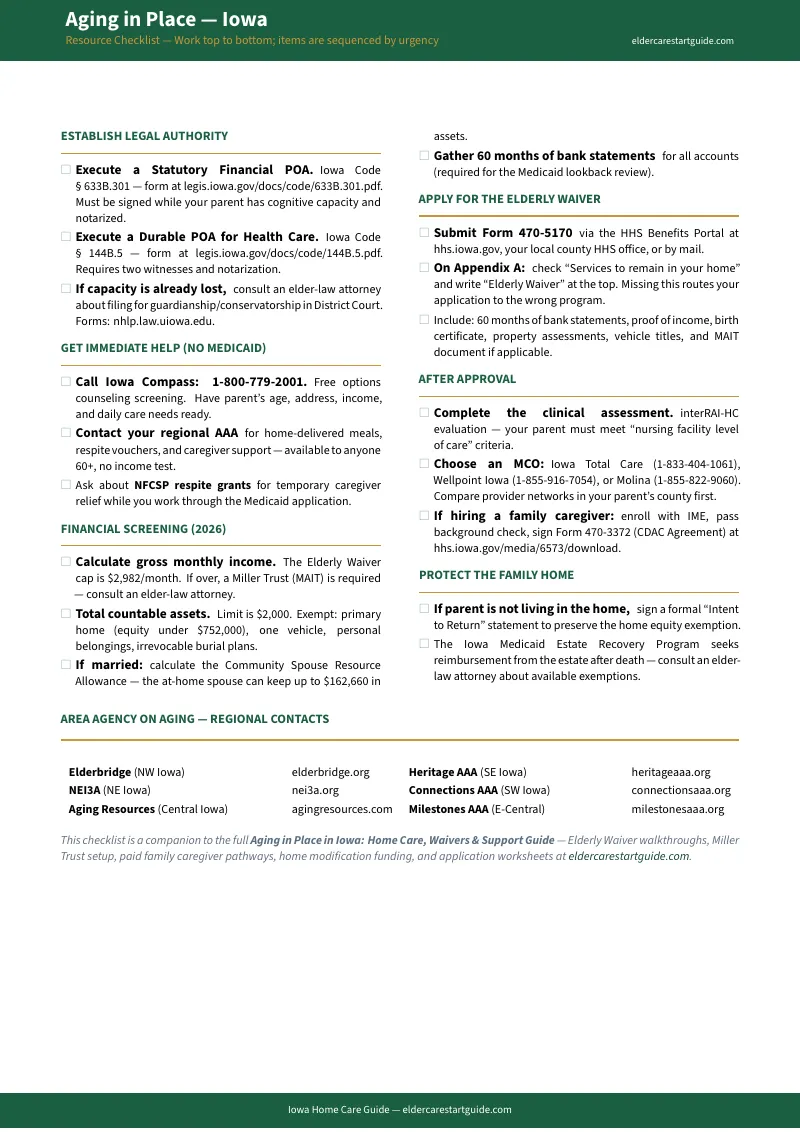
- Quick-Start Checklist — A one-page action list with the 20 most critical items in priority order: establish legal authority, call LifeLong Links (866-468-7887), gather financial records, calculate countable assets, arrange the clinical assessment, file the Elderly Waiver application.
- Elderly Waiver Application Steps — The complete 5-step application process on one printable page, from the Iowa Compass intake call through MCO enrollment and care plan development.
- Financial Eligibility Reference — All 2026 thresholds, exempt assets, allowable spend-down strategies, and verification dates on a single fridge sheet.
- Document Gathering Checklist — Every document you need before filing, organized by category with the 60-month lookback requirement highlighted.
- Spousal Protection Worksheet — Fill-in calculator for the Community Spouse Resource Allowance and Minimum Monthly Maintenance Needs Allowance.
- CCO Caregiver Enrollment Guide — Step-by-step Consumer Choices Option setup with Veridian Fiscal Solutions, billing codes, and ongoing requirements.
- Estate Recovery Shield — What Iowa Medicaid can and cannot recover, the exemptions that protect the family home, and when to involve an attorney.
- Home Safety Assessment — Room-by-room checklist with Iowa modification funding sources to complete before the state assessor visits.
- Emergency Contact Card + Backup Care Protocol — Fillable cards for your parent's wallet and fridge, plus the backup plan the MCO requires.
- Forms Directory — Every official Iowa form with where to find it.
- Key Contacts Reference — All six AAAs, three MCOs, state hotlines, and fill-in fields for your team.
- Compliance Tracker — Monthly and annual tasks to keep Elderly Waiver services active.
Who This Is For
- Adult children whose parent is being discharged from the hospital and someone needs to figure out how to arrange home care that costs $25 to $35 an hour privately
- Families whose parent's income exceeds $2,982/month and they need a Miller Trust set up correctly — not a generic template that gets rejected
- Caregivers who were paid under CDAC before 2026 and need to transition to the Consumer Choices Option through Veridian Fiscal Solutions
- Family members who want to become paid caregivers under CCO but don't know how to enroll, build the budget, or handle the T1019 billing
- Anyone terrified that Iowa Medicaid will seize their parent's home after death — and who wants to understand what estate recovery actually reaches
- Out-of-state siblings coordinating Iowa Medicaid applications remotely with no idea which AAA to contact
Why Not Free Government Resources?
The Iowa HHS publishes eligibility limits. LifeLong Links offers options counseling. Brevy and Medicaid Planning Assistance websites list state-specific thresholds.
Here is what none of them provide:
- A step-by-step Miller Trust setup with the trust structure, bank account instructions, and disbursement order Iowa requires — not a "consult an attorney" note
- The full CCO enrollment walkthrough with Veridian onboarding, budget-building, and the $4.03 per-unit rate calculation — not a paragraph saying "family members may be eligible"
- A side-by-side home health versus home care comparison with Iowa-specific payers, agencies, and referral paths — not a generic definitions page
- The estate recovery rules broken down by asset type, with the specific exemptions that shield the family home — not a legal disclaimer
Government sites administer rules. Elder law firms explain them for $254 per hour. This guide bridges the gap — translating hundreds of pages of Iowa administrative code into a sequence you can execute in an evening.
Satisfaction Guarantee
If the guide doesn't give you a clearer path forward, email [email protected] and we'll make it right.
— Less Than One Hour of an Iowa Elder Law Attorney's Time
An initial consultation with an Iowa elder law attorney averages $254 per hour. A full Medicaid planning engagement runs $2,000 to $10,000. A guardianship proceeding adds thousands in court costs and attorney fees.
This guide won't replace an attorney for complex estate restructuring or a contested guardianship. But for the Miller Trust setup, Elderly Waiver application, CCO enrollment, home modification funding, and estate recovery protection that most Iowa families need, it covers the ground at a fraction of the cost — and if you do need an attorney, you'll walk in with an organized file instead of a box of unsorted bank statements.
Start with the free checklist to see if the approach fits your situation. The full guide goes deeper — every threshold, every strategy, every form, every phone number.