
Your Parent Has Dementia. Iowa's Care System Has Six Agencies, Two Waiver Programs, and Zero Instructions for Families.
Maybe the diagnosis came last month and you're trying to figure out what happens next. Maybe it's been two years of managing at home and the wandering, the sundowning, the 3 AM wake-ups have finally broken you. Or maybe the hospital just called — a fall, a UTI that unmasked something worse — and you have 72 hours to find a memory care placement before discharge.
Whatever brought you here, the situation is the same: Iowa's dementia care system is fragmented across six Area Agencies on Aging, a Medicaid program that splits care costs from room and board, a licensing framework that doesn't even have a standalone "memory care" category, and a set of legal authority rules that lock you out of your parent's finances if you didn't get the right documents signed in time.
The Iowa Dementia Care Navigation System
This isn't a pamphlet about "understanding Alzheimer's." It's a complete care navigation system built specifically for Iowa families — covering the state-specific programs, Medicaid rules, facility certification requirements, and legal frameworks that apply only here.
While national referral sites like A Place for Mom steer you toward commission-paying facilities and ignore the Medicaid Elderly Waiver entirely, and state websites scatter critical information across HHS, DIAL, and LifeLong Links, this guide consolidates everything into a clear sequence of decisions with the tools to execute each one.
What's Inside
- Iowa Dementia-Specific Program Certification Guide — Iowa doesn't license "memory care" separately. Memory care operates as a certified dementia-specific program inside assisted living or nursing facilities under IAC Chapter 481-69. This section shows you exactly how DIAL certification works, what the 8-hour staff training mandate means for care quality, and how to verify any facility's certification status online
- Medicaid Elderly Waiver Walkthrough — the complete eligibility process: income limit ($2,982/month), asset limit ($2,000 single applicant), 60-month look-back, nursing facility level-of-care assessment, and the critical room-and-board payment split that catches every family off guard (Medicaid pays for care services in assisted living, but you pay room and board out of pocket)
- Miller Trust Setup Guide — if your parent's income exceeds $2,982/month, they must establish a Medical Assistance Income Trust to qualify for Medicaid. Step-by-step instructions for creating and maintaining the trust, including bank account setup and monthly disbursement tracking
- Memory Care Cost Comparison by Iowa Region — Des Moines ($7,494-$8,550/month), Cedar Rapids ($6,708-$7,320/month), Waterloo ($4,028-$4,833/month), plus community fees ($1,500-$2,500) and tier-based care add-ons that can increase a base rate by $2,000/month. Includes the home-care pricing paradox: full-time home care runs $94,000/year in Iowa — significantly more than assisted living memory care
- Medicare GUIDE Model Access Guide — CMS's Guiding an Improved Dementia Experience program provides up to $2,500/year in caregiver respite at no cost to traditional Medicare beneficiaries. Lists every active Iowa GUIDE provider: Broadlawns Medical Center, Cedar Valley Hospice, Stonehill Communities, and the PocketRN/Right at Home partnership
- Wandering Safety and Endangered Person Advisory System — Iowa uses the EPA system (not a standalone Silver Alert). How to file a report, what triggers highway sign alerts, and a wandering-profile template so your parent's information is ready before an emergency
- Legal Authority Roadmap — Financial Power of Attorney (Chapter 633B, durable by default), Healthcare Power of Attorney (Chapter 144B, activates on incapacity determination), execution requirements (notarized or two witnesses), and the guardianship/conservatorship process ($3,000-$7,000 in court costs) when the window for voluntary documents has closed
- MERP and Asset Protection Strategies — how Iowa's Medicaid Estate Recovery Program works, which assets are at risk, and legal approaches to protect the family home
- LifeLong Links and AAA Navigation Directory — which of Iowa's six regional Area Agencies covers your county, with direct contacts for Elderbridge, NEI3A, Aging Resources of Central Iowa, Heritage, Connections, and Milestones AAA, plus the LifeLong Links toll-free number for centralized intake
- Respite Funding Access Guide — National Family Caregiver Support Program grants (no income test, administered through AAAs), Elderly Waiver respite allocation, and the GUIDE Model respite benefit, organized by eligibility requirements so you can stack programs
- 10 Standalone Printable Worksheets — ADL Decline Tracker, Medication Management Log, Financial Eligibility Calculator, Miller Trust Disbursement Sheet, Facility Evaluation Scorecard, Wandering Profile Card, Legal Document Checklist, Care Transition Timeline, Sibling Communication Script, and Respite Planning Calendar — each a self-contained PDF you can print and bring to family meetings, facility tours, or attorney appointments
Who This Is For
- Adult children in Iowa managing a parent's new or worsening dementia diagnosis who need a structured plan, not scattered web searches
- Families facing a sudden hospital discharge into memory care placement with days to decide and no preparation
- Solo caregivers reaching burnout who need to understand the real cost comparison between continuing home care and transitioning to a residential setting
- Planners working to get legal authority, Medicaid eligibility, and asset protection in place before their parent loses the capacity to sign documents
- Long-distance family members coordinating Iowa care from out of state who need to understand state-specific programs and certification requirements
Why Not Just Google It?
You can. The information exists — scattered across the Iowa HHS website, the DIAL certification portal, LifeLong Links, six regional Area Agencies on Aging, CMS GUIDE Model enrollment pages, Iowa Legal Aid, and hundreds of pages of Iowa Administrative Code.
The problem isn't access. It's sequence, synthesis, and Iowa-specific detail. National dementia sites don't explain that Iowa has no standalone memory care license. Medicare.gov doesn't list which Iowa providers participate in the GUIDE Model. The Medicaid application page doesn't walk you through the Miller Trust your parent will need if their Social Security exceeds $2,982/month. And none of these sources tell you what to do first when you're staring at a 72-hour discharge window.
An elder law attorney in Iowa charges $235-$254/hour. A geriatric care manager charges $150-$250/hour. This guide gives you the same structured decision framework — the worksheets, the eligibility calculators, the facility evaluation tools, the legal checklists — so when you do hire a professional, you spend one session executing instead of three sessions learning the basics.
The Free Checklist vs. The Full Guide
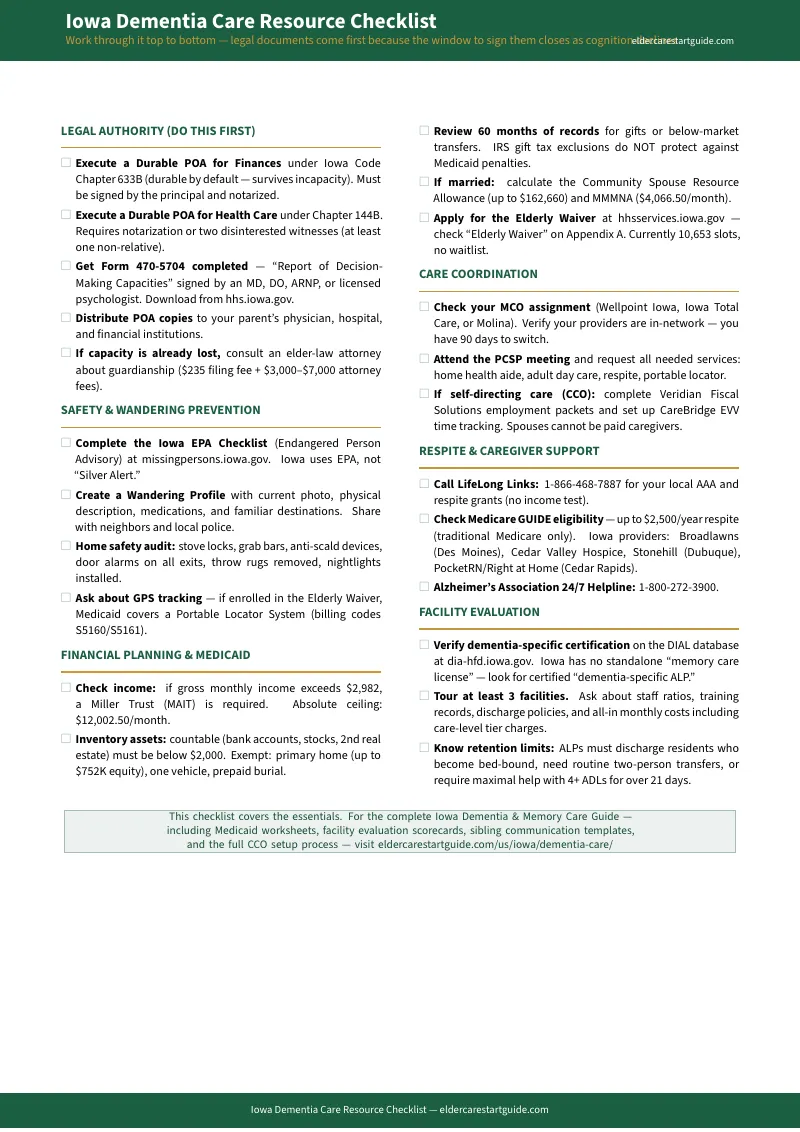
The free checklist gives you the 20 essential steps in sequence — what to do and in what order. The full guide gives you the how: the Medicaid Elderly Waiver application walkthrough, the Miller Trust setup instructions, the memory care cost maps by Iowa region, the DIAL certification verification process, the legal authority documents with execution requirements, and the 10 standalone worksheets that turn each checklist item into a completed task.
Get the Iowa Dementia Care Navigation System →
Your parent's safety and your family's financial future depend on getting these decisions right. The guide costs less than 15 minutes of an elder law attorney's time — and it prepares you to use that attorney's time on strategy instead of orientation.