
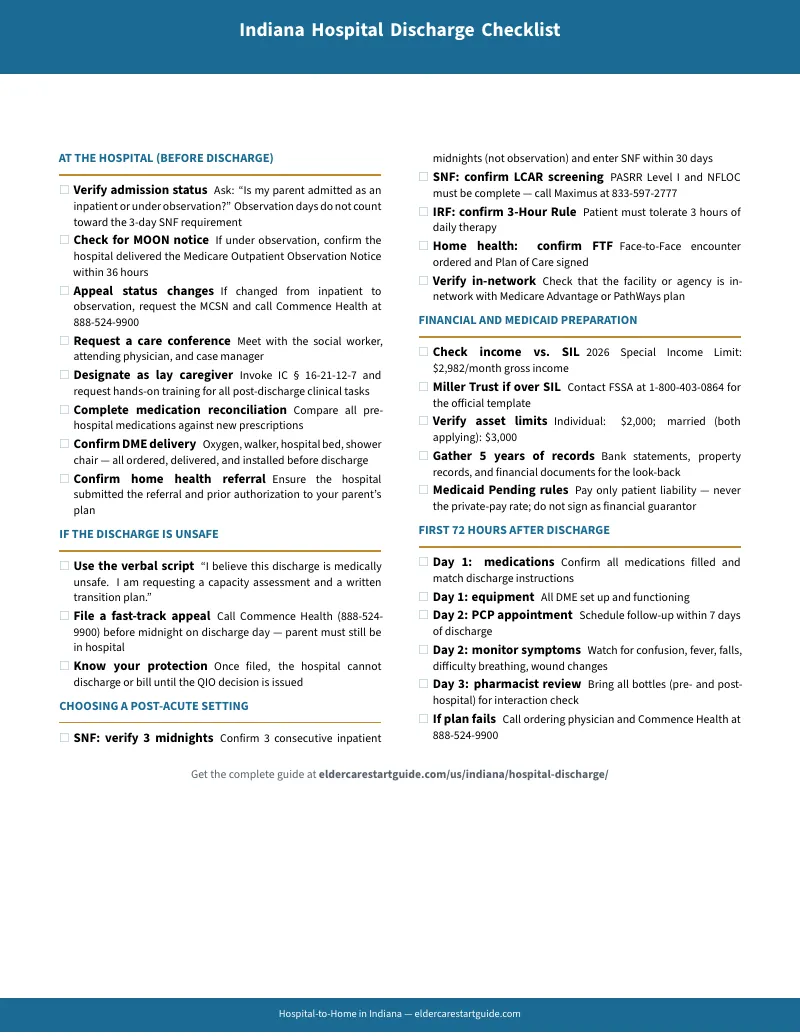
Your Parent Is Being Discharged Tomorrow. Nobody Explained What Happens Next.
The case manager just told you your parent is going home — or to a nursing facility you've never visited — and they need a decision by morning. You don't know whether the hospital stay qualifies for Medicare-covered rehab. You don't know what "observation status" means or why it might cost your family tens of thousands of dollars. You don't know how to say no.
You searched "hospital discharge rights Indiana" and found government fact sheets that explain what hospitals are required to do, but not what you should actually say, file, or demand when the discharge planner calls your parent's bed ready.
Meanwhile, the PathWays for Aging waiver waitlist has surpassed 12,000 people. The elder law attorney wants $400 an hour just to explain the basics. And your parent's cognitive decline is accelerating faster than the paperwork can keep up.
The Indiana Hospital Transition Navigation System
This is not a pamphlet of general tips. It is the process around the process — the precise sequence of verifications, appeals, enrollment steps, and legal protections that $400/hour elder law attorneys explain in billable consultations and that Indiana's overwhelmed Area Agencies on Aging cannot walk you through during a weekend discharge crisis.
The guide covers every step from the first hospital status check through discharge appeal, post-acute placement, PathWays for Aging enrollment, Medicaid eligibility, Miller Trust setup, facility rights, and home care coordination — organized in the order you will actually face these decisions.
Indiana's system is uniquely complicated. PathWays for Aging moved everyone 60 and older into managed care under Anthem, Humana, or UnitedHealthcare. The Aged and Disabled waiver waiting list is years deep. The state is a strict income cap state — over $2,982 per month and your parent is disqualified unless they establish a Miller Trust. One wrong signature on a nursing home admission agreement can make you personally liable for months of care.
What's Inside
- Hospital Status Verification & the Observation Trap — Your parent can spend four days in a hospital bed and still not qualify for Medicare rehab coverage if classified as "outpatient observation." This chapter explains the Two-Midnight Rule, the Medicare Outpatient Observation Notice (MOON), the 2025 CMS Change of Status Notice appeal, and the exact questions to ask the admissions desk before any discharge conversation begins.
- The Discharge Appeal — Freezing a Premature Discharge — Call Commence Health (Indiana's designated Quality Improvement Organization) before midnight on the scheduled discharge day and the hospital cannot remove your parent while the appeal is reviewed. The guide includes the phone numbers, the verbal script for the call, the "Important Message from Medicare" form you must receive, and the 48-hour decision timeline.
- Choosing the Right Post-Acute Setting — Inpatient Rehabilitation Facility vs. Skilled Nursing Facility vs. home health — with the three-midnight qualifying rule, the 30-day SNF transfer window, Medicare's 100-day benefit structure ($217/day coinsurance for days 21–100 in 2026), your parent's right to choose their facility, and CMS performance metrics to compare Indiana facilities beyond the hospital's recommended list.
- Indiana PathWays for Aging — How managed care works for Medicaid members 60 and older, what services the MCE coordinates (home health, DME, rehab, personal care), how to verify enrollment, Consumer-Directed Services for hiring your own caregiver, and the dual-eligible coordination rules for people on both Medicare and Medicaid.
- Waiver Waitlists & Priority Placement — The PathWays for Aging waitlist, the Health and Wellness waiver for adults under 60, the CHOICE program as a gap-filler, priority status categories that bypass the chronological queue, the 45-day acceptance window (miss it and the invitation is permanently rescinded), and the 180-day eligibility completion deadline.
- Medicaid Eligibility & the Miller Trust — Indiana's strict income cap ($2,982/month in 2026), the Qualified Income Trust that redirects excess income, asset limits, the 60-month lookback period, spousal impoverishment protections, the personal needs allowance ($52/month), and compliant spend-down strategies that reduce countable assets without triggering penalties.
- Medicaid Pending & Nursing Home Admission — What happens during the 90-day application review, why you should never sign as a personal financial guarantor, the resident's share-of-cost obligation during the pending period, and what happens if the application is denied — including eviction rules and debt liability.
- The First 72 Hours After Discharge — Medication reconciliation, follow-up appointment scheduling, home safety modifications, red flag symptoms that warrant an ER return, and the critical difference between home health (Medicare-covered skilled nursing and therapy) and home care (custodial assistance with daily activities).
- Legal Authority — POA, HIPAA & Guardianship — The Indiana Durable Power of Attorney, healthcare representative appointment, HIPAA authorization, and the full probate guardianship process for families whose parent can no longer sign documents — emergency temporary guardianship, permanent guardianship, bonds, and annual court reporting.
- Filial Responsibility — Indiana's laws that can obligate adult children to contribute to a parent's support. The guide explains when enforcement happens, what triggers it, and how to protect yourself before signing any facility agreements.
- Facility Rights & Safety — The Indiana Long-Term Care Ombudsman, the Indiana Department of Health inspection database, involuntary discharge protections, abuse reporting, and the Special Care Disclosure Act for dementia units.
- When to Hire a Professional — Decision matrix for elder law attorneys, geriatric care managers, Medicaid planners, SHIP counselors, and hospital social workers. Know exactly when you need professional help and when the guide covers the ground.
- Key Contacts Directory — Every phone number, website, and form reference on one page: Commence Health, Indiana FSSA, your local AAA, PathWays MCE helplines, the Long-Term Care Ombudsman, SHIP, Medicare, and county Medicaid offices.
12 PDFs — Print What You Need, When You Need It
The full guide plus 10 standalone printable tools and a quick-start checklist — each designed to be used at the bedside, in a care conference, or at the kitchen table:
- Observation Status Decision Tree — visual flowchart to determine whether Medicare will cover rehabilitation
- Discharge Appeal Scripts — pre-written verbal scripts for filing an emergency appeal with Commence Health
- Post-Acute Care Comparison — IRF vs. SNF vs. home health side-by-side with qualifying rules and costs
- PathWays for Aging Navigator — MCE plan comparison, covered services, and Consumer-Directed Services reference
- Waiver Waitlist Roadmap — deadlines, priority categories, and CHOICE gap-filling while you wait
- Medicaid Eligibility Worksheet — fillable income and asset inventory with 2026 Indiana thresholds and Miller Trust setup steps
- Medication Reconciliation Worksheet — compare pre-admission and discharge medications before giving the first dose
- First 72 Hours Checklist — day-by-day action items to prevent readmission
- Legal Authority Checklist — POA, HIPAA, healthcare representative, and guardianship document tracker
- Key Contacts Directory — every phone number on one page to print and post on the fridge
Who This Is For
- Adult children whose parent is being discharged from an Indiana hospital and they need to know whether the stay qualifies for Medicare rehab — or whether observation status just made them liable for the full cost
- Families facing a discharge they believe is unsafe and who need the exact steps to file an emergency appeal through Commence Health before midnight
- Caregivers trying to navigate Indiana PathWays for Aging — the managed care system that now controls their parent's home health, rehab, and waiver services through Anthem, Humana, or UnitedHealthcare
- Families whose parent's income is over $2,982/month and they need to understand the Miller Trust — not a generic "consult an attorney" instruction
- Anyone on the 12,000-person PathWays for Aging waiver waitlist who needs to understand priority placement categories, the 45-day acceptance deadline, and what CHOICE provides in the meantime
- Out-of-state siblings coordinating an Indiana parent's hospital transition remotely with no idea which AAA covers the county or how to get home health authorized through the MCE before discharge
Why Not Free Government Resources?
Indiana FSSA publishes eligibility rules. Your local AAA provides options counseling — eventually. Commence Health handles appeals. Medicare.gov explains coverage in national terms.
Here is what none of them provide:
- The step-by-step discharge appeal sequence with the exact Commence Health phone numbers, verbal scripts, and timing rules — not a paragraph telling you that you "have the right to appeal"
- A side-by-side comparison of IRF vs. SNF vs. home health with the qualifying rules, cost structures, and in-network verification steps specific to Indiana's PathWays managed care system
- The Miller Trust setup process with the timing relative to your Medicaid application, the trust-to-facility payment flow, and the consequences of getting the sequence wrong
- The waiver waitlist navigation system — priority categories, the 45-day acceptance window, the 180-day eligibility deadline, and what CHOICE provides while you wait
Government sites administer rules. Elder law firms explain them for $400 per hour. This guide bridges the gap — translating Indiana's managed care policies, waiver systems, and discharge rights into a sequence you can execute from a hospital waiting room.
Satisfaction Guarantee
If the guide doesn't give you a clearer path forward, email [email protected] and we'll make it right.
— Less Than One Hour of an Indiana Elder Law Attorney's Time
An initial consultation with an Indiana elder law attorney runs $300 to $500 per hour. A full Medicaid planning engagement costs $3,000 to $10,000. A guardianship proceeding adds $5,000 to $15,000 in court and legal fees.
This guide won't replace an attorney for contested guardianships or complex trust restructuring. But for the hospital status verification, discharge appeal process, post-acute placement comparison, PathWays navigation, Medicaid eligibility analysis, and Miller Trust basics that most Indiana families need during a hospital crisis, it covers the ground at a fraction of the cost — and if you do need an attorney, you'll walk in with an organized file instead of a stack of unanswered questions.
Start with the free checklist to see if the approach fits your situation. The full guide goes deeper — every threshold, every deadline, every form, every phone number.