
Your Parent Needs to Stay Home. Indiana Has Programs That Pay for It — If You Can Navigate the System.
Your parent fell. Or maybe they didn't fall — they just stopped cooking, stopped taking medications on time, left the front door unlocked three nights in a row. Either way, you're the one who noticed, and now you're the one trying to figure out what to do about it.
You Googled "home care Indiana" and found out there's a Medicaid waiver that covers in-home care. You called the local Area Agency on Aging and they told you assessments are now handled by a company called Maximus. You found the FSSA website and learned about something called "PathWays for Aging" — but nobody told you what it replaced, how to get past the 11,000-person waitlist, or what happens when your parent's income is $47 over the monthly cap.
Meanwhile, you priced out private home care. $30 to $40 per hour. $7,200 to $9,600 per month for 8 hours a day. Your parent's savings won't last a year at that rate.
The Indiana Home Care Navigation System
This is not a list of eligibility rules you can find on the FSSA website. It is the process around the rules — the part that $5,000-to-$12,000 Medicaid planning attorneys explain in billable consultations and that overloaded state caseworkers never have time to walk you through.
The guide covers every step from hospital discharge to stable home care: qualifying for PathWays for Aging, passing the Maximus Level of Care assessment, setting up a Miller Trust to bypass the income cap, bridging the waitlist gap with the CHOICE program, getting paid as a family caregiver, protecting the family home from estate recovery, securing legal authority before a parent loses capacity, and building a long-term care plan — organized in the order you will actually need them.
Indiana recently completed the largest overhaul of its home care system in decades. The old Aged and Disabled Waiver split into PathWays for Aging (60+) and the Health and Wellness Waiver (under 60). Maximus replaced the local AAAs as the clinical gatekeeper. Managed care entities — Anthem, Humana, and UnitedHealthcare — now coordinate all waiver services. Most guides online still describe the old system. This one describes the system your family will actually encounter.
What's Inside
- PathWays for Aging Application Roadmap — The complete waiver application process in plain language. How Maximus conducts the Level of Care assessment using the interRAI tool, what Nursing Facility Level of Care means and how to document your parent's ADL limitations to meet it, and the three managed care entity options your family will choose between once approved.
- Miller Trust Setup Guide — Indiana's income cap for long-term care is $2,982 per month in 2026. If your parent's Social Security plus pension exceeds that by even a few dollars, they're disqualified — unless you establish a Qualified Income Trust (Miller Trust). The guide walks through opening the trust account with a local bank, calculating the monthly excess income transfer, maintaining the administrative log, and avoiding the mistakes that trigger Medicaid denials.
- Waitlist Strategy and CHOICE Bridging — The PathWays waiver waitlist exceeds 11,000 individuals. But Indiana maintains Priority Status categories that bypass it entirely — hospital discharge, nursing facility transition, and imminent health or safety risk. The guide explains how to document priority eligibility and, for families that don't qualify, how to use the state-funded CHOICE program ($250,000 asset limit, no waitlist in most regions) as interim support while waiting for a waiver slot.
- Paid Family Caregiver Programs — Indiana offers two paths to get paid for caring for your parent. Attendant Care (ATTC) pays non-spouse relatives up to 40 hours per week. Structured Family Caregiving (SFC) pays co-resident caregivers — including spouses — a daily tax-free stipend reaching $750 to $800 per week. The guide details the eligibility differences, the Legally Responsible Individual rules that block spouses from ATTC, how to request an SFC transition from your care coordinator, and the state-approved SFC provider agencies that handle enrollment.
- Medicaid Asset Protection — Indiana's countable asset limit is $2,000 for a single applicant. The guide covers every exempt asset category (primary residence, one vehicle, burial accounts, personal property), the spousal Community Spouse Resource Allowance, the 60-month look-back period for uncompensated transfers, legitimate spend-down strategies, and the distinction between the Medicaid resource limit and the CHOICE program's far more generous $250,000 threshold.
- Estate Recovery Shield — Indiana's Medicaid Estate Recovery Program (MERP) can reclaim long-term care costs from your parent's estate after death — including the family home. The guide details the Caregiver Child Exemption (live-in child who delayed nursing home placement for 2+ years), surviving spouse protections, dependent child exemptions, what documentation you need to file a successful exemption claim, and the timeline for estate recovery claims after death.
- Legal Authority Toolkit — How to execute a Durable Financial Power of Attorney and a Health Care Representative appointment under Indiana Code while your parent still has capacity. What each document covers, where to file them, and why acting before cognitive decline saves your family from a court-supervised Guardianship that costs thousands of dollars and weeks of probate hearings.
- Home Modifications and Community Resources — The Environmental Modifications (E-mods) benefit under the waiver, typical lifetime funding limits of $15,000 to $20,000, the bidding process with licensed contractors, non-emergency medical transportation through managed care plans, Meals on Wheels and home-delivered meal programs, adult day services, and the complete directory of Indiana's 15 regional Area Agencies on Aging (INconnect Alliance).
- Appeals and Rights — If your parent is denied waiver services, the guide explains the 4-level appeal process: managed care entity internal appeal, state fair hearing through FSSA, additional review, and judicial review. Includes timelines, what to include in your appeal letter, and the continuation-of-benefits rules that keep services running during the appeal.
- 30-Day Action Plan — A day-by-day timeline from crisis to stable care: legal authority (Days 1–3), CHOICE application for bridging (Days 3–7), Maximus assessment preparation (Days 7–14), Medicaid financial documentation assembly (Days 14–21), waiver application submission (Days 21–30). Each step cross-references the relevant guide chapter so you know exactly where to go for details.
Plus: Printable Standalone Worksheets and References
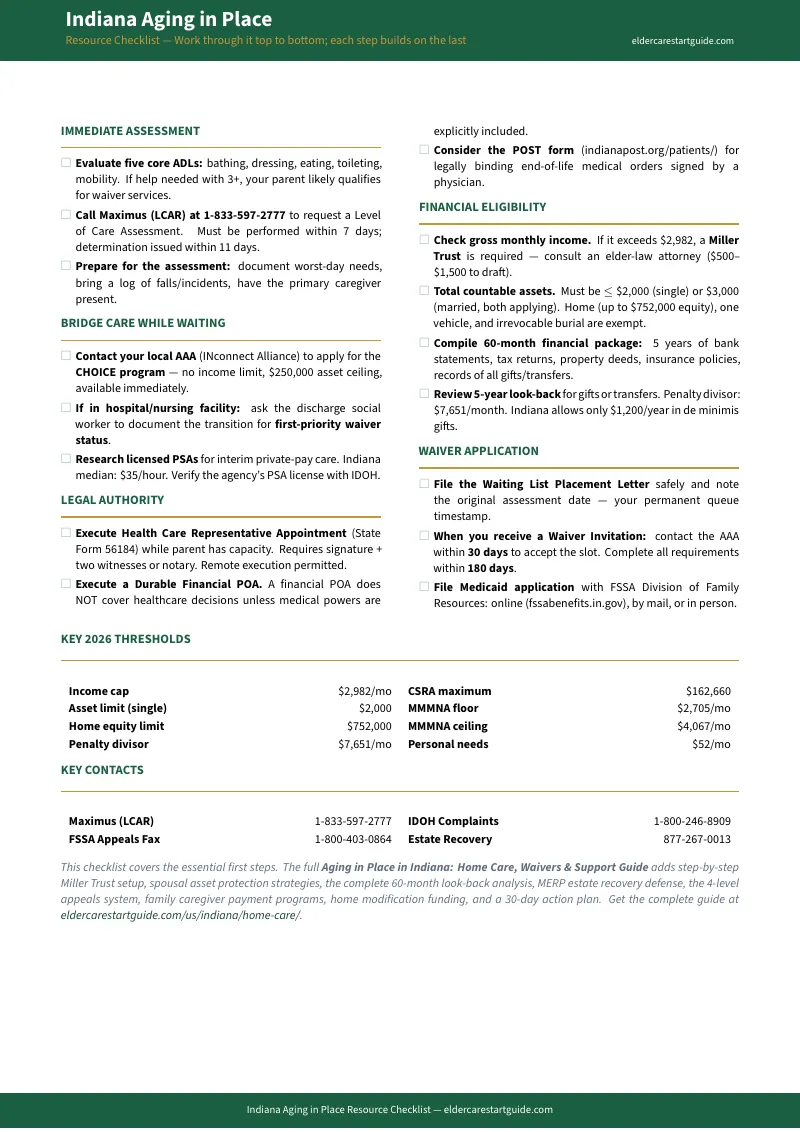
- Indiana Aging in Place Resource Checklist — The 17-item action list that comes with the free download, covering legal authority, clinical assessment preparation, financial eligibility, home safety, and program applications.
- Miller Trust Setup Worksheet — Bank letter template, monthly income calculation, deposit tracking log, and annual reporting checklist.
- Medicaid Financial Eligibility Worksheet — Asset inventory with exempt/countable classification, income tally against the $2,982 cap, and spend-down strategy tracker.
- LCAR Assessment Preparation Guide — Document your parent's ADL limitations in the format Maximus assessors use, so nothing is understated during the evaluation.
- Home Safety Assessment — Room-by-room checklist with Indiana-specific E-mod funding sources and contractor requirements.
- Family Care Plan Worksheet — Schedule caregiver coverage across family members, track ATTC vs. SFC hours, and document care tasks for the Caregiver Child Exemption.
- Key Contacts and Forms Reference — FSSA, Maximus LCAR Help Desk, managed care entity numbers, AAA directory, and every form number with its purpose.
Who This Is For
- Adult children whose parent is being discharged from the hospital and someone needs to figure out how to arrange home care that costs over $100,000 a year privately
- Families who discovered their parent's income is over the $2,982 Medicaid cap and assumed they don't qualify — without knowing about the Miller Trust
- Caregivers stuck on the 11,000-person PathWays waitlist who don't know about Priority Status categories or CHOICE bridging
- Spouses providing daily care who want to get paid but were told "you can't be a paid caregiver" — without being told about Structured Family Caregiving
- Families terrified that MERP will seize the family home after their parent dies — and who want to understand the exemptions before it's too late
- Out-of-state siblings coordinating Indiana home care applications remotely with no idea who to call since the Maximus transition
Why Not Free Government Resources?
The FSSA publishes eligibility limits. The Division of Aging maintains a website. Maximus has a Help Desk phone number. Your local AAA offers options counseling.
Here is what none of them provide:
- A step-by-step Miller Trust setup guide showing you how to open the account, calculate the monthly transfer, and maintain the records — not just a legal definition that says "consult an elder law attorney"
- A Maximus LCAR assessment preparation strategy explaining how to document ADL limitations in the format assessors actually use — not the FSSA's clinical fact sheet written for providers
- A waitlist strategy covering Priority Status categories, CHOICE bridging, and the documentation that gets your parent moved to the front of an 11,000-person line — not "your name has been added to the list"
- A side-by-side comparison of Attendant Care vs. Structured Family Caregiving showing exactly who qualifies for each, what the pay is, and how to transition between them — not scattered across four different state web pages
- An estate recovery analysis explaining the Caregiver Child Exemption documentation requirements and the timeline your family needs to meet — not a one-paragraph MERP notice from FSSA
Government sites publish regulations. This guide compiles fragmented state, federal, and managed care data into a single, sequential process you can follow from crisis to stable home care — without paying a Medicaid planner $5,000 to $12,000 to explain things you can learn yourself.
Your Parent's Safety Net
Every week you spend researching is a week your parent goes without the funded care they may already be entitled to. Medicaid applications are processed based on filing date — but only if you file.
Get the Indiana Home Care Guide →
The free checklist gives you the 17-item action list to start immediately. The full guide gives you every chapter, every worksheet, every form reference, and the complete navigation system for keeping your parent safely at home in Indiana.