You're paying $6,000 a month for memory care — and you still don't know if your parent is in the right place
Your parent wandered out the front door last Tuesday. Or the neurologist just said "moderate-stage Alzheimer's" and you have no idea what that means for their care plan. Or you're watching their savings drain at $72,000 a year and nobody can tell you whether Medicaid will help, how long the waitlist is, or what happens when the money runs out.
Indiana's dementia care system changed completely in 2024 — the Aged and Disabled Waiver is gone, replaced by PathWays for Aging, a managed care model that put three private insurance companies between your parent and their services. Most of what you read online still describes the old system. The attorneys who could sort it out charge $300 to $500 an hour. The lead-generation sites that dominate Google want to sell your phone number to a private-pay facility, not help you understand your Medicaid options.
The Indiana Dementia Care Decision System
This guide replaces the scattered, outdated information with a single system that maps every decision point in Indiana's dementia care landscape — from the moment of diagnosis through facility placement, Medicaid qualification, and estate recovery protection. It is built on Indiana's 2026 rules, including the sweeping changes from House Enrolled Act 1277, signed by Governor Braun in March 2026.
This is not a national overview with Indiana mentioned in a sidebar. Every threshold, every program, every dollar figure is Indiana-specific and current as of 2026.
What's Inside
- PathWays for Aging Waiver Navigation — how the MCE system works, what the waiting list actually means versus the PathWays medical program, and how to protect your parent's application date when the queue runs 11,000+ deep
- Memory Care Licensing Decoder — Indiana has no standalone memory care license, which means the facility marketing "specialized dementia care" may be an assisted living residence that legally cannot retain your parent when they need total transfer assistance. The guide explains Residential Care Facilities vs. Comprehensive Care Facilities and walks you through the IC 12-10-5.5 Disclosure Form line by line
- Medicaid Spend-Down Calculator Worksheets — the exact 2026 income cap ($2,982/month), asset limits ($2,000 single), Community Spouse Resource Allowance ($32,532 to $162,660), Miller Trust setup instructions, and a 60-month look-back audit template so you can identify penalty-triggering transactions before the state does
- Silver Alert & Project Lifesaver Preparation Kit — a pre-filled emergency dispatch script for reporting a Missing Endangered Adult under Indiana Code § 12-7-2-131.3, with the clinical documentation checklist that gets law enforcement moving immediately instead of asking you questions you can't answer under stress
- Legal Authority Action Plan — the exact sequence for executing a Durable Financial POA and Health Care Representative appointment while your parent still has capacity, plus the full guardianship filing process (physician's report requirements, surety bond rules, biennial accounting obligations) if that window has closed
- CHOICE Program Bridge Strategy — how to use Indiana's state-funded CHOICE program (no income limits, $250,000 asset cap) as a bridge while waiting for PathWays waiver enrollment, and why transitioning from CHOICE to PathWays triggers priority placement on the waitlist
- Four-Level Medicaid Appeal System — the complete appeal sequence from MCE internal review through Administrative Law Judge hearing, FSSA final decision, and judicial review — with filing deadlines and the continuation-of-benefits rule that keeps services running during your appeal
- HEA 1277 Impact Analysis — the 100-day managed care carve-out for nursing home residents, individual cost caps on in-home services, the standalone assisted living waiver mandate, and the shortened estate recovery timeline that affects every family's asset protection plan
Who This Is For
- Crisis-mode caregivers — your parent wandered, fell, or is being discharged from the hospital and you need a safe placement plan within 48 hours
- Asset protection planners — you're watching private-pay memory care drain the family's savings and need to understand Medicaid qualification without losing the home
- Legal authority seekers — you've been managing your parent's care informally and just hit an administrative wall at the bank, the doctor's office, or the admission desk
Why Not Free Tools?
A Place for Mom and Caring.com will happily connect you with a "free advisor." Their revenue comes from referral fees paid by private-pay facilities — they have no financial reason to tell you about Medicaid, CHOICE, or home care options that don't generate a commission. Indiana's FSSA portal has the raw policy data, but it is written in regulatory language and assumes you already understand the system you're trying to learn. Your local Area Agency on Aging provides excellent intake counseling, but their staff are legally prohibited from giving specific financial advice — they cannot tell you how to spend down assets or when to establish a Miller Trust.
This guide closes the gap between free but incomplete information and $3,000-to-$7,000 Medicaid planning retainers. It gives you the strategic roadmap that helps you walk into an elder law attorney's office already knowing what to ask — or handle the entire process yourself if your situation is straightforward enough.
What You Get
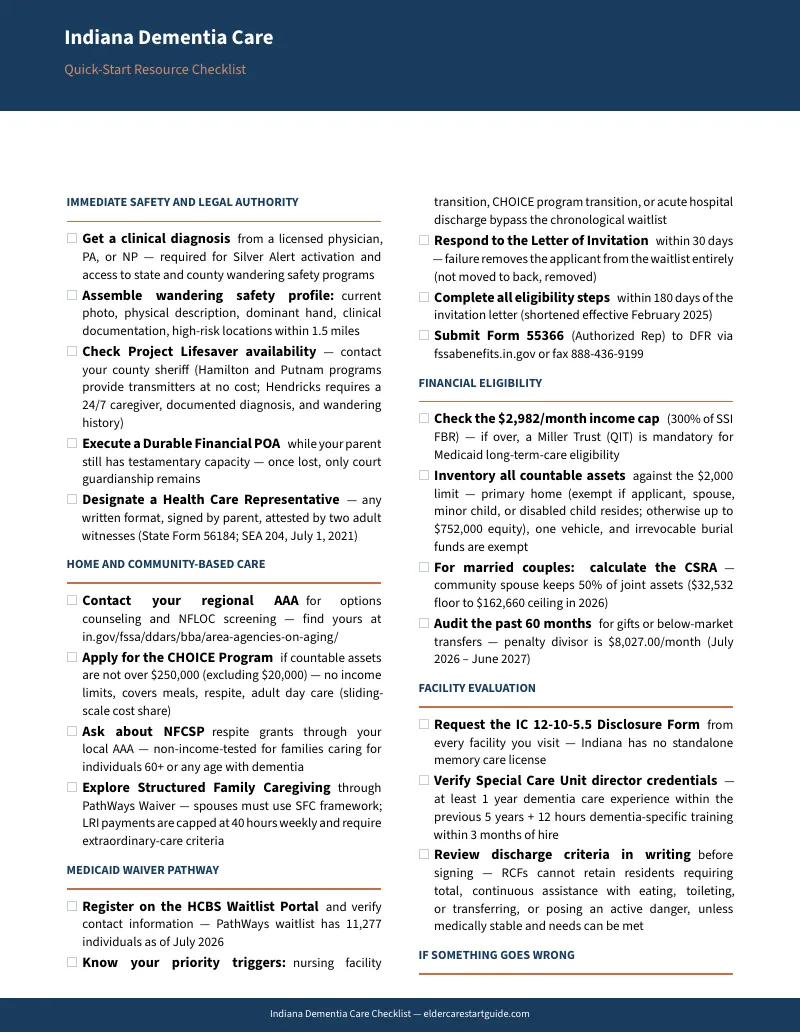
The complete guide (48 pages), a 24-item dementia care resource checklist, and 7 standalone printable tools — an emergency dispatch script for reporting a Missing Endangered Adult, a Medicaid financial inventory worksheet, a spousal income protection calculator, a memory care facility audit checklist, a QIT monthly ledger, a five-year look-back audit sheet, and an agency communication log. Nine PDFs total, each designed to be printed and used at the kitchen table, on a facility tour, or in an elder law attorney's office.
Your purchase includes every future update at no additional cost. When Indiana's standalone assisted living waiver launches, when PathWays waitlist rules change, when Medicaid thresholds adjust — the guide is updated and you get the new version automatically.
30-day satisfaction guarantee. If the guide doesn't help you navigate Indiana's dementia care system more clearly than what you've been piecing together from Google, email us for a full refund. No questions, no hoops.
The free checklist is available below — download it, use it tonight, and see how the full guide builds on it. When you're ready for the complete system, the guide is here.
For , you get the same strategic framework that Medicaid planners charge thousands to walk you through — adapted for Indiana's 2026 rules and designed for families doing this themselves.