Your Parent Needs More Care Than You Can Provide — And Indiana's System Has No Single Map
The signs have been building: missed medications, a fall that went unnoticed for hours, a refrigerator full of expired food, conversations that loop in circles. You know something has to change. But when you start researching Indiana's elder care system, you find dozens of disconnected state websites, dense administrative code, and "free" referral services that steer families toward facilities paying them $3,000–$6,000 in placement commissions.
Meanwhile, the clock is ticking. A hospital discharge planner may be pressuring you to place your parent within 48 hours. Or you have been managing everything alone for months and you are running out of capacity. Either way, the questions are the same: Does my parent qualify for PathWays for Aging? What does assisted living actually cost in Indiana versus home care? How do I check a facility's real inspection history — not their marketing brochure? And what happens to my parent's assets if they need Medicaid?
The Indiana Care Navigator: Every Program, Threshold, and Decision Point in One Sequence
The Choosing Care in Indiana Guide translates Indiana's elder care system — PathWays for Aging, the Aged & Disabled Waiver, the 16 Area Agencies on Aging, the Division of Family Resources, Maximus assessments, IDOH facility licensing — into a single step-by-step plan. It starts with assessing your parent's actual needs, walks you through every care setting with Indiana-specific cost data, and ends with the exact application sequence for Medicaid long-term care benefits.
This is not a generic national overview. Every threshold, contact number, cost figure, and regulatory reference is specific to Indiana's 2026 programs.
What's Inside
A Clinical Warning-Signs Framework — an objective checklist for evaluating whether your parent can remain safely in their current living situation. Covers medication management, wandering, falls, nutritional decline, and ADL limitations — so you can assess the situation with data rather than guilt.
Indiana Care Setting Comparison with Real Costs — home health aides average $30–$32/hour in Indiana. Assisted living averages $4,849/month. Semi-private nursing home rooms average $7,800/month. The guide runs side-by-side scenarios showing exactly when home care becomes more expensive than facility care, and explains which services each setting can legally provide under Indiana licensing rules.
PathWays for Aging — The Full Enrollment Map — Indiana transitioned many aged and disabled Medicaid members into PathWays for Aging in 2024. The guide explains what this managed care program covers (personal care, home modifications, adult day care, respite), the enrollment process through managed care entities, and how it differs from the traditional Aged & Disabled Waiver.
2026 Medicaid Eligibility Thresholds + Application Sequence — $2,000 individual asset limit. $2,982 monthly income cap for waiver services. Spousal impoverishment protections allowing the community spouse to retain up to $162,660 in assets. The guide walks through the complete application: Maximus Level of Care assessment → Division of Family Resources financial determination → enrollment broker selection. It covers spend-down strategies and Miller Trusts for applicants whose income exceeds the cap.
Facility Vetting with State Inspection Data — step-by-step instructions for accessing the Indiana Department of Health Survey Report System, reading facility inspection histories, interpreting the Scope and Severity Matrix, and identifying "Immediate Jeopardy" citations — before you schedule a single tour.
The Long-Term Care Ombudsman and Complaint System — how to access free, confidential advocacy for residents of nursing homes and assisted living facilities, when to use the Ombudsman versus the IDOH complaint process, and the exact contact channels for reporting safety concerns.
Area Agency on Aging Navigation — Indiana's 16 AAAs mapped by region, with direct contact information, the services they administer (options counseling, the CHOICE program, pre-screening), and how to use the INconnect Alliance network to access the right resources without weeks of wait.
Legal Authority Foundations — what happens when your parent loses cognitive capacity without a Financial Power of Attorney or Designated Healthcare Representative in place, how to act before a guardianship proceeding becomes necessary, and the documents you need organized before engaging the state system.
8 Standalone Printable Worksheets — pull out the sections you need and bring them with you. Included: Warning Signs Assessment (document observations before involving agencies), Care Setting Comparison (costs and decision checklist on one page), Legal Authority Checklist (every document to execute and where to file it), PathWays for Aging Enrollment Map (step-by-step from assessment to enrolled), Medicaid Financial Worksheet (2026 thresholds, asset inventory, budget calculator), Facility Tour Checklist (print and bring on every visit), Area Agency on Aging Directory (regional contacts and services), and Key Contacts and Resources (every phone number and form reference on one page).
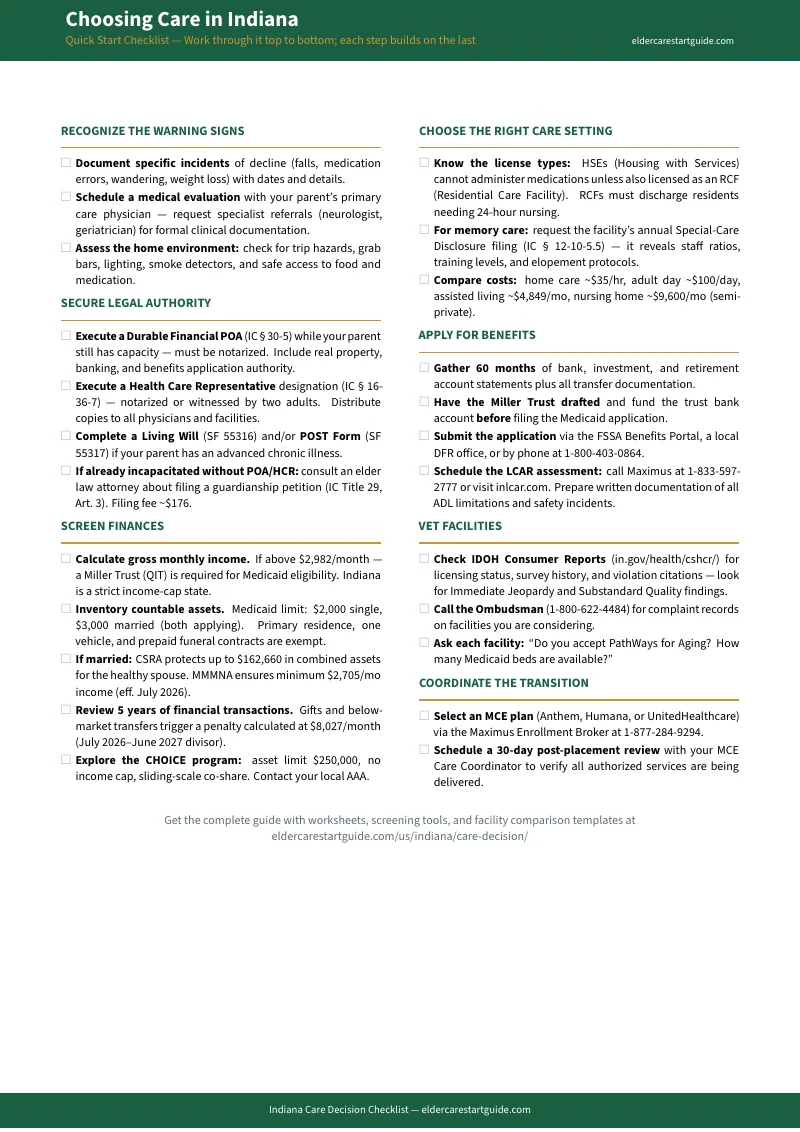
Plus: The Indiana Care Decision Checklist — a one-page printable reference with every critical action item, key contact, regulation reference, and deadline in priority order.
Who This Is For
- The adult child facing a hospital discharge deadline — your parent cannot go home safely and you have days, not weeks, to understand your options and make a placement decision
- The family caregiver approaching burnout — you have been managing everything and it is no longer sustainable, but you do not know how to transition to professional care or what Indiana programs can help
- The family navigating Medicaid for the first time — your parent's savings are running out and you need to understand eligibility rules, spend-down strategies, and the application process before assets are depleted
- The sibling group that cannot agree — you need an objective cost-comparison framework and structured decision process to move the family from opinions to data
- The long-distance coordinator — your parent lives in Indiana and you are managing their care from another state, needing the state agencies, regional contacts, and application steps mapped in one place
Why Not Use Free Resources?
Indiana publishes thousands of pages of administrative code, regulatory guidance, and program descriptions across FSSA, IDOH, and 16 regional AAA websites. The information exists — but it is written in dense bureaucratic language, spread across dozens of disconnected portals, and frequently outdated.
Regional AAA offices are understaffed. Securing an appointment for options counseling can take weeks — time that a family dealing with a hospital discharge or escalating safety concerns does not have. And the state does not provide a proactive, strategic sequence of actions. They process applications. They do not tell you what to do first, what to prepare, or how to avoid the errors that lead to 90-day denials.
"Free" national referral services like A Place for Mom operate on placement commissions — they receive 50–100% of the first month's rent when your parent signs a lease at a partnered facility. They will not recommend lower-cost community options, facilities that accept Medicaid waivers, or any provider outside their paying network.
An elder law attorney charges $300–$500 per hour, with Medicaid planning packages running $3,000–$15,000. For families with straightforward estates, the guide demonstrates which steps you can handle yourself — and for those who do need legal counsel, it ensures you arrive at that first meeting with organized documentation rather than paying $400 an hour for basic data collection.
The Choosing Care in Indiana Guide is 100% independent — no placement commissions, no facility partnerships, no sponsored recommendations. It organizes Indiana's public system into one clear action plan for .
100% Satisfaction Guarantee
If the guide does not help you navigate Indiana's elder care system more confidently, email us for a full refund. No conditions, no time limit.
Start with the free checklist or get the complete guide
Download the Indiana Care Decision Checklist at no cost — a one-page reference with the most critical action items in priority order. If you need the full system mapped out, the complete guide covers every program, threshold, and decision point for .