
The Hospital Called. Medicare Is Running Out. Nobody Is Telling You How Illinois Medicaid Actually Works.
Your parent's Medicare skilled nursing benefit ends after 100 days. After that, the nursing home bills $8,500 to $10,000 a month — and your parent's savings are on the clock. You know Medicaid is supposed to cover long-term care. What nobody told you is that Illinois splits the rules across three state agencies, uses a system that's different from almost every other state, and buries the answers you need in regulatory language that reads like it was written to discourage applications.
You've spent hours on state websites and come away with more confusion than answers. Is the asset limit $2,000 or $17,500? Do you need a Miller Trust? What's a spend-down? Can the state really take the house? You typed these questions into Google and got a different answer from every source — because most Medicaid guides are written nationally, and Illinois breaks the mold on almost every rule that matters.
An elder law attorney charges $300 to $500 an hour to explain this. A Medicaid planning firm charges $5,000 to $10,000 for the full process. Most of that cost is spent on basic information-gathering — organizing your parent's financial records, understanding the state's rules, and preparing the application. That's the work this guide was built to do.
— The Illinois Medicaid Navigation System
The Illinois Medicaid Navigation System is a step-by-step guide that walks you through every stage of securing Medicaid-funded long-term care in Illinois — from the first financial inventory through application, clinical assessment, spousal protections, and estate recovery planning. It's the process an elder law attorney follows, translated into plain English with worksheets you fill in yourself.
This isn't a generic "50-state Medicaid overview" with a paragraph about Illinois. It's built entirely around Illinois-specific rules, thresholds, forms, and agencies — including the mechanics that make Illinois different from almost every other state.
What's Inside
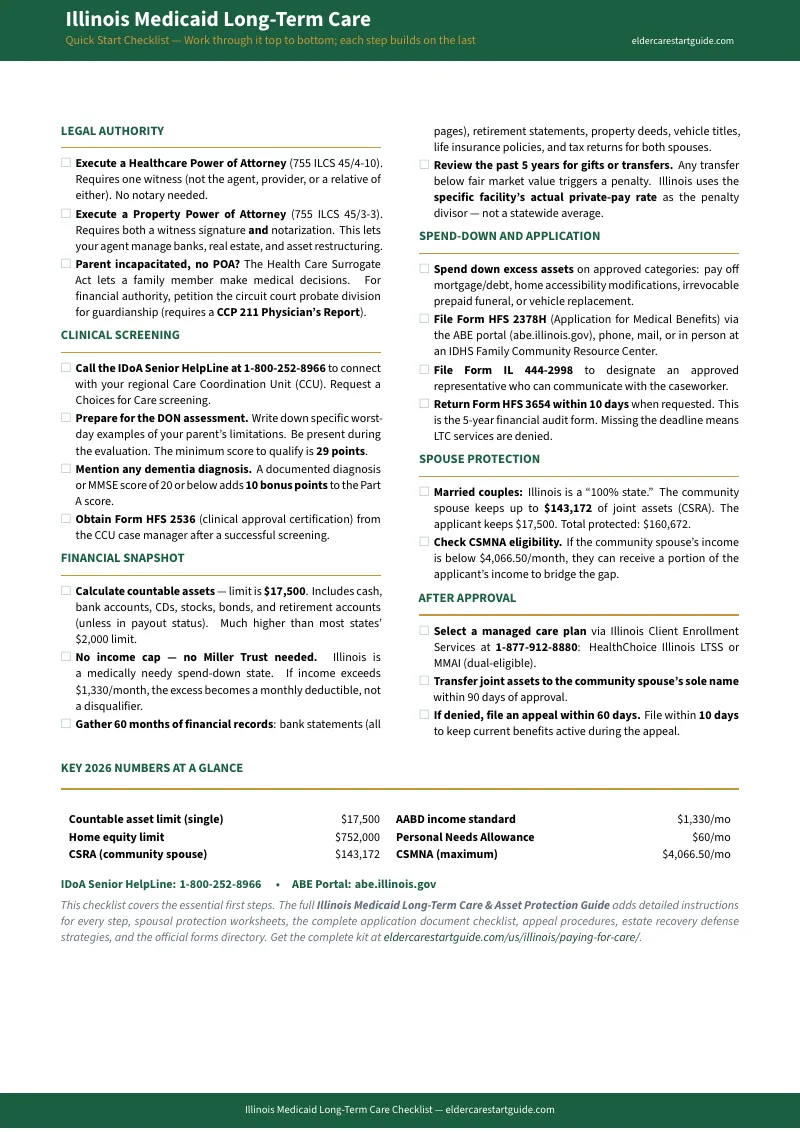
- Illinois Financial Eligibility Workbook — a line-by-line worksheet that separates countable from exempt assets using Illinois's $17,500 limit (not the $2,000 limit you'll see in national guides). Covers the primary home exemption ($752,000 equity threshold), vehicle exemption, irrevocable prepaid funeral plans, and every other asset category Illinois treats differently.
- Medically Needy Spend-Down Calculator — Illinois doesn't use Miller Trusts. If your parent's income exceeds the $1,330 monthly standard, the excess becomes a monthly deductible. This calculator walks you through both pathways: submitting medical receipts to your local FCRC, or enrolling in the Pay-In Spend-Down Program using form HFS 458SP-4. It shows you exactly how much your parent pays each month and what's left for the facility.
- Spousal Protection Planner — Illinois allows the community spouse to keep up to $143,172 in assets (the CSRA) and receive a monthly income diversion of up to $4,066.50 from the institutionalized spouse. This planner walks you through the IM-73 Resource Assessment, the "snapshot date" calculation, and the strategies that maximize what the healthy spouse retains.
- DON Assessment Preparation Guide — the Determination of Need assessment administered by your regional Care Coordination Unit (CCU) is the clinical gateway to all Medicaid-funded home care and the Community Care Program. Your parent must score at least 29 points. Seniors frequently mask their limitations during a brief interview, resulting in a denial. This guide explains what the CCU evaluates, how to document your parent's actual daily functioning, and what to do if the initial score falls short.
- Five-Year Lookback Audit Worksheet — Illinois reviews 60 months of asset transfers before the application date. Unlike most states, Illinois calculates penalty periods using your parent's specific facility's private-pay rate — not a statewide average. This worksheet helps you identify and document every transfer that could trigger a penalty, and shows you the math the caseworker will run.
- Estate Recovery Defense Checklist — Illinois is a probate-only recovery state, and the $25,000 safe harbor (Public Act 102-1037) permanently waives claims against estates below that threshold. This checklist walks you through Transfer on Death Instruments, joint tenancy structures, and trust strategies that keep assets out of probate entirely. It also covers the mandatory exemptions — surviving spouse, children under 21, and blind or disabled dependents — that block recovery regardless of estate size.
- Community Care Program & Paid-Caregiver Guide — as of April 2026, Illinois allows spouses to be hired as paid caregivers under the CCP, earning $20–$21 per hour. This section covers eligibility, the 24-hour training requirement, background check process, and how to connect with a state-contracted provider agency.
- Application Process Roadmap — a sequential walkthrough from initial financial document gathering through FCRC application submission, caseworker interview, DON assessment scheduling, and eligibility determination. Includes key forms, timelines, and the specific offices to contact at each step.
- Appeals Guide & Template Letters — if your parent's application is denied or the DON score seems wrong, this section covers the formal hearing request process, preparation strategies, and template letters for communicating with HFS and DHS caseworkers.
Who This Is For
- Adult children in Illinois facing a parent's transition from hospital or home to nursing facility, assisted living, or Medicaid-funded home care
- Families approaching the Medicare Day-100 cliff who need to secure Medicaid coverage before private-pay costs drain their parent's savings
- Spouses trying to protect household assets when one partner enters long-term care — and not sure what they're entitled to keep
- Caregivers exploring whether they can get paid through the Community Care Program while keeping their parent at home
- Families with a parent who transferred assets in the past five years and needs to understand the lookback consequences before applying
Why Not Just Use Free Resources?
Illinois publishes its Medicaid rules across three departments: HFS handles eligibility and estate recovery, DHS runs the local FCRC offices where you apply, and the Department on Aging coordinates the Care Coordination Units that administer the DON assessment. Each agency publishes its own rules in its own regulatory language, in its own corner of the internet, organized by bureaucratic function — not by what you need to do next.
National portals like Medicaid Planning Assistance give you a solid overview of Illinois's limits, but they don't cover the specific forms, the regional CCU contacts, or the step-by-step spend-down enrollment process. Elder care referral services like A Place for Mom or Caring.com will match you with facilities — because they earn commissions from the ones they recommend. They don't cover Medicaid waivers, in-home care programs, or asset protection strategies, because there's no referral fee in those.
Illinois Legal Aid Online is genuinely excellent — but it's designed as a legal education resource, not a planning workbook. It explains the rules clearly but doesn't give you worksheets to calculate your specific spend-down, document your own five-year transfer history, or prepare your parent for the DON assessment.
This guide connects all three agencies' rules into one sequential process, with worksheets at every decision point. It's the difference between reading about the rules and actually working through them with your parent's numbers in front of you.
Satisfaction Guarantee
If this guide doesn't help you navigate Illinois Medicaid long-term care more confidently, email us within 30 days for a full refund. No forms, no questions.
Get Started Now
Download the free Illinois Medicaid Eligibility Checklist to see the key thresholds and steps at a glance. When you're ready for the complete process — the spend-down calculator, spousal protection planner, lookback audit worksheet, DON assessment prep, and estate recovery defense — get the full Illinois Medicaid Long-Term Care & Asset Protection Guide.