Your Parent Needs Help. Illinois Won't Let You Give It — Until You Have the Right Paperwork.
Your parent fell. Or a hospital discharge planner just told you they can't go home alone. Or you walked into the bank to pay their mortgage and the teller said, "We can't discuss this account with you."
You're doing everything — driving to appointments, managing medications, fielding calls from siblings — but you have zero legal authority to sign a single document on your parent's behalf. Illinois law doesn't care that you're the one showing up every day. Without the right legal instruments in place, banks will lock you out, hospitals won't share test results, and the Care Coordination Unit that controls access to state-funded home care won't process your parent's application.
The Illinois Legal Authority Roadmap
This kit is not a stack of blank forms. It's the process around the forms — the part that $300–$500/hour elder law attorneys explain in a consultation and that free government websites scatter across a dozen PDFs and agency portals.
It covers two paths: proactive planning (when your parent can still sign) and court-supervised guardianship (when capacity is already gone). And it connects both paths to the state benefit system you will almost certainly need to navigate — the Community Care Program for home care, Illinois Medicaid's medically needy spend-down, and the asset limits that operate under the state's 209(b) rules rather than the standard federal thresholds.
What's Inside
The kit includes a 13-chapter guide, a printable quick-start checklist, and 7 standalone planning worksheets — 9 PDFs total:
- Capacity Assessment Framework — A plain-language protocol for determining whether your parent can still legally sign a power of attorney under Illinois law, with documentation steps that protect against future challenges from siblings or institutions.
- Statutory Durable POA for Property Walkthrough — Not just the form. Which power categories to initial (and why skipping "estate, trust, and beneficiary transactions" can block you from Medicaid spend-down planning six months later). How immediate vs. springing authority works in practice. The 14-point type coversheet requirement that trips up most families.
- Health Care POA + HIPAA Authorization Package — 755 ILCS 45/Art. IV compliance. Witness disqualification rules (who can't sign). Why notarization isn't technically required but prevents delays with hospital legal departments. How the Health Care Surrogate Act (755 ILCS 40/) operates as a fallback — and its limits.
- Guardianship Process Guide — When and how to file in Illinois probate court. The Physician's Report (Cook County Form CCP 0211). Guardian ad Litem appointment. The mandatory inquiry into whether a Supported Decision-Making Agreement is a viable alternative. County-specific filing fees with worked examples for Cook, DuPage, Lake, and Will counties.
- Emergency Guardianship — The 60-day temporary guardianship process for crisis situations. How to coordinate with hospital discharge planners when the clock is running and you have no legal authority to sign admission papers.
- Alternatives to Full Guardianship — Supported Decision-Making Agreements under 755 ILCS 46. Limited guardianship. Representative payee status. When each alternative works and when plenary guardianship is unavoidable.
- Community Care Program & Medicaid Roadmap — The Determination of Need assessment (29-point threshold), Illinois' $17,500 asset limit under 209(b) rules, the medically needy spend-down pathway, spousal protections (CSRA up to $143,172), and managed care enrollment through HealthChoice Illinois.
- Medicaid Financial Planning — The 60-month look-back period, gifting penalty calculations with a worked dollar example, the $4,000-to-$17,500 "exempt range" that delays mandatory Medicaid application, and home equity exemption rules.
- Fiduciary Compliance — Five mistakes that cost families thousands: the "responsible party" trap, co-mingling funds, the bond calculation surprise, self-dealing risk, and annual reporting failures. A transaction documentation protocol that satisfies court requirements and prevents sibling disputes.
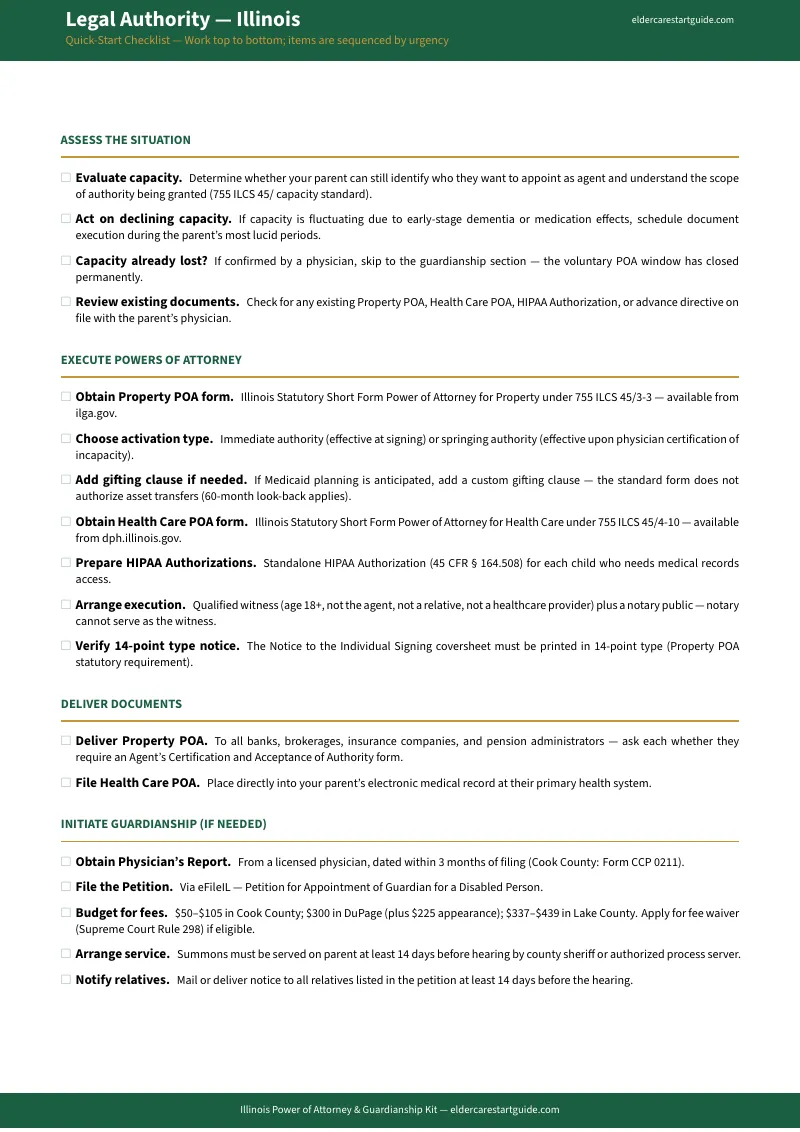
- Quick-Start Checklist — A printable action list that extracts the most time-sensitive items from the full guide. Start here when you're in crisis mode and need to know what to do today, this week, and this month.
Who This Kit Is For
- Adult children who just learned they need "power of attorney" and don't know where to start
- Families facing a hospital discharge where the parent can't go home alone and nobody has legal authority to sign admission papers
- Caregivers whose parent has early-stage dementia and can still sign — but the window is closing
- Siblings who need a clear, documented process to avoid disputes about who controls what
- Families dealing with a bank that won't honor their existing power of attorney
- Anyone trying to navigate the Community Care Program or Medicaid spend-down without paying thousands in attorney fees
Why Not Just Use Free Forms?
Illinois provides free statutory power of attorney forms. Illinois Legal Aid Online has them. The Department of Public Health publishes the Health Care POA. You can download them right now.
Here's what those forms don't tell you:
- Which of the power categories to initial — and how skipping "estate, trust, and beneficiary transactions" will prevent you from restructuring assets for Medicaid eligibility six months from now
- What to do when your parent's bank refuses to honor the form you just had notarized — and how 755 ILCS 45/3-4.5 forces them to accept a properly executed statutory POA or face liability
- How to determine whether your parent can still legally sign, or whether you've already crossed the threshold into guardianship territory
- The exact sequence of steps for the Community Care Program application, the Determination of Need assessment, and the Medicaid spend-down calculation that keeps your parent qualified for home services
The forms are step one of a twenty-step process. This kit covers all twenty.
Satisfaction Guarantee
If the kit doesn't give you a clearer path forward, email [email protected] for a full refund — no time limit.
— Less Than One Hour of an Elder Law Attorney's Time
The average initial consultation with an Illinois elder law attorney runs $300 to $500. A full guardianship proceeding can cost $4,500 or more in court fees and legal representation.
This kit won't replace an attorney for complex litigation or multi-million dollar trust planning. But for the standard power of attorney execution, institutional acceptance, and Medicaid navigation that most Illinois families need, it covers the process at a fraction of the cost.
Start with the free checklist to see if the approach fits your situation. The full kit goes deeper with the complete 13-chapter guide, worked examples, and 7 printable planning worksheets — including a capacity assessment discussion guide, POA execution checklist, document delivery tracker, guardianship filing checklist, Medicaid asset inventory, a care coordination contact log, and an annual reporting calendar for court-appointed guardians.