
Your Parent's Nursing Home Costs $10,494 a Month. The Asset Limit Is $2,000. Nobody Mentioned the Miller Trust That Bypasses the Income Cap Entirely.
The rehab facility just told you Medicare's 100-day skilled nursing window is closing. Your parent can't go home safely. The nursing home wants $10,494 per month — semi-private — and a private room pushes past $12,167. The social worker mentioned "spending down" to qualify for Idaho Medicaid, and you started searching online.
You found the number: $2,000. That's Idaho's countable asset limit for a single nursing home Medicaid applicant. Your parent has a house, a savings account, and a lifetime of careful planning. At $2,000, almost everything has to go. And Idaho is a strict income-cap state — if your parent's gross monthly income exceeds $3,002 by even one dollar, they're automatically disqualified. No medically needy spend-down pathway exists.
What nobody told you during the discharge scramble: Idaho law allows a Qualified Income Trust — a Miller Trust — that routes excess income through a dedicated bank account, naming the State of Idaho as remainder beneficiary. Set it up before the first day of the benefit month, and that income cap disappears. But file the Medicaid application without the trust in place, and you get an automatic denial. Timing is the single most consequential decision in the entire process.
The Idaho Medicaid Asset Protection Navigation System
This isn't a summary of Medicaid rules you could piece together from idalink.idaho.gov, the Idaho Commission on Aging, and a dozen law firm blogs. The Idaho Medicaid Asset Protection Navigation System maps the exact sequence of decisions, screenings, filings, and deadlines your family needs — starting from wherever you are right now — so you don't burn through savings because you did things in the wrong order.
The critical mistake most families make: they start the nursing home spend-down before understanding the Miller Trust timeline. They drain accounts to $2,000 without realizing the trust must be established and funded before the first day of the month they want benefits. They give money to family members without understanding that Idaho's 60-month lookback catches those transfers and the IRS gift-tax exclusion has zero bearing on Medicaid eligibility. They assume Area Agencies on Aging caseworkers will help them protect assets — but caseworkers are evaluators, not advocates, and they are forbidden from offering planning advice.
The guide puts you in the right order: evaluate the Aged & Disabled Waiver for home-based care first, understand the income cap and Miller Trust requirements, map what's countable and what's exempt, calculate spousal protections, execute the spend-down with approved methods, then file with the Idaho Department of Health and Welfare with everything organized.
What You Get — 10 PDFs
- 16-Chapter Guide — The complete Idaho Medicaid Asset Protection Navigation System: the functional assessment and Uniform Assessment Instrument, Idaho's $3,002 income cap and Miller Trust setup, the $2,000 asset limit and exempt resources, spousal protections (CSRA and MMMNA), the 60-month lookback and transfer penalties, step-by-step DHW application process, patient liability calculation, Aged & Disabled Waiver for home and assisted living care, Idaho's managed care transition, estate recovery defense (including the 90-day Undue Hardship Waiver window), Powers of Attorney and guardianship, advanced planning strategies, facility selection, and fair hearing appeals. Every dollar figure reflects 2026 Idaho regulations.
- Care Program Comparison (printable standalone) — Side-by-side comparison of Institutional Medicaid, the Aged & Disabled Waiver, and Idaho's managed care plans. The decision most families skip: the A&D Waiver lets your parent stay home with paid attendant care while the nursing home pathway forces a facility placement. Print it and bring it to your Area Agency on Aging screening.
- Eligibility Calculator (printable standalone) — Idaho's three-part eligibility test broken into fillable worksheets: the $2,000 countable asset limit, the $3,002 income cap with Miller Trust threshold calculation, and the nursing facility level of care (NFLOC) criteria from the Uniform Assessment Instrument.
- Asset Inventory Worksheet (printable standalone) — Map every liquid account, retirement account, real property, vehicle, and insurance policy as countable or exempt. Includes a running total against the $2,000 limit and flags for community property rules under Idaho's marital property framework.
- Spousal Protection Calculator (printable standalone) — When one spouse enters a facility and the other stays home: worksheets for the Community Spouse Resource Allowance (floor $32,532 to ceiling $162,660), the Monthly Maintenance Needs Allowance, and income transfer calculations to prevent spousal impoverishment.
- Spend-Down Planner (printable standalone) — Track every Idaho-approved method to reduce countable assets: irrevocable pre-paid funeral contracts, home repairs, debt payoffs, vehicle purchases for a community spouse, and burial savings. Each row includes receipt tracking so DHW caseworkers cannot challenge your expenditures.
- 60-Month Lookback Audit (printable standalone) — Log every transfer in the lookback window, flag exempt transfers, and calculate potential penalty periods. Includes the IRS gift-tax exclusion trap, joint account presumption, Caretaker Child exemption criteria, and cure strategies for transfers already made.
- Application Document Checklist (printable standalone) — Every document the Idaho DHW requires: identity verification, legal authority, 60 months of financial records, income documentation, medical records, and spousal protection documents. Includes an idalink portal filing guide and application tracking sheet.
- Estate Recovery Worksheet (printable standalone) — Assess your estate's exposure to Idaho's expanded recovery program, track the 90-day Undue Hardship Waiver deadline, and evaluate exemptions for surviving spouses, disabled children, and hardship claims. Includes the Financial Recovery Section contact information and hearing request procedures.
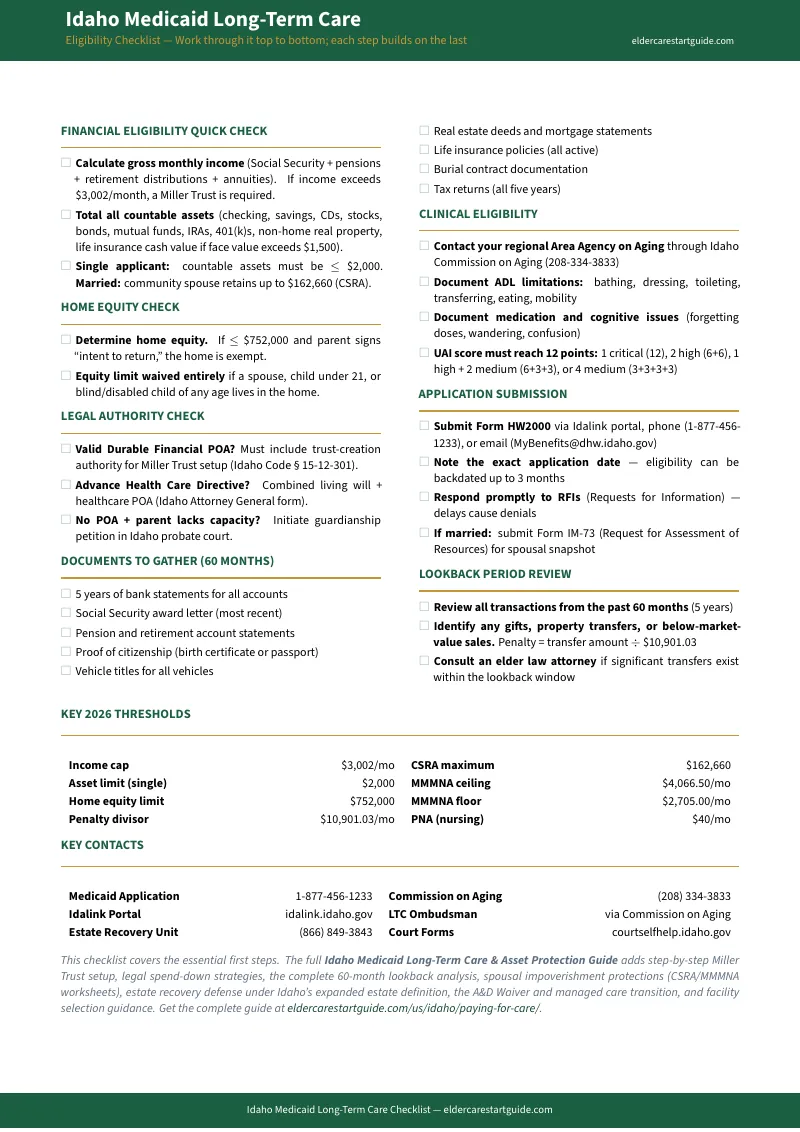
- Quick-Start Checklist (Free Download) — 20 actionable items organized by priority: A&D Waiver screening, Miller Trust setup timeline, financial document gathering, legal authority assessment, spend-down planning, and application filing. Know exactly what to do tonight, this week, and this month.
Who This Guide Is For
- Adult children in Idaho who need to figure out how to pay for a parent's long-term care — nursing home, assisted living, or home care — without losing everything
- Families facing a hospital discharge with no Medicaid application started and a facility demanding private-pay rates of $10,494 or more per month
- Caregivers who want to keep a parent at home through the Aged & Disabled Waiver but don't understand the Uniform Assessment Instrument, the income cap, or the participant-directed option
- Married couples where one spouse needs nursing home care and the other needs to understand exactly how much of their joint savings Idaho law protects
- Families who made financial transfers in the last five years and need to understand whether those gifts will trigger a Medicaid penalty — and how to document exceptions
- Out-of-state siblings coordinating an Idaho parent's care remotely and needing every DHW contact, Area Agency on Aging referral number, and filing deadline in one place
Why Free Information Isn't Getting You Anywhere
The Idaho Department of Health and Welfare publishes the official Medicaid financial guidelines on idalink.idaho.gov. The numbers are accurate. But they don't tell you the order. They don't explain that establishing a Miller Trust before the first day of the benefit month is mandatory for over-income applicants, or that the A&D Waiver's participant-directed option lets you hire your own adult child as a paid caregiver. Caseworkers evaluate eligibility — they cannot tell you how to qualify.
The elder law firms in Boise, Pocatello, and Idaho Falls publish helpful blog posts about Medicaid planning. Every one ends with a call to schedule a $300-$500/hour consultation. Their content is designed to sell legal services, not to give you a complete, executable sequence of steps.
Paying for Senior Care, A Place for Mom, and Caring.com rank well on Google, but their business model is referral fees from assisted living facilities. They are structurally incentivized to move your parent into a facility, not to help you qualify for state-funded home care that has no referral fee attached.
This guide fills the gap between the government portal that gives you facts without sequence, the law firm that gives you sequence but only through a $3,000-$10,000 planning retainer, and the referral site that steers you toward placements you may not need.
Satisfaction Guarantee
If this guide doesn't give you a clear, actionable path to paying for your parent's long-term care in Idaho, email [email protected]. We read every message.
— Less Than One Hour of an Elder Law Attorney's Time
Idaho elder law attorneys charge $300 to $500 per hour. A comprehensive Medicaid planning package runs $3,000 to $10,000. A single procedural mistake — a lookback penalty triggered by a gift to a grandchild, a Miller Trust not established before the benefit month, a missed 90-day Undue Hardship Waiver window — can cost your family months of unnecessary private-pay bills at $10,494 per month.
This guide won't replace an attorney when you need one (and it tells you exactly when that is). But it will save you hours of research, prevent the most expensive mistakes, and ensure you walk into any conversation — with the DHW, the nursing facility, your local Area Agency on Aging, or an elder law firm — knowing exactly what Idaho law requires.
Download the free Quick-Start Checklist to see the 20 most urgent action items. When you're ready for the complete system, the full guide is waiting.