
Memory Care in Idaho Costs $5,951 a Month. The Asset Limit Is $2,000. And Idaho Doesn't Even Issue a Standalone Memory Care License.
Your parent wandered out the front door at 2 AM and the sheriff brought them home. Or the discharge planner at St. Luke's said they can't go home without round-the-clock supervision. You searched "memory care Idaho" and found A Place for Mom, a few facility directories, and the Idaho Department of Health and Welfare website — none of which explain that Idaho regulates memory care under its general Residential Assisted Living Facility (RALF) rules, what the FLARES inspection database actually reveals about a facility's compliance history, or whether the Aged and Disabled Waiver covers your parent's care.
Then you hit the financial wall: $2,000 in countable assets for a single applicant. A $3,002 monthly income cap that Idaho enforces with no medically needy spend-down pathway. If your parent's Social Security and pension exceed that cap by even one dollar, you need a Qualified Income Trust — a Miller Trust — with the state of Idaho named as the irrevocable remainder beneficiary. And if your parent is married, the Community Spouse Resource Allowance is capped at $162,660, with the Monthly Maintenance Needs Allowance calculated using a formula that most families have never seen.
What nobody explained at the hospital: the state determines whether your parent qualifies for waiver-funded care through a Uniform Assessment Instrument (UAI) that measures Nursing Facility Level of Care (NFLOC). A dementia diagnosis alone isn't enough. The assessor needs documented deficits in activities of daily living — bathing, dressing, transferring, toileting — described in clinical language your parent's doctor may not have used. Families who don't prepare for this assessment fail it, wait months to reapply, and burn through savings at private-pay rates the entire time.
The Idaho Dementia Care Navigation System
This isn't a summary of IDAPA rules you could piece together from aging.idaho.gov, elder law blog posts, and referral site listings. The Idaho Dementia Care Navigation System maps the exact sequence of legal decisions, clinical assessments, financial maneuvers, and facility evaluations your family needs — starting from wherever you are right now — so you don't trigger a Medicaid penalty, lose the family home to estate recovery, or sign a guardianship petition when a Power of Attorney would have worked.
The critical mistake Idaho families make: they place a parent in a memory care facility before establishing legal authority. A Durable Power of Attorney only works if your parent has the cognitive capacity to sign it. Once that window closes — and dementia closes it permanently — your only option is a guardianship proceeding under Idaho Code Title 15, Chapter 5, which requires a county district court petition, a mandatory Court Visitor to interview your parent, a Guardian Ad Litem attorney to represent their interests, a $25 online training course for the petitioner, and filing fees that add up fast. Contested guardianships routinely exceed $10,000 in legal costs. The guide puts you in the right order: legal authority first, then safety planning, then clinical assessment, then financial planning, then placement.
What You Get
- 16-Chapter Guide — The complete Idaho Dementia Care Navigation System: diagnosis response and legal capacity windows, Durable POA execution requirements vs. court-supervised guardianship (Court Visitor, GAL appointment, $25 mandatory training, annual reporting), home safety modifications and wandering prevention, Idaho's Endangered Missing Person Alert system under Idaho Code § 67-2922, RALF licensing under IDAPA 16.03.22 (staffing ratios, 16-hour orientation, dementia-specific training within 30 days), UAI assessment and NFLOC criteria, Aged and Disabled Waiver enrollment, Medicaid financial eligibility (income cap, asset limit, Miller Trust setup, spousal protections, estate recovery exemptions), FLARES inspection database walkthrough, and the crisis action timeline. Every dollar figure reflects 2026 Idaho regulations.
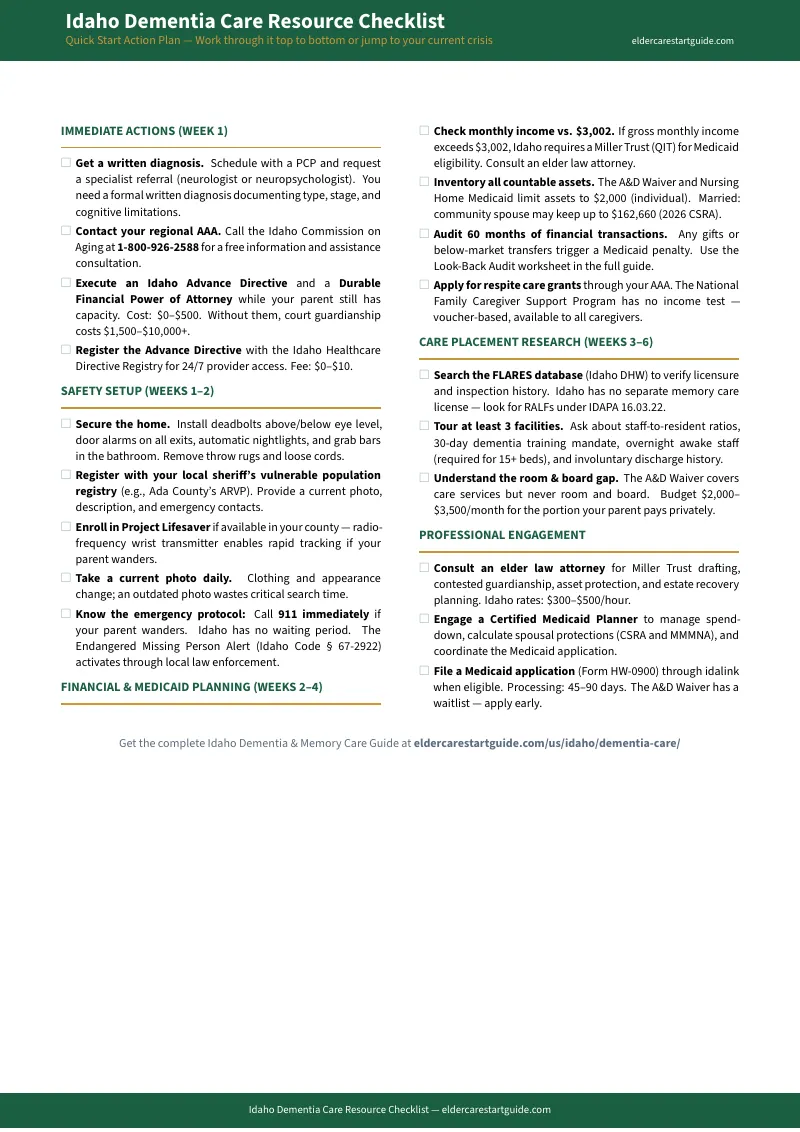
- Quick-Start Checklist (Free Download) — 19 actionable items organized across key categories: immediate safety measures, legal authority assessment, financial snapshot, Medicaid eligibility check, facility evaluation prep, and professional consultation triggers. Know exactly what to do tonight, this week, and this month.
- 7 Standalone Printable Worksheets — Ready to print and bring to facility tours, attorney meetings, and waiver intake calls:
- Medicaid Asset & Income Worksheet — Audit countable vs. exempt assets, calculate Miller Trust requirements, track monthly trust disbursements, and complete the 60-month look-back audit
- Spousal Resource Calculator — Community Spouse Resource Allowance and Monthly Maintenance Needs Allowance calculations to prevent spousal impoverishment
- Facility Comparison Worksheet — Side-by-side evaluation for touring memory care RALFs, built around IDAPA 16.03.22 requirements and FLARES inspection results
- Care Budget Planner — Map every income source against care expenses to calculate how long savings will last at current burn rate
- Home Safety Assessment — Room-by-room checklist for dementia-proofing a home, including A&D Waiver-funded modification options
- Legal Authority Decision Tree — Determine whether POA is still viable or guardianship is required, with Idaho-specific capacity standards and court process steps
- Crisis Contacts & Resource Directory — Every Idaho phone number you need at 2 AM: all six Area Agency on Aging offices by county, Idaho Commission on Aging, FLARES search link, Long-Term Care Ombudsman, law enforcement for Endangered Missing Person Alerts
Who This Guide Is For
- Adult children in Idaho coordinating memory care for a parent with dementia — whether you're managing a hospital discharge crisis today or planning ahead after an early-stage diagnosis
- Families trying to understand whether the Aged and Disabled Waiver covers memory care costs, how the UAI assessment works, and what the waiver never pays for (room and board)
- Caregivers whose parent can no longer sign a Power of Attorney and who need to navigate Idaho's guardianship process under Title 15, Chapter 5 without an attorney on retainer
- Families facing the $2,000 asset limit, the $3,002 income cap, or the 60-month lookback period who need a clear spend-down sequence and Miller Trust setup before filing
- Anyone touring memory care facilities in Idaho who wants to use FLARES inspection data and IDAPA staffing requirements to evaluate communities beyond the marketing brochure
- Out-of-state siblings coordinating an Idaho parent's care remotely — needing every AAA contact, court form, FLARES link, and Endangered Missing Person Alert procedure in one document
Why Free Information Isn't Getting You Anywhere
The Idaho Department of Health and Welfare publishes program eligibility pages. aging.idaho.gov has caregiver resources. The Idaho Commission on Aging links to the six regional Area Agencies on Aging. All of this is public, all of it is free, and none of it tells you what to do first.
A Place for Mom and Caring.com rank well on Google, but their business model is referral fees from private-pay facilities — often a full month's rent. They are structurally incentivized to steer your parent toward an expensive placement, not to help you qualify for the A&D Waiver or set up a Miller Trust. They won't walk you through the UAI assessment process because Medicaid-funded placements don't pay them commissions.
The elder law firms in Boise, Coeur d'Alene, and Idaho Falls publish helpful blog posts about Medicaid planning. Every one ends with a call to schedule a consultation at $300 per hour. A comprehensive Medicaid planning package from a certified planner can run comparable to a month of private-pay care. Their content is designed to sell legal services, not to give you a complete, executable sequence you can follow yourself.
This guide fills the gap between the state website that gives you facts without sequence, the law firm that gives you sequence through a costly engagement, and the referral site that steers you toward placements you may not need.
Satisfaction Guarantee
If this guide doesn't give you a clear, actionable path through Idaho's dementia care, Medicaid, and legal systems, email [email protected]. We read every message.
— Less Than One Hour of an Idaho Elder Law Attorney's Time
Idaho elder law attorneys charge $300 or more per hour. A court-supervised guardianship petition costs thousands in legal fees, Court Visitor expenses, and Guardian Ad Litem charges. A single procedural mistake — a lookback penalty from an asset transfer, a Power of Attorney executed after your parent lost capacity, a Miller Trust filed without the state named as remainder beneficiary — can delay Medicaid eligibility by months and cost your family tens of thousands in private-pay memory care or nursing home rates.
This guide won't replace an attorney when you need one (and it tells you exactly when that is). But it will save you hours of research, prevent the most expensive mistakes, and ensure you walk into any conversation — with the AAA options counselor, the court clerk, the facility admissions director, or the elder law firm — knowing exactly what Idaho law requires.
Download the free Quick-Start Checklist to see the 19 most urgent action items. When you're ready for the complete system, the full guide is waiting.