
Your Parent Needs More Help — and Hawaii's Care System Has No Map
The call came from the hospital. Or maybe it was slower — skipped medications, a fall that wasn't serious until it was, a wandering episode that ended with the police. Either way, you're now deciding what comes next for your parent in one of the most expensive care markets in the country.
Hawaii has seven different regulated care settings, each with its own licensing rules, capacity limits, and payment sources. Nursing homes run over $15,000 per month. Assisted living averages $12,000. Even part-time home care costs nearly $8,000 monthly. And the state programs that can help — Med-QUEST, Kupuna Care, the Kupuna Caregivers Program — each have different eligibility rules, different application processes, and different coverage.
State websites give you directories and regulatory details. Elder law attorneys charge $339 to $500 per hour. National placement sites like A Place for Mom will match you with facilities — because the facilities pay them referral fees. None of these give you a step-by-step system for figuring out what level of care your parent actually needs, what you can afford, and how to get there without a crisis forcing a bad decision.
The Hawaii Care Decision System
This guide replaces the scattered research with a structured decision process built specifically for Hawaii families. It covers the full sequence — clinical needs assessment, care setting comparison, financial planning, legal authority, facility vetting, and transition management — in the order you need it, with Hawaii-specific forms, agencies, phone numbers, and dollar amounts throughout.
It works whether you live on Oahu helping your parent daily or you're on the mainland trying to coordinate care across the Pacific.
— What's Inside
- All seven Hawaii care settings compared side by side — non-medical home care, skilled home health, adult day care, adult day health, assisted living (ALFs), adult residential care homes (ARCHs), and skilled nursing, with licensing rules, capacity limits, and the clinical needs each one handles
- Cost breakdowns with payment source analysis — current Hawaii rates for every care level, with exactly which costs Med-QUEST covers, what Kupuna Care pays for, and what remains private-pay
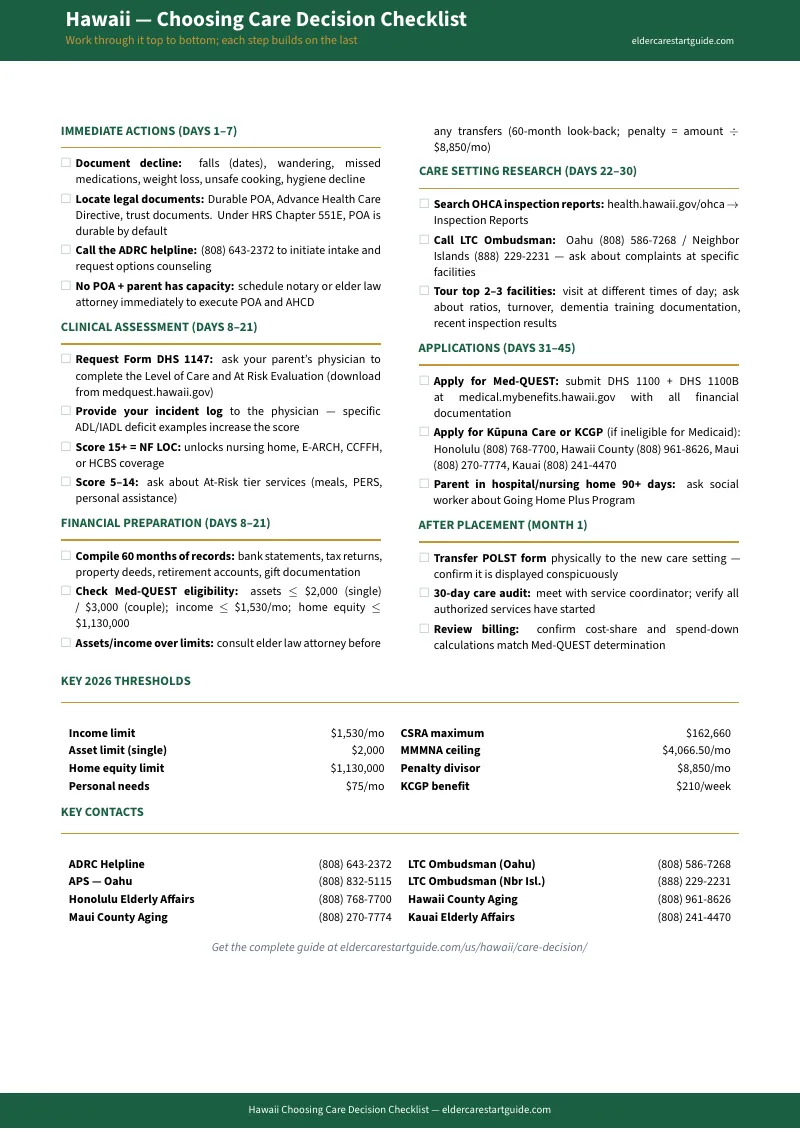
- Med-QUEST eligibility and application walkthrough — the DHS 1147 form, the $2,000 asset limit (still enforced despite HB1416), spousal impoverishment protections (CSRA up to $162,660), and the Medicaid Estate Recovery rules that can affect the family home
- Kupuna Care and Kupuna Caregivers Program access — eligibility, services covered, how to apply through your county ADRC, and the $210/week working-caregiver benefit most families don't know exists
- Facility vetting system — how to pull DOH/OHCA inspection reports, read CMS Care Compare ratings, check staffing metrics, and use the Long-Term Care Ombudsman's complaint history before committing to any facility
- Pre-crisis legal authority checklist — Power of Attorney, Advance Health Care Directive, HIPAA authorization, and the specific Hawaii forms your parent needs signed while they still have legal capacity
- 30-day transition timeline — week-by-week plan from crisis to stable care arrangement, with checklists for hospital discharge coordination, facility move-in, or home care setup
- Long-distance coordination templates — structured tools for mainland-based children managing a Hawaii parent's care remotely, including communication logs, agency contact trackers, and delegation worksheets
- 9 standalone printable worksheets — care setting comparison, financial eligibility quick check, document preparation checklist, family care coordination, facility vetting checklist, 30-day transition timeline, care settings quick reference, key contacts and resources, and legal authority quick reference — print what you need for facility tours, family meetings, and attorney consultations
Who This Is For
- The local caregiver hitting the wall — you've been helping your parent while working and raising your own family, and the demands — lifting, nighttime supervision, medication management — are becoming unsafe for both of you
- The mainland child in crisis mode — your parent is still in Hawaii and something has happened. You need to assess the situation, evaluate options, and coordinate care from thousands of miles away
- The family facing a hospital discharge — the discharge planner says your parent can't go home alone, and you have days — not weeks — to figure out what comes next
- The family navigating cultural pressure — you feel the weight of caring for kūpuna at home, but your parent's needs may have grown beyond what the family can safely handle
Why This Works Where Free Resources Don't
Hawaii's Executive Office on Aging and the ADRC provide directories and program descriptions, but they don't give you a decision framework. You get a list of licensed facilities and a phone number to call — not a system for evaluating whether your parent needs assisted living or would be safer in an adult residential care home, or how to structure the finances so Med-QUEST covers the care services while the family home stays protected.
National referral platforms like A Place for Mom and Caring.com will walk you through their process — because their process ends with a facility placement that earns them a referral fee. They have limited coverage of Hawaii-specific programs like Kupuna Care, and they have no incentive to help you explore options that don't involve a facility partnership.
This guide is independent. No referral partnerships, no facility affiliations, no data collection for third-party sales. Just the information you need to make the right decision for your family.
Satisfaction Guarantee
If the guide doesn't give you a clearer picture of your parent's care options within the first 30 minutes of reading, email us for a full refund. No questions, no forms.
Get Started Now
Download the free Hawaii Care Decision Checklist to see the 20 items you need to assess before choosing a care setting. Ready for the complete system? Get the full guide with cost breakdowns, Med-QUEST walkthrough, facility vetting tools, and transition timeline.