
Your Parent Needs Long-Term Care. Georgia's Medicaid System Isn't Going to Walk You Through It.
The nursing home charges $8,800 to $11,000 a month. Medicare covered the first 20 days, then the co-pays started, and after day 100 the coverage ends entirely. The facility social worker says you need to "apply for Medicaid" — but nobody explains how a system with a $2,982 income cap, a $2,000 asset limit, and a 60-month lookback audit of every financial transaction actually works.
Georgia is a strict income-cap state. If your parent's gross income exceeds $2,982 by even one dollar, the application is automatically denied. No spend-down option, no exception — unless you set up a Qualified Income Trust, which nobody at the hospital mentioned. The state's Division of Family and Children Services will audit five years of bank statements, property transfers, and gifts. One gift to a grandchild three years ago could trigger a penalty that leaves your family paying out of pocket for months.
Elder law attorneys in Georgia charge $350 to $500 an hour. A full Medicaid planning engagement runs $5,000 to $12,000. You shouldn't need to spend that just to understand the process.
— The Georgia Medicaid Protection Planner
This is the Georgia Medicaid Protection Planner — a step-by-step guide that takes the entire Georgia Medicaid long-term care process and maps it into a sequential system you can follow from crisis to coverage. It covers every decision point between "the hospital says Mom can't go home" and "Medicaid is approved, the home is protected, and the bills are covered."
It's not a national overview with Georgia mentioned in a sidebar. It's not a one-page eligibility checklist from a referral service that earns commissions from the facilities it recommends. This is the specific regulatory, financial, and legal process for Georgia — the income caps, the asset rules, the CCSP and SOURCE waiver differences, the QIT setup instructions, the lookback exceptions, the estate recovery protections — organized in the order you'll actually need them.
What's Inside — 11 Printable PDFs
- Complete 15-Chapter Guide (guide.pdf) — the full Georgia Medicaid long-term care process from crisis to coverage, including eligibility pathways, QIT setup, spend-down strategies, the five-year lookback, CCSP and SOURCE waivers, spousal protections, estate recovery, Structured Family Caregiving, appeals, and the application walkthrough.
- QIT (Miller Trust) Setup Workbook (qit-setup-workbook.pdf) — step-by-step instructions for establishing the irrevocable trust, opening the dedicated bank account, redirecting income, managing monthly disbursements in priority order, and keeping the required ledger. Includes common QIT mistakes that cause denial.
- Penalty-Free Spend-Down Planner (spend-down-planner.pdf) — a fillable tracker of Georgia-approved strategies to reduce countable assets below the $2,000 limit without triggering lookback penalties. Covers burial trusts, debt payoff, home modifications, vehicle purchases, and more — with a running-total calculator.
- 60-Month Lookback Audit Guide (lookback-audit.pdf) — what DFCS will examine, which transfers trigger penalties, which are exempt, the penalty calculation formula ($11,122 divisor), and a self-audit tracker to review 60 months of transactions before filing.
- Spousal Protection Worksheet (spousal-protection-worksheet.pdf) — fillable worksheet calculating the Community Spouse Resource Allowance (up to $162,660), Monthly Maintenance Needs Allowance (up to $4,066.50/month), and patient liability after spousal protections.
- Estate Recovery Protection Worksheet (estate-recovery-worksheet.pdf) — asset titling inventory to identify which assets bypass probate, protection strategies (JTWROS, Lady Bird deeds, POD/TOD, living trusts), mandatory deferrals, home-specific exemptions, and the $25,000 first-dollar exemption.
- CCSP vs. SOURCE Waiver Decision Matrix (waiver-decision-matrix.pdf) — side-by-side comparison of Georgia's two home care waivers with a decision worksheet mapping your parent's income, physician preferences, and care needs to the right program.
- Application Document Checklist (application-document-checklist.pdf) — every document you need before submitting through Georgia Gateway: personal ID, income records, 60 months of bank statements, medical forms, required Georgia forms, and conditional items.
- Structured Family Caregiving Guide (sfc-caregiver-guide.pdf) — how to get approved and paid as a family caregiver through Georgia's SFC program. Covers eligibility, provider agency enrollment, Personal Care Agreement requirements, and daily care log documentation.
- Key Contacts & Quick Reference (key-contacts.pdf) — Georgia agencies, phone numbers, key forms with download locations, and all 2026 financial thresholds on one printable sheet.
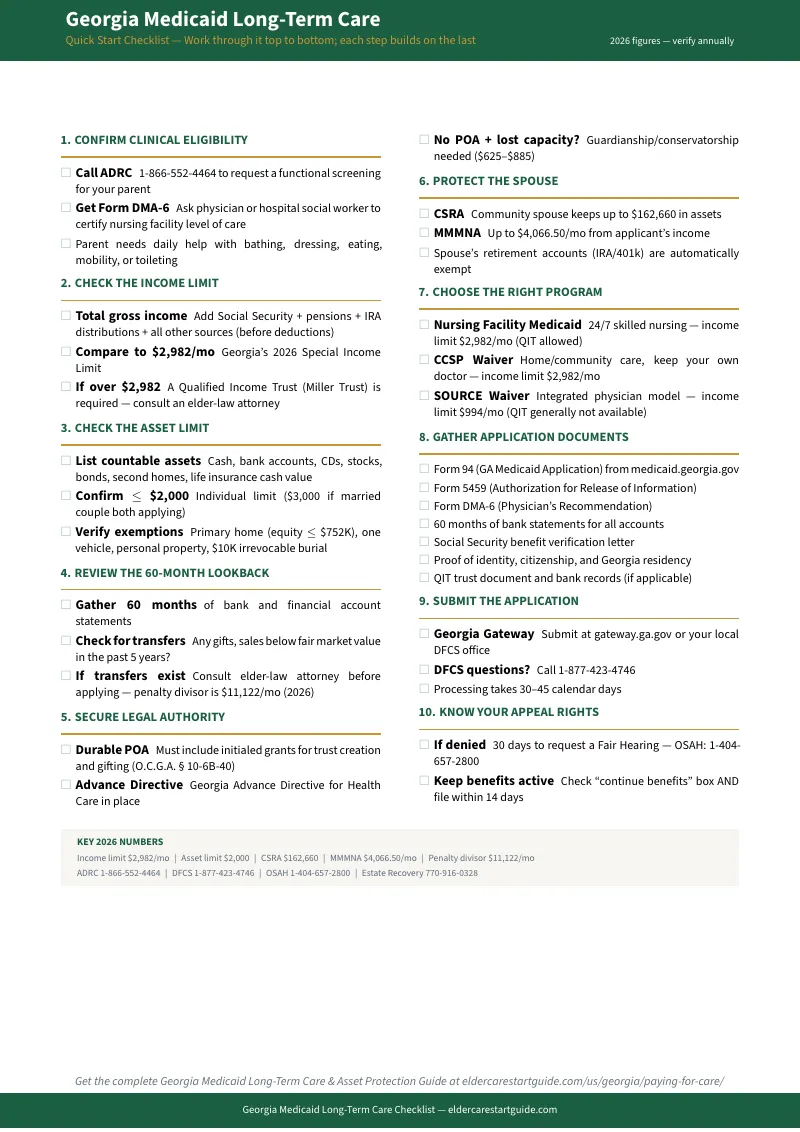
- Eligibility Checklist (Free Download) (checklist.pdf) — a quick-reference overview of Georgia's income limits, asset limits, and the 10 critical steps from confirming clinical eligibility through submitting the application.
Who This Is For
- Adult children trying to figure out how to pay for a parent's nursing home, assisted living, or home care in Georgia — especially after a hospital discharge or dementia diagnosis
- Families facing the 100-day Medicare cliff and needing to transition a parent to Medicaid coverage before savings run out
- Spouses trying to understand how to protect their own retirement assets and income while qualifying their partner for long-term care Medicaid
- Caregivers exploring whether Georgia's CCSP or SOURCE waiver can fund home-based care and whether they can get paid through the Structured Family Caregiving program
- Families who've been told they need a Miller Trust but don't know what it is, how to set one up, or how to manage it after approval
Why Not Just Use Free Resources?
Georgia publishes Medicaid eligibility rules across the Department of Community Health, the Division of Family and Children Services, the Georgia Gateway portal, and the Area Agencies on Aging. The information exists — it's scattered across agencies that don't coordinate with each other, written in regulatory language, and organized by bureaucratic function instead of by what you need to do next.
National referral services like A Place for Mom will find you a facility for free. But they earn commissions from the facilities they recommend, so they steer toward private-pay assisted living and memory care. They don't cover Medicaid waivers, CCSP vs. SOURCE differences, QIT setup, or estate recovery protections because there's no referral fee attached. This guide covers every option — including the ones nobody gets paid to tell you about.
Elder law attorney firms provide excellent planning — at $5,000 to $12,000 for a full engagement. This guide gives you the same step-by-step process, the same checklists, and the same asset protection strategies so you can manage it yourself. If you do need an attorney for a specific issue, you'll know exactly which issue to hire them for instead of paying for a full engagement.
Satisfaction Guarantee
If the guide doesn't help you navigate Georgia's Medicaid system more confidently, email us within 30 days for a full refund. No forms, no questions.
Get Started Now
Download the free Eligibility Checklist to see whether your parent is likely to qualify. When you're ready for the full process — the QIT setup, the spend-down strategies, the waiver comparison, the application walkthrough, and the estate recovery protections — get the complete Georgia Medicaid Protection Planner.