
Your Parent Needs Help. Georgia's Legal System Has a Trap Nobody Warned You About.
Your parent fell last week, or the bank called about suspicious transactions, or the doctor just said "early-stage Alzheimer's." Somewhere between the hospital discharge planner handing you a stack of forms and the nursing home asking you to sign as "Responsible Party," you realized you have no legal authority to do any of this — pay their bills, access their medical records, sign their admission paperwork, or redirect their savings before Medicaid's 60-month lookback clock runs out.
You searched for a Georgia power of attorney form and found the free statutory template on the state portal. What it didn't tell you: that form lacks the "hot powers" clause under O.C.G.A. § 10-6B-56, which means your parent's agent cannot create a Miller Trust, fund an irrevocable trust, or make the asset transfers needed to qualify for Medicaid long-term care. You're holding a document that looks official but cannot do the one thing your family will need most.
And here's the trap: Georgia's Structured Family Caregiving program pays live-in family caregivers $1,987 to $2,400 per month through the CCSP and SOURCE waivers. But court-appointed guardians are disqualified from receiving that compensation. If you wait too long, your parent loses capacity, and you're forced into a $3,900 to $4,900 probate guardianship — you lose the caregiving income too.
The Georgia Legal Authority Navigation System
This is not a set of blank forms you can download from georgia.gov. It is the decision framework around Georgia's elder law system — the part that elder law attorneys explain for $340 to $369 per hour and that state agency websites never cover.
The guide walks you through both legal tracks: the voluntary pathway (durable financial POA + advance directive while your parent still has capacity) and the involuntary pathway (probate court guardianship and conservatorship when capacity is already lost). Every chapter follows the order these decisions actually arrive — because nobody facing a hospital discharge deadline or a bank rejection has time to read chapters out of sequence.
What's Inside
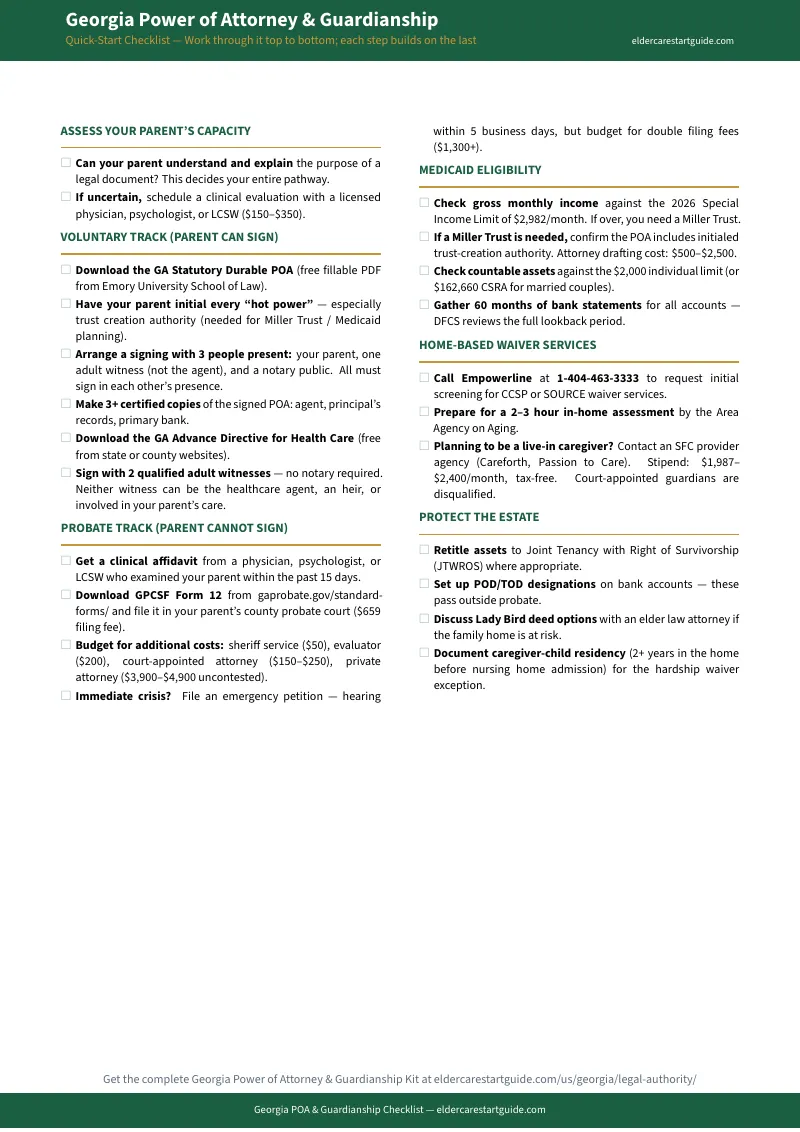
- The Two-Track Decision Framework — A capacity assessment that determines your parent's legal track today: can they still sign a durable POA (voluntary), or has capacity already been lost (probate court)? This single determination controls everything — your costs, your timeline, your SFC eligibility, and whether you spend $340 per hour on an attorney or handle it yourself.
- Durable Financial POA With Medicaid "Hot Powers" — The standard Georgia statutory form (O.C.G.A. § 10-6B-70) does not include the authority to create, fund, or amend irrevocable trusts. The guide explains exactly which clauses must be expressly granted under O.C.G.A. § 10-6B-56 to enable Miller Trust setup and Medicaid-compliant asset transfers — the same customizations that elder law firms charge thousands to draft.
- Georgia Advance Directive for Health Care — The single document that combines a healthcare power of attorney, a living will, and a guardian nomination clause under O.C.G.A. § 31-32-5. Covers the strict witness exclusion rules (who cannot serve), the divorce revocation rule, and how the advance directive solves the HIPAA access problem that blocks families from their parent's medical records.
- Signing Day Checklist — Georgia's execution requirements are unforgiving: a financial POA requires the principal, one competent witness, and a notary public — all three physically present in the same room at the same time under O.C.G.A. § 10-6B-5. One wrong signature, one missing witness, and the bank rejects the document. The checklist walks you through every step so nothing is missed.
- Probate Court Guardianship and Conservatorship — Full Process — When your parent cannot sign, the guide covers the GPCSF Form 12 petition, the mandatory court-appointed attorney for your parent, the clinical evaluation, the formal hearing, the surety bond requirement for conservators, and the ongoing reporting obligations (inventory within 60 days, annual returns). Includes a cost summary by line item so you know exactly what to budget.
- Emergency Guardianship (O.C.G.A. § 29-4-16) — When you cannot wait for the standard process: the legal threshold for immediate risk, the expedited timeline, and the critical detail that emergency appointments expire after 60 days and require a second full filing to convert to permanent status.
- CCSP/SOURCE Waiver Enrollment — Georgia's primary home and community-based care programs, accessed through Empowerline (1-866-552-4464) and your regional Area Agency on Aging. Covers the 2026 income cap ($2,982/month), the $2,000 asset limit, and the Qualified Income Trust (Miller Trust) setup for over-income applicants.
- Structured Family Caregiving Eligibility — How to qualify for the $67 to $80 daily tax-free stipend to care for your parent at home, and why preserving POA agent status (instead of court-appointed guardian status) is the key to keeping this benefit — the "guardianship trap" that most families discover only after it is too late.
- Medicaid Asset Protection — The 60-month lookback period, the penalty calculation, the Spousal Impoverishment protections (Community Spouse Resource Allowance up to $162,660, MMMNA, home equity exemption), and the specific transfers that Georgia law treats as safe: paying debts, funding prepaid irrevocable burial arrangements, and establishing caregiver agreements at fair market value.
- Estate Recovery Protection — Georgia's probate-only limitation on Medicaid recovery under O.C.G.A. § 49-4-147.1, the $25,000 minimum value exemption, mandatory deferrals for surviving spouses, the caregiver child exception, and the sibling equity exception. Explains which assets pass through probate (vulnerable) and which do not (protected).
- Care Facility Licensing and Quality Research — How to access Georgia's facility inspection records, what to look for in repeated violations, staffing ratios, residents' rights under O.C.G.A. § 31-8-125, and the Long-Term Care Ombudsman's role. The questions to ask during a tour that the facility would prefer you did not ask.
Plus: Printable Standalone Tools
- Quick-Start Checklist — One-page 20-item action list with every threshold, phone number, and deadline at a glance
- Capacity Assessment Framework — Determine which legal track applies to your parent today
- Signing Day Checklist — Step-by-step execution guide for the POA and advance directive signing
- Probate Court Filing Organizer — Document and records checklist for the GPCSF Form 12 petition
- Miller Trust Setup Reference — Qualified Income Trust requirements for over-income Medicaid applicants
- Medicaid Asset Inventory Worksheet — Countable vs. exempt assets, spousal protections, and spend-down strategies
- Facility Vetting Checklist — Complete one per facility: environment, staffing, finances, discharge policies, red flags
- Estate Recovery Protection Reference — Exemptions, deferrals, exceptions, and asset types at a glance
- SFC Enrollment Guide — Step-by-step Structured Family Caregiving qualification and application process
- Georgia Eldercare Resource Directory — Every phone number, website, and agency contact you will need
Who This Is For
- Adult children whose parent is showing cognitive decline and needs a durable power of attorney and advance directive executed before capacity is lost — under Georgia law, not generically
- Families whose parent has already lost capacity and needs a probate court guardianship or conservatorship, and want to understand the full process and costs before hiring an attorney
- Caregivers who have been managing their parent's life without legal authority and just hit an institutional wall — the bank rejected them, the hospital cited HIPAA, or the nursing home is demanding a "Responsible Party" signature
- Live-in family caregivers who want to get paid through Structured Family Caregiving but need to understand the guardianship disqualification rule before they accidentally lock themselves out
- Families trying to protect a parent's home, savings, or community spouse's assets from Medicaid's $2,000 asset limit and post-death estate recovery
- Anyone whose parent's income exceeds the $2,982 Special Income Limit and needs a Miller Trust set up to qualify for CCSP or SOURCE waiver services
- Siblings navigating disagreements over who should hold legal authority, how to manage a parent's assets, and whether the parent still has the capacity to make their own decisions
Why Not Free Government Forms?
Georgia's statutory POA form is free. The Advance Directive template is available on the georgia.gov portal. Empowerline will take your call and refer you to your regional AAA.
Here is what none of them provide:
- A decision framework that tells you which legal track applies to your parent right now and what to do in what order — not a list of agencies to call in no particular sequence
- The "hot powers" clauses that must be expressly added to the statutory POA form to enable Miller Trust creation and Medicaid asset transfers — the standard template cannot do this
- The execution rules explained in plain language, so you know exactly who must be in the room, what disqualifies a witness, and what makes a bank reject the document
- The SFC guardianship disqualification rule, which determines whether you can be paid $2,400 per month or work for free — and which most families discover only after they have already filed in probate court
- A step-by-step probate guardianship process with line-item costs, so you know what you're paying for before you walk into an attorney's office at $340 to $369 per hour
State agencies administer programs. Elder law attorneys explain them at $340 to $369 per hour. This guide bridges the gap — translating hundreds of pages of Georgia statutes, probate rules, and agency procedures into a sequence you can work through in an evening.
Satisfaction Guarantee
If the guide doesn't give you a clearer path forward for your parent's care, email [email protected] and we'll make it right.
— Less Than One Hour of an Elder Law Attorney's Time
An initial consultation with a Georgia elder law attorney runs $340 to $369 per hour. A full Medicaid planning engagement can exceed $5,000. A guardianship proceeding adds $3,900 to $4,900 in legal fees alone.
This guide won't replace an attorney for contested guardianship litigation or complex multi-million dollar trust work. But for the POA execution, advance directive, waiver enrollment, asset protection, and facility vetting that most Georgia families need, it covers the process at a fraction of the cost — and if you do need an attorney, you'll walk in with organized records and the right questions instead of starting from scratch.
Start with the free checklist to see if the approach fits your situation. The full guide goes deeper — every statute, every strategy, every form, every phone number.