Your parent's diagnosis changed everything. The system they need hasn't changed at all.
Georgia's dementia care system is built on a web of licensing categories, waiver programs, and financial thresholds that no family is expected to understand — and no single website explains in one place. You need to know whether your parent belongs in a Personal Care Home or an Assisted Living Community. You need to know whether they qualify for CCSP or SOURCE. You need to know that Georgia is a strict income-cap state, and that exceeding $2,982 in monthly income by a single dollar makes your parent ineligible for Medicaid unless a Qualified Income Trust is already in place.
The free resources online don't connect these pieces. The Division of Aging Services publishes policy manuals but doesn't explain how to use them. Elder-law firms explain concepts but gate the procedures behind $200-to-$550/hour consultations. National placement sites like A Place for Mom will happily match you to a memory care center — because they earn a referral commission — but they won't mention that CCSP and SOURCE waivers could cover the care services portion of the bill, because those programs don't generate commissions.
The Georgia Dementia Care Action System
This guide replaces scattered research with a single sequenced plan — built around Georgia's specific statutes, agencies, and financial limits. Every chapter follows the order families actually need: legal authority first (before capacity runs out), financial preparation second (before the Medicaid application), and facility selection third (with the tools to verify a center's actual compliance, not just its marketing).
What's Inside
- Legal authority preparation — how to execute a Georgia Financial Power of Attorney and Advance Directive for Health Care with the correct witnessing and notarization requirements, and what happens if capacity is already gone (guardianship filing, GPCSF 12, emergency temporary letters)
- CCSP and SOURCE waiver roadmap — step-by-step application through your regional Area Agency on Aging, DON-R assessment preparation, and how to choose between the two waiver programs based on income level and county availability
- Medicaid financial worksheets — the Medicaid Financial Inventory Worksheet (countable vs. exempt assets against the $2,000 limit, retirement payout-status audit), the Spousal Income Protection Worksheet (CSRA up to $162,660 and MMMNA shelter costs), and the QIT Monthly Ledger with bank-account and EIN setup checkboxes
- Certified memory care center evaluation — how to verify House Bill 987 staffing ratios (1:12 waking, 24/7 licensed nurse), check HFRD compliance records, and review discharge terms before signing an admission agreement
- Mattie's Call emergency profile — a fill-in template formatted to match what Georgia law enforcement needs during a wandering crisis, including the pre-staged DNA sample and physician's letter
- Structured Family Caregiving enrollment — how approved family caregivers can receive compensation through CCSP and SOURCE for the personal care they're already providing
- Adult Day Health cost analysis — how ADH programs ($2,167–$2,232/month) can be fully funded through waivers, allowing you to maintain employment while your parent receives professional daytime care
Who This Guide Is For
You are an adult child in Georgia managing a parent's dementia care — and you're exhausted. Maybe you're three days out from a hospital discharge with no placement plan. Maybe you've been providing unpaid care for a year and hit the wall when sundowning turned violent. Maybe you just got the diagnosis and have a window to plan before capacity deteriorates.
Whatever brought you here, you need Georgia-specific procedures — not generic advice, not a directory of facilities hoping for your referral, and not a free consultation pitch that ends with a $5,000 retainer quote.
Why Not Free Resources?
Every fact in this guide is publicly available somewhere. The Georgia Division of Aging Services, the Department of Community Health, the probate court system, and the Alzheimer's Association all publish pieces of the picture. The problem isn't access — it's assembly.
You could spend forty hours cross-referencing HFRD licensing databases with CCSP policy manuals and probate court filing requirements. Or you could follow a single sequenced action plan that connects legal preparation to financial eligibility to facility selection to emergency readiness — in the order the system actually requires, with the specific Georgia thresholds that determine what your family qualifies for.
The guide costs less than thirty minutes of an elder-law attorney's time. Families who complete the worksheets before a professional consultation typically cut their billable hours significantly — because they arrive with organized assets, verified income figures, and the right questions.
Satisfaction Guarantee
If the guide doesn't deliver what you need, email us and we'll make it right. No hoops, no forms, no waiting period.
Get Started Now
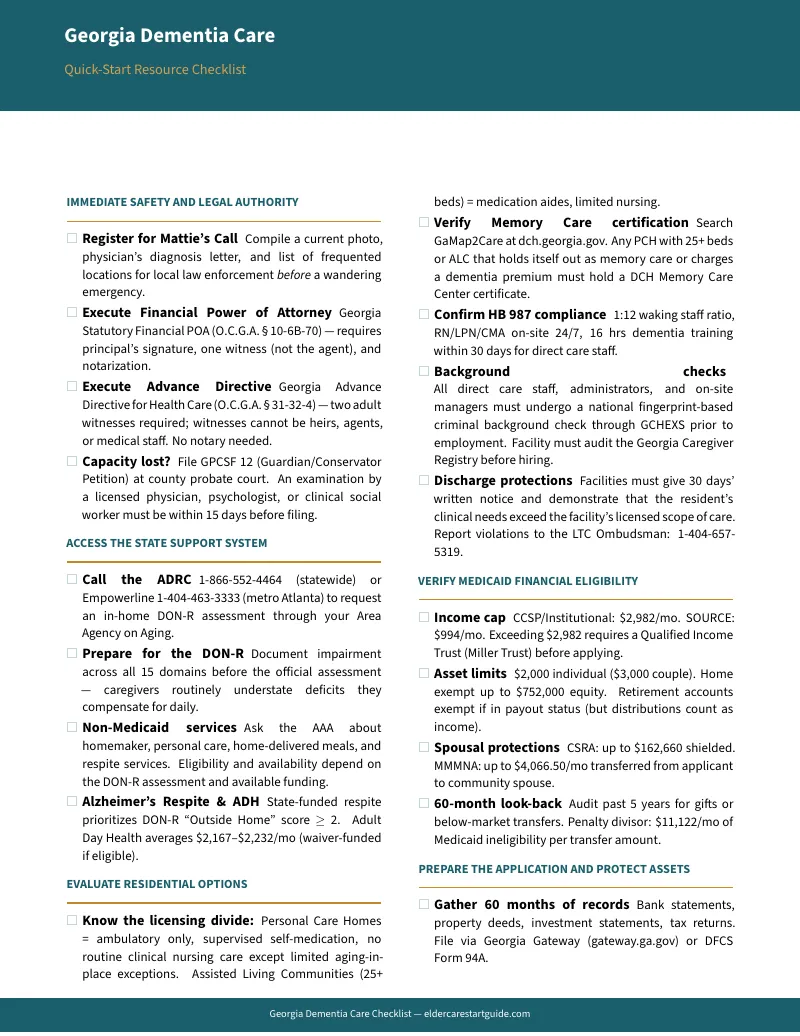
Download the free Georgia Dementia Care Resource Checklist (2 printable pages) to see the key steps and contacts at a glance. When you're ready for the full system — the 43-page guide plus eight fillable worksheets and logs — upgrade to the complete kit for .