Your Parent's Savings Disappear at $10,000+ a Month — Unless You Know Florida's Rules
A single month of nursing home care in Florida costs more than most families spend on housing in a year. Assisted living runs $4,000 to $6,000 per month. Home health aides charge $25 to $35 per hour. And Medicare covers almost none of it.
Meanwhile, Florida Medicaid long-term care has some of the strictest eligibility rules in the country — a $2,000 asset limit, a $2,982 income cap, and a five-year lookback that turns a well-intentioned gift to a grandchild into months of disqualification. Three separate state agencies handle different parts of the application. The waiver waitlist for home care can stretch past a year. And if you miss the window to get your parent's legal documents in order before cognitive decline sets in, you're looking at $4,000 to $10,000 in guardianship court costs just to get the authority to manage their finances.
Most families learn these rules the hard way — after a hospital discharge gives them 48 hours to find placement, or after a gift made three years ago triggers a penalty period that leaves Medicaid refusing to pay even though their parent has less than $2,000 left.
The Florida Medicaid Care Planner — Every Rule, Every Deadline, Every Workaround in One Place
This is not a generic overview of "how Medicaid works." The Florida Medicaid Long-Term Care & Asset Protection Guide is a 14-chapter, Florida-specific planning system that walks you through the entire process — from establishing legal authority while your parent still has capacity, through the financial eligibility maze, to protecting the family home after your parent passes.
It covers the specific agencies you will deal with (DCF, DOEA, AHCA), the specific forms you need to file (Form 5000-3008, ACCESS Florida application), and the specific dollar thresholds that apply in 2026 — not approximations from a national website that conflates Florida's income cap with another state's medically needy spend-down.
What's Inside
- The Three-Agency Roadmap — Florida splits Medicaid long-term care across DCF (finances), DOEA (clinical assessment), and AHCA (managed care plans). The guide maps exactly which agency handles each step so you stop getting bounced between phone lines.
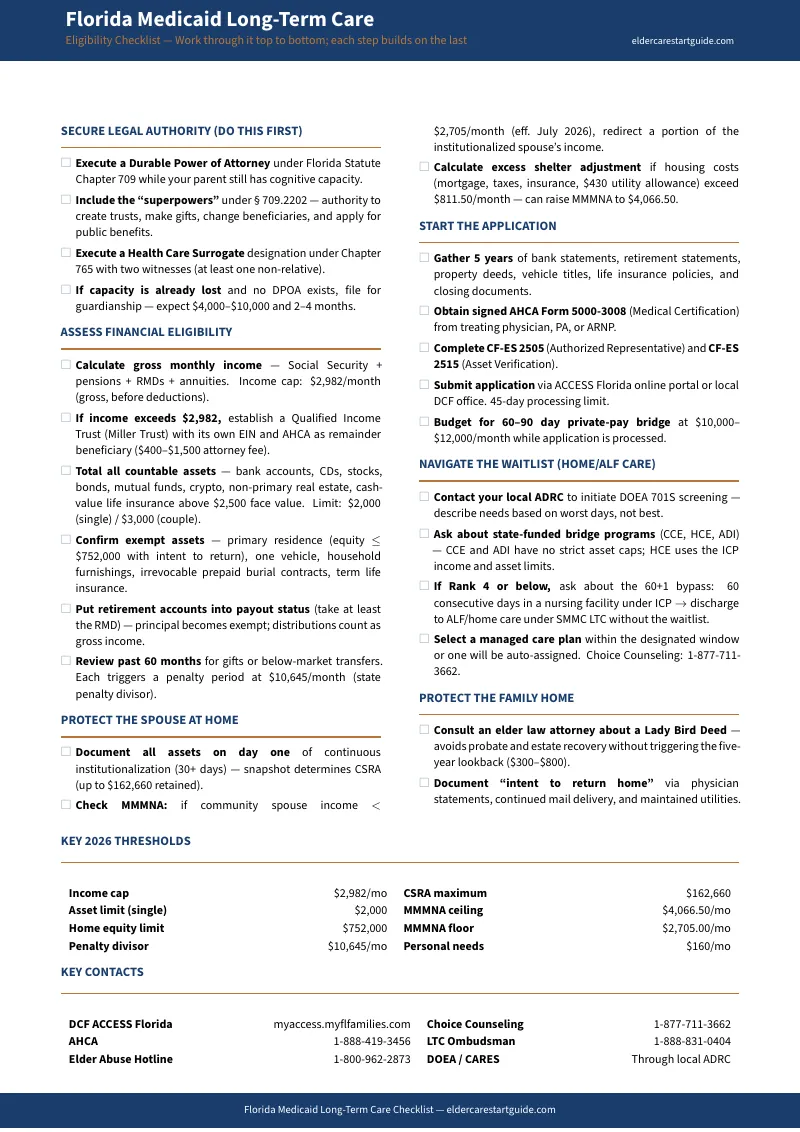
- The Financial Eligibility Worksheet — walks you through the 2026 income cap ($2,982/month gross), the $2,000 countable asset limit, which assets are exempt (homestead, one vehicle, prepaid burial, IRAs in payout status), and how to calculate whether your parent needs a Qualified Income Trust.
- Qualified Income Trust Setup Guide — step-by-step instructions for establishing a Miller Trust: the irrevocable trust document, the dedicated bank account with its own EIN, the monthly deposit-and-disburse cycle, and the common mistakes (commingling funds, missing the state remainder-beneficiary clause) that get trusts disqualified.
- The Compliant Spend-Down Playbook — the difference between a disqualifying transfer and a legitimate spend-down is whether you bought something at fair market value for your parent's direct benefit. The guide itemizes every approved category: debt payoff, home modifications, vehicle replacement, prepaid funeral contracts, and reimbursing yourself for documented caregiving expenses.
- The Caregiver Agreement Framework — how to structure a Personal Services Contract so you can legally pay a family caregiver from your parent's assets without triggering a lookback penalty. Includes the lump-sum calculation formula (regional fair market wage × life expectancy from Appendix A-14), daily logging requirements, and the tax implications the IRS cares about.
- Homestead Protection Strategies — a clear comparison of Lady Bird Deeds vs. Irrevocable Trusts for keeping the family home out of Florida's estate recovery program. Covers the "intent to return home" documentation that keeps the home exempt during your parent's lifetime, even from a nursing facility.
- The SMMC-LTC Waitlist Strategy — how the DOEA 701S screening tool scores your parent's priority rank, why understating needs during the interview can bury your parent at Rank 3 indefinitely, and how the 60+1 rule lets families bypass the waitlist entirely through a 60-day nursing facility stay.
- Spousal Impoverishment Protections — the Community Spouse Resource Allowance ($162,660 maximum in 2026), the Monthly Maintenance Needs Allowance ($2,705 to $4,066.50), and when the "spousal refusal" exception applies.
- The Application Step-by-Step — from gathering five years of bank statements, through the ACCESS Florida portal, to the CARES clinical assessment — with the specific documents, forms, and physician certifications you need at each stage.
- Denial Appeals Process — how to request a Medicaid Fair Hearing within 90 days, the most common grounds for reversal (administrative errors, mismatched clinical data, incorrect asset valuation), and how to continue receiving benefits during the appeal.
- 6 Printable Planning Worksheets — a QIT monthly ledger for tracking trust compliance, an asset inventory worksheet, a spend-down decision tracker with receipt documentation, a financial pre-audit checklist for the five-year DCF review, a 701S interview preparation guide, and an agency communication log for building your appeals paper trail.
Who This Guide Is For
- Adult children coordinating a parent's long-term care in Florida — whether you are facing a sudden hospital discharge, managing a slow cognitive decline, or planning ahead while there is still time to get legal documents in order.
- Families weighing whether to hire an elder-law attorney — at $3,000 to $15,000 for a full Medicaid planning engagement, most families need to understand the landscape before deciding what professional help they actually need. This guide gives you that foundation.
- Caregivers managing a parent's finances — if you hold or are about to file for Durable Power of Attorney, this guide helps you organize the financial audit, avoid lookback traps, and document your own caregiving expenses compliantly.
- Families stuck on the SMMC-LTC waitlist — if your parent was screened at Priority Rank 3 or 4 and you need to understand your options for getting care sooner.
Why Free Resources Fall Short
State agency websites give you the forms but not the strategy. They will tell you the income cap is $2,982 — they will not tell you how to structure a Qualified Income Trust so that an over-income parent qualifies, or how to calculate whether a caregiver agreement will survive a DCF audit.
National lead-generation sites (A Place for Mom, Caring.com) publish general articles to capture your contact information and sell it to local facilities. Their content conflates rules across states — Florida is an income-cap state that does not allow medically needy spend-down of excess income, a distinction that most national guides gloss over entirely.
Elder-law attorneys provide comprehensive planning, but initial consultations run $300 to $600 per hour, and many families need to organize their parent's financial picture and understand the basic rules before they can even have a productive conversation with an attorney.
The Guarantee
If you open the guide and decide it does not help you navigate your parent's situation, email us for a full refund. No forms, no waiting period.
Get Started Now
Download the free checklist to see how the eligibility assessment works. When you are ready for the full guide — with the Qualified Income Trust setup, spend-down playbook, homestead protection strategies, and step-by-step application walkthrough — get the complete toolkit for less than a single hour of an elder-law attorney's billing rate.
Get the Full Toolkit →