Your Parent Can't Sign a Check. The Bank Won't Talk to You. And Nobody Told You This Would Happen.
Your parent had a fall, a stroke, a diagnosis that changed everything overnight. Now you are standing in a bank lobby being told you cannot access their accounts. The hospital social worker is pressuring you to sign a facility admission agreement by Friday. And the elder law attorney's office quoted you $5,000 just to start.
You are doing all the caregiving, all the decision-making, all the worrying — but legally, you have no authority to do any of it. In Florida, being the next of kin gives you nothing. Not access to bank accounts, not the right to redirect Social Security deposits, not the ability to sign a nursing home contract without putting your own assets on the line.
The Florida Legal Authority System
This is not a form packet. It is not a generic multi-state template that will get rejected the first time you walk into a bank. It is the complete legal-authority system for Florida families — covering both paths: private planning when your parent still has capacity, and court-supervised guardianship when they do not.
Every statutory citation, every dollar figure, every process step is Florida-specific. The guide is organized along the path families actually walk — from executing the right documents while you still can, through the guardianship process when the window has closed, to the Medicaid and long-term care systems that fund what comes next.
What's Inside
- Florida Durable Power of Attorney — Done Right the First Time — Florida eliminated springing powers of attorney in 2011. Every DPOA is effective immediately upon signing. The guide explains why this matters, how to structure the document so your parent retains day-to-day control, the exact execution requirements (two witnesses, notary, physical presence), and the mandatory durability language under Chapter 709 that banks check before accepting anything. Most generic templates fail here.
- The Superpower Rules That Banks Actually Enforce — Florida Statutes Section 709.2202 lists specific high-impact powers — creating trusts, making gifts, changing beneficiaries — that are only valid if the principal separately initialed next to each one. Banks do not read your DPOA for intent. They check for initialed superpowers by line item. If the initials are missing, the power is void, and you cannot set up the Qualified Income Trust your parent needs for Medicaid. The guide flags every superpower and shows exactly how to document each one.
- Health Care Surrogate and HIPAA — Both, Not Either — A surrogate designation under Chapter 765 lets you make medical decisions when your parent is incapacitated. But it does not let doctors share medical information with you while your parent is still competent. A standalone HIPAA authorization fills that gap. Florida hospitals frequently reject HIPAA releases older than 24 months — the guide explains when and how to keep them current, and why the surrogate designation alone is not enough.
- Guardianship When the Window Has Already Closed — If your parent has already lost capacity and never signed a DPOA, you are in probate court under Chapter 744. The guide walks through the dual petition process (incapacity determination plus guardian appointment), the three-member examining committee, the mandatory defense attorney the court assigns to your parent, and the difference between plenary and limited guardianship. It covers the costs ($5,000 to $12,000 for an uncontested case), the timeline (30 to 60 days minimum), and the annual reporting requirements that never go away.
- Emergency Temporary Guardianship — Hours, Not Months — When your parent is in imminent danger — active financial exploitation, a medical emergency with no authorized decision-maker — Section 744.3031 allows an ETG that can grant authority within hours. The guide explains the "imminent danger" standard, the 24-hour notice requirement, the 90-day expiration, and when the court will grant an ex parte order without prior notice. Includes the filing checklist.
- Medicaid SMMC LTC Readiness — Florida's Statewide Medicaid Managed Care Long-Term Care program has hard income and asset limits. If your parent's gross monthly income exceeds $2,982, they need a Qualified Income Trust (Miller Trust). But you cannot set up that trust for an incapacitated parent unless the DPOA explicitly includes the signed superpowers for trust creation. Without them, you are forced into guardianship first — adding months of delay and thousands in private-pay nursing home costs. The guide connects the legal-authority documents to the Medicaid qualification sequence so nothing falls through the gap.
- Nursing Home Admission Without Personal Liability — Facilities push admission agreements with "responsible party" and "guarantor" clauses that can make you personally liable for your parent's care costs. Federal law prohibits this. The guide shows you how to sign as agent, not in your personal capacity, which clauses to strike, and how to format the signature so the facility cannot hold you financially responsible.
- Spousal Protection Formulas — When one spouse enters care, the community spouse keeps between $32,532 and $162,660 in assets under the Community Spouse Resource Allowance, plus a Monthly Maintenance Needs Allowance of up to $4,067. The guide walks through the Snapshot Date calculation, the Excess Shelter Allowance, and when to request a fair hearing for a higher income allocation.
Plus: 11 Printable Standalone Tools
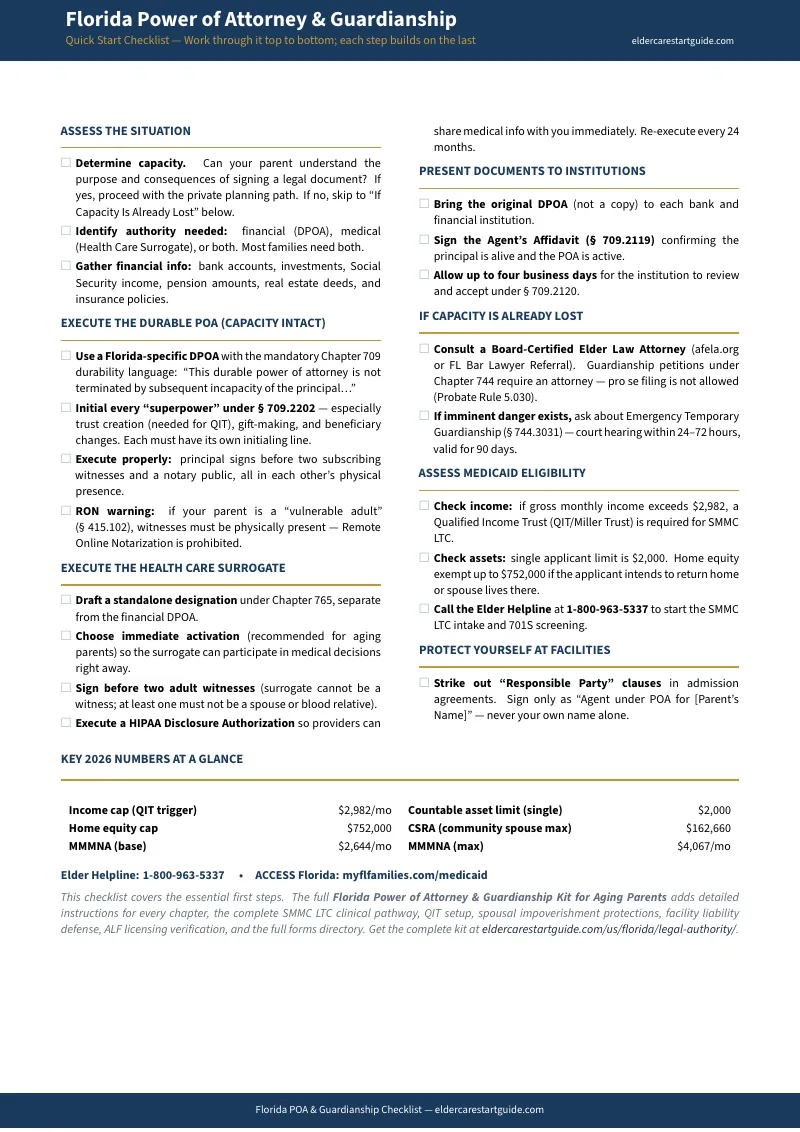
- Quick-Start Checklist — A 20-item action list covering both paths: DPOA execution for parents with capacity and guardianship filing for parents without it
- DPOA Execution Checklist — Every step for the signing table: witnesses, notary, durability language, superpower initials, and bank presentation
- Superpower Reference — All six § 709.2202 powers with initialing verification — bring this to confirm every superpower is properly documented
- Guardianship Filing Checklist — Chapter 744 dual petition process, examining committee timeline, post-appointment reporting requirements, and cost breakdown
- ETG Filing Checklist — Emergency Temporary Guardianship under § 744.3031: qualifying criteria, 24-hour notice requirements, and 90-day timeline
- Medicaid Eligibility Cheat Sheet — 2026 income and asset limits for SMMC LTC, MEDS-AD, QMB, SLMB, QI, OSS, and non-Medicaid state programs on one page
- QIT Setup Steps — Qualified Income Trust creation, monthly deposit and disbursement tracking worksheet
- Facility Signing Guide — How to sign nursing home admission papers without personal liability, with signature format and guarantor clause response
- Spousal Protection Worksheet — CSRA and MMMNA calculation worksheets with 2026 limits, fair hearing guidance, and spousal refusal overview
- Key Contacts Reference Card — Every Florida eldercare phone number, website, and form reference on one printable page
- SMMC LTC Pathway — The six-step clinical eligibility process from Elder Helpline call through managed care plan selection, with waitlist priority ranks
- ALF Verification Checklist — Assisted living facility licensing categories, inspection verification steps, and staff credential checks
Who This Is For
- Adult children who just got the call — a fall, a diagnosis, a hospital stay — and need legal authority to act for a parent in Florida
- Families whose parent still has capacity and want to execute a DPOA that banks will actually accept, not a generic form that gets rejected at the counter
- Caregivers whose parent has already lost capacity and are facing the guardianship process with no idea what it costs, how long it takes, or what rights their parent will lose
- Spouses trying to protect their own financial security while one partner transitions to long-term care
- Siblings who need a clear, neutral reference point to resolve disagreements about who should hold power of attorney or be appointed guardian
- Families starting the Medicaid application process who need the legal authority documents structured correctly before the first filing
- Out-of-state adult children coordinating Florida legal planning remotely
Why Not a Generic Form or a Free Website?
Generic document builders sell multi-state templates. They include springing clauses that have been void in Florida since 2011. They lump all powers into a single grant instead of itemizing the superpowers that banks require under Section 709.2202. They skip the specific witness and notary execution requirements that make the document enforceable.
Free government portals — the Florida Courts website, the Department of Elder Affairs, the Clerk of the Circuit Court — publish blank forms and eligibility thresholds. They do not explain how the CARES assessment works, how to structure the DPOA for Medicaid readiness, or how to avoid personal liability when signing a nursing home admission agreement.
Elder law attorneys cover all of this — at $300 to $500 per hour, with a typical engagement running $3,000 to $15,000 for Medicaid planning alone.
This guide sits in the gap between free forms that get rejected and professional fees that most families cannot absorb during a crisis. For , you get the same Florida-specific process knowledge — organized in the order you need it, written so you can act on it the same day you read it.
60-Day Satisfaction Guarantee
If the guide does not give you a clear path forward for your parent's legal situation in Florida, email us within 60 days for a full refund. No forms, no questions.
Get Started Now
Download the free checklist to see the 20-step action sequence. When you are ready for the full system — every chapter, every statutory citation, every process walkthrough — the complete guide is available for .