
The hospital says your parent is "ready for discharge." You know they're not.
Your parent fell at home, spent four days in a Florida hospital bed, and now the case manager is pushing for discharge by Friday. The house still has the same loose rug that caused the fall. Nobody has explained whether Medicare will cover rehab. And the admissions packet for the nursing facility down the road is 40 pages of legalese that needs a signature before 5 p.m.
This is what families face every day in Florida hospitals. The discharge planner's job is to free up a bed — not to protect your family's finances, extend your parent's stay, or find the safest next step. You need a plan that works in the hours you actually have.
The Discharge Defense Playbook
This guide is built around a single idea: you have more rights than the hospital will tell you about, and you have more time than they're giving you.
Every chapter maps to a specific moment in the transition — from the first hours after admission through the first 72 hours at home — with the exact Florida statutes, federal regulations, and appeal procedures to use at each step. It is not a passive directory of agencies. It is a sequential, operational playbook designed to be used at the bedside, in the car on the way to the rehab facility, or on a phone call with a case manager from 800 miles away.
What's Inside
- Observation Status Detection Kit — Florida hospitals can classify your parent as "under observation" rather than admitted as an inpatient, even after multiple nights in a hospital bed. This classification means the stay is billed under Medicare Part B (with 20% co-insurance) instead of Part A, and it disqualifies your parent from Medicare-covered skilled nursing care afterward. The guide includes the exact questions to ask the attending physician and a script for requesting conversion to inpatient status under the Two-Midnight Rule.
- Acentra Health Appeal Blueprint — if you believe the discharge is clinically unsafe, you can file an expedited appeal with Acentra Health (Florida's Medicare Quality Improvement Organization) that legally freezes the discharge and keeps your parent covered during the review. The guide provides the toll-free numbers, fax lines, filing deadlines, and the exact language to use — step by step, hour by hour.
- Facility Contract Shield — nursing homes and assisted living facilities in Florida routinely present dense admissions packets that contain "Responsible Party" and "Co-Signer" clauses. If you sign individually rather than as an agent under a Durable Power of Attorney, you become personally liable for every dollar of the bill. The guide includes the precise signature formula that protects your personal finances and tells you which clauses to strike before signing.
- Florida Medicaid Long-Term Care Pathway — Florida's Statewide Medicaid Managed Care Long-Term Care program is not an automatic entitlement. It requires a telephonic screening by your regional Aging and Disability Resource Center, a frailty-ranked priority score, and placement on a waitlist that can last months. The guide walks you through the entire pipeline — from the initial 701A screening to the CARES assessment to the ACCESS Florida financial application — including the Institutional Care Program shortcut that bypasses the waitlist entirely for qualifying nursing home residents.
- Qualified Income Trust Builder — if your parent's gross monthly income exceeds Florida's 2026 Medicaid cap, they need a Miller Trust to qualify for Medicaid long-term care. The guide includes step-by-step instructions for creating, funding, and maintaining one — work that typically costs three to five billable hours at an elder law firm.
- "Medicaid Pending" Protection Ledger — once the ACCESS Florida application is submitted, federal and state regulations protect the nursing home resident from eviction for non-payment during the review period. But the family must still pay "Patient Responsibility" — the parent's monthly income minus a $160 Personal Needs Allowance and applicable deductions. The guide includes the calculation worksheet and payment documentation template.
- Home Health Qualification Checklist — Medicare home health requires the patient to be certified as "homebound" with an active Plan of Care signed by a qualified clinician. The guide covers the 2026 billing updates, explains who can now certify the face-to-face encounter, and shows you how to prevent a Low Utilization Payment Adjustment from cutting your parent's visit frequency.
- 72-Hour Post-Discharge Safety Protocol — the first three days after discharge are when medication errors, equipment failures, and falls are most likely to send your parent back to the hospital. The guide includes a day-by-day checklist: medication reconciliation on Day 1, home health agency intake verification on Day 2, and primary care follow-up scheduling on Day 3.
Who This Is For
- Out-of-state coordinators managing a parent's care from hundreds of miles away, trying to direct local advocates and verify clinical decisions over the phone
- Local caregivers who live near the hospital but are overwhelmed by the financial complexity — especially the fear of losing the family home to a Medicaid spend-down
- Chronic-care families dealing with progressive dementia, Parkinson's, or repeated hospitalizations who need specific regulatory leverage to push back against institutional pressure to discharge
Why the Free Information Isn't Enough
Hospital social workers are institutional employees. Their performance metrics are tied to clearing beds and maintaining surge capacity, not to extending your parent's stay or protecting your family's assets. They are legally barred from giving you financial or legal strategies. Their referral list is a list of paying facilities, not an objective evaluation of your options.
State agency websites — the Department of Elder Affairs, the ADRCs, CMS.gov — outline rules and eligibility criteria. But they do not tell you how to appeal a discharge, how to structure a Miller Trust, or how to sign a facility contract without becoming personally liable. They describe the system. This guide shows you how to work the system.
Lead-generation platforms like A Place for Mom position themselves as "free, unbiased advisory services" — but they earn commissions from the facilities they recommend. They don't cover Medicare appeals, Medicaid planning, or contract protections, because those processes don't generate placement fees.
And elder law attorneys — the professionals who can genuinely help — charge $350 or more for an initial consultation and $3,000 to $15,000 for a Medicaid planning retainer. This guide does not replace an attorney. But it prepares you to walk into that office with a fully organized dossier, saving thousands in billable discovery time.
What You Get
Your download includes 12 printable PDFs:
- The Full Guide — 13 chapters covering every stage from admission through long-term care placement, with scripts, contact directories, and financial worksheets
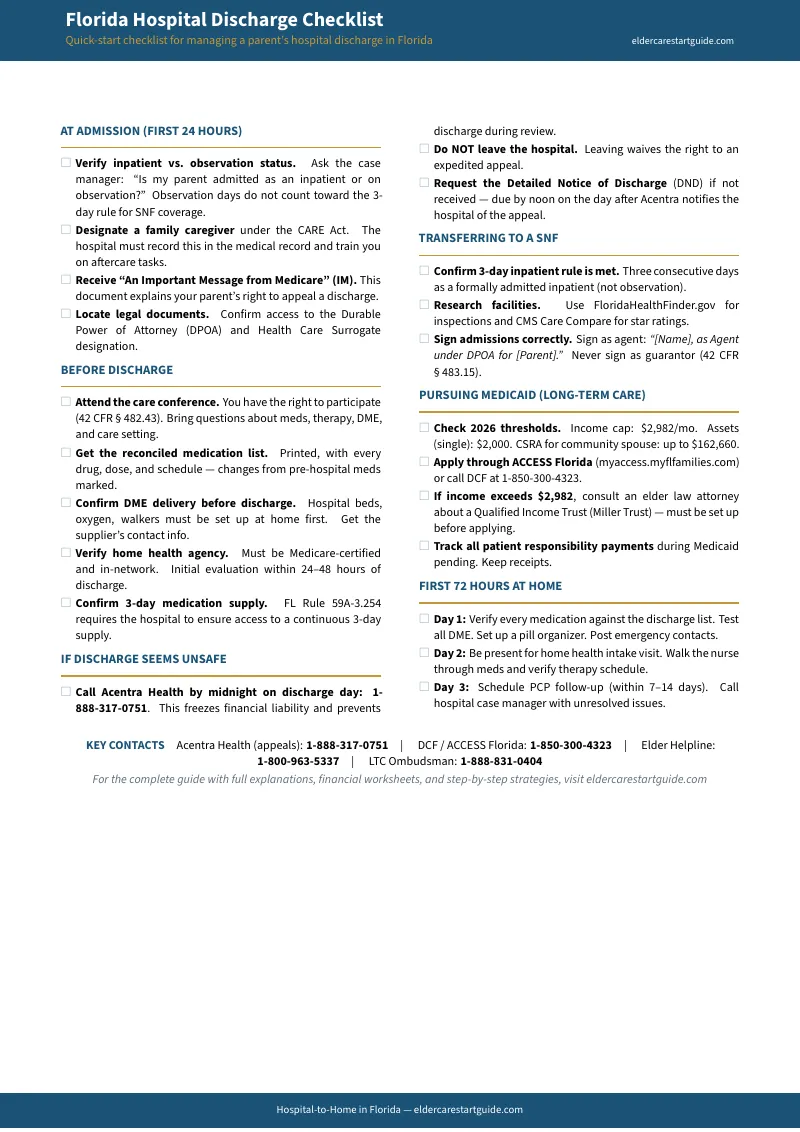
- The Checklist — a one-page action sheet with the critical steps and deadlines, designed for bedside or care conference use
- Observation Status Script Card — the exact questions to ask and a fill-in tracker for recording hospital responses
- Acentra Health Appeal Tracker — step-by-step appeal filing tracker with deadlines, case numbers, and outcome fields
- Facility Contract Review Checklist — clause-by-clause review checklist with the correct signature formula and a signing record
- Medicaid LTC Pathway Tracker — track each step from ADRC screening through ACCESS Florida application
- Miller Trust Worksheet — income calculation, trust setup checklist, and monthly distribution calculator
- Medicaid Pending Payment Ledger — monthly patient responsibility payment log with receipt tracking
- Home Health Qualification Checklist — Medicare eligibility verification and pre-discharge coordination tracker
- 72-Hour Post-Discharge Tracker — day-by-day safety checklist for the critical first three days at home
- Florida Contacts Reference Card — essential agencies, hotlines, and a fill-in section for your personal contacts
- 2026 Quick Reference Card — Medicaid thresholds, Medicare cost-sharing, and spousal protection amounts at a glance
100% Satisfaction Guarantee
If the guide does not give you the clarity and tools you need to navigate your parent's transition, email us and we will refund you in full. No forms, no hoops, no time limit.
The free checklist shows you what to do. The full guide shows you exactly how to do it — with the statutes, scripts, and financial tools that protect your parent and your family.