Your Parent Needs Home Care. Florida's System Won't Tell You Where to Start.
The decline has been building — the missed medications, the fall in the bathroom, the stove left on overnight — and you know your parent can't stay safely at home without help. Or maybe the hospital just issued a discharge notice, and you have 48 hours to figure out what happens next.
Either way, you're facing a system split across three state agencies (AHCA, DOEA, DCF), a waitlist of over 48,000 people, financial eligibility rules that disqualify families earning $35,000 a year unless they set up an irrevocable trust, and a clinical assessment that determines everything — but nobody explains how to prepare for it.
Meanwhile, private home care in Florida runs $6,100 a month. Elder law attorneys charge $350–$500 an hour. And the free referral services? They're paid by the facilities they recommend — they don't cover home-based waiver programs, because there's no commission in keeping your parent at home.
— The Florida Home Care Navigation System
This is the Florida Home Care Navigation System — a step-by-step guide that maps Florida's fragmented aging-in-place bureaucracy into a single, sequential process. It covers every decision point between "my parent needs help at home" and "services are active, the caregiver is paid, and the family home is protected."
Every phone number, form, dollar figure, and legal citation is Florida-specific and current for 2026. Where federal rules apply (Medicare coverage, Medicaid financial standards), we explain how Florida implements them — because the state-level details are where families get tripped up.
What's Inside
- Crisis Triage Protocol — the exact steps, calls, and documentation for when your parent's situation is urgent. Includes the Elder Helpline intake process, the DOEA 701S screening call, how the eCIRTS priority scoring algorithm works (ranks 1–8), and what to say to avoid suppressing your parent's priority score.
- Three-Agency Navigation Map — which agency controls which decision (AHCA for Medicaid and licensing, DOEA for clinical assessments and waitlists, DCF for financial eligibility), plus the SMMC 3.0 regional structure showing all 9 lettered regions and their contracted managed care plans.
- DPOA Superpowers Audit — Florida Statute § 709.2202 requires individually initialed "superpowers" for trust creation, gifting, and beneficiary changes. If your parent's existing power of attorney was signed without these initialed provisions, it's likely defective for Medicaid planning. The guide walks through exactly what to check.
- Qualified Income Trust (Miller Trust) Setup — Florida is an income-cap state. If your parent's gross monthly income exceeds $2,982, they're categorically ineligible for Medicaid LTC unless they establish a QIT. The guide covers bank account structure, required trust language, the monthly distribution sequence, and the exact IRS routing after death.
- 60-Month Look-Back Defense — the asset transfer rules that catch families off guard. Covers compliant spend-down strategies (mortgage payoff, prepaid funeral, home modifications, vehicle purchase), the penalty divisor formula, and Florida's Lady Bird Deed — the enhanced life estate deed that transfers property at death without probate or Medicaid estate recovery.
- State-Funded Programs While You Wait — CCE (Community Care for the Elderly), HCE (Home Care for the Elderly), and ADI (Alzheimer's Disease Initiative) don't require Medicaid eligibility and can bridge the gap during the waitlist. The guide explains eligibility, what they cover, and how to stack them with SMMC services when approval comes through.
- Provider Tier Breakdown — the legal and regulatory differences between a Licensed Home Health Agency (W-2 employees, liability insurance), a Nurse Registry (1099 contractors, liability falls on the family), and a Homemaker/Companion provider (prohibited from hands-on personal care by Florida law). Includes background screening requirements and how to verify any provider through the AHCA clearinghouse.
- SMMC LTC Enrollment Walkthrough — the complete five-step process: CARES clinical assessment preparation, ACCESS Florida financial application, QIT activation, regional plan selection (Humana, Sunshine Health, Simply Healthcare, Florida Community Care), and care plan development with your assigned care coordinator.
- Participant-Directed Option (PDO) — how to hire family members as paid caregivers through the SMMC program, including spouses. Covers Level 2 background screening, fiscal management company registration, 2026 wage rates ($14.00/hour rising to $15.00 on September 30), and the Personal Services Contract alternative for pre-Medicaid arrangements.
- 11-Region AAA Directory — every Area Agency on Aging in Florida with direct phone numbers, counties served, and the specific programs each one administers.
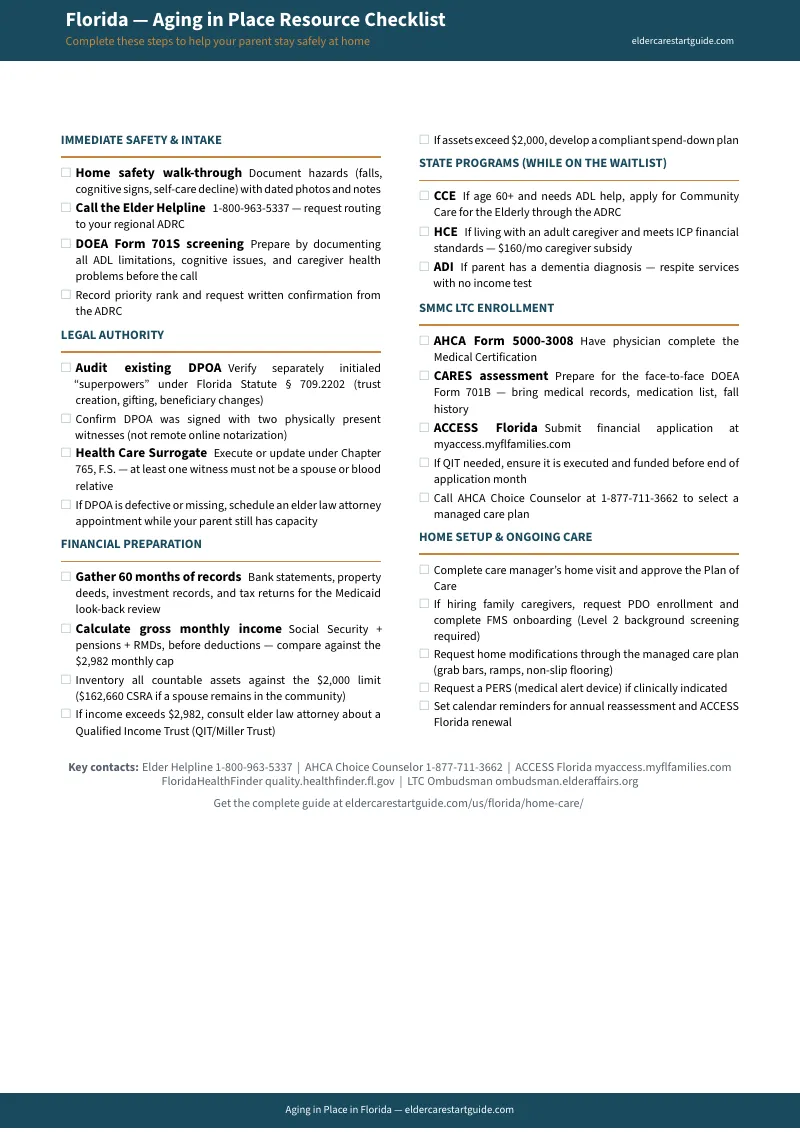
- 20-Item Aging in Place Checklist (Free Download) — a printable action checklist covering every critical step from safety assessment through program enrollment and care activation.
- 9 Standalone Printable Worksheets — crisis triage protocol, financial eligibility pre-screen, Miller Trust setup, 60-month look-back audit, DPOA superpowers audit, SMMC enrollment walkthrough, PDO setup guide, key contacts fridge sheet with all 11 AAAs, and a home safety assessment. Print what you need and bring it to the meeting, phone call, or attorney appointment.
Who This Is For
- Adult children managing an aging parent's home care needs in Florida — whether it's a sudden hospital discharge or a slow decline that's become unsustainable
- Families navigating Florida Medicaid LTC eligibility, the SMMC waiver system, or state-funded alternatives like CCE and HCE for the first time
- Caregivers who want to get paid for the care they're already providing through the Participant-Directed Option or a Personal Services Contract
- Siblings trying to build consensus with an objective framework instead of arguing from opinions and guilt
Why Not Just Use Free Resources?
You can find pieces of this information across Florida's state websites. The DOEA publishes waitlist information on one portal. AHCA posts provider licensing data on another. DCF handles financial eligibility through ACCESS Florida. Legal requirements are scattered across three separate chapters of the Florida Statutes. And the 11 Area Agencies on Aging each have their own websites with different formats and varying levels of detail.
The problem isn't that the information doesn't exist — it's that it's organized by government function instead of by what you need to do next. When you're making care decisions under time pressure, reassembling that puzzle from scratch costs you days you may not have.
National referral services will find your parent a facility, but they earn commissions from the facilities they recommend. They don't cover Medicaid home-based waivers, state-funded CCE or ADI programs, or the Participant-Directed Option — because there's no referral fee in keeping your parent at home. This guide covers every option, including the ones nobody gets paid to tell you about.
Satisfaction Guarantee
If the guide doesn't help you make a more informed care decision for your parent, email us within 30 days for a full refund. No forms, no questions.
Get Started Now
Download the free Aging in Place Checklist to see the 20 critical steps at a glance. When you're ready for the full process — the CARES assessment prep, the QIT setup, the SMMC enrollment walkthrough, the PDO hiring steps, and the 11-region AAA directory — get the complete Florida Home Care Navigation System.