The Hospital Discharge Planner Gave You 72 Hours to Choose Between Home Care, Assisted Living, and a Nursing Home. You Have Never Heard of a CARES Assessment, a Miller Trust, or a Standard vs. ECC License — and Every Wrong Choice Costs Your Family Thousands.
Your parent was admitted after a fall. Or a stroke. Or a cognitive episode that scared everyone. The hospital stabilized them, and now the discharge planner is asking what your "post-acute plan" is. She needs to know by Friday. She is not going to help you choose — that is not her role. She just needs a destination.
So you start calling. The placement agency that advertises "free expert guidance" wants your phone number and your parent's zip code before they will talk to you. They will call back five times today. The assisted living facility down the road quoted $5,200 a month and said Medicaid might help, but could not explain how. The elder law attorney's office said a consultation is $300 and they have an opening in three weeks. Your parent's savings account has $47,000 in it and you have no idea how long any of this is supposed to last.
The Florida Elder Care Decision Guide is a Care-Setting Navigation System — a step-by-step roadmap that walks you from the first clinical warning signs through facility selection, AHCA licensing verification, Medicaid eligibility, SMMC enrollment, and ongoing care management. Not a national overview that treats Florida as a footnote. Not a blog post designed to sell you a $5,000 legal retainer. A Florida-specific manual built on Chapter 429 F.S., the DOEA CARES program, and the 2026 Medicaid income and asset rules — covering every agency, every form, every deadline, and every financial trap in the order you actually encounter them.
What's Inside the Care-Setting Navigation System
A 15-chapter guide, a 20-item decision checklist, and standalone reference worksheets — covering every phase of the elder care decision in Florida from the first signs of decline through facility enrollment and Medicaid activation:
Recognizing When a Parent Needs Help — and How to Document It
The care-decision process starts before any phone call or facility tour. You need to document specific ADL and IADL difficulties — bathing, dressing, medication management, financial competence, driving safety — with dates and examples. This documentation is not just for family discussions. It becomes the clinical evidence the state evaluates during the CARES 701S screening. Families who walk into that screening with vague concerns ("Mom seems confused sometimes") get lower priority scores than families who present a dated log of specific incidents. The guide shows you exactly what to observe and how to record it so the state assessment reflects your parent's actual condition.
Florida's Care Settings Compared — Costs, Rules, and Clinical Boundaries
Florida offers six distinct care settings, and the boundaries between them are regulatory, not just clinical. Home companion care runs $22–$32/hour statewide. Licensed home health aides cost $25–$35/hour, with Miami-Dade rates reaching $42/hour. Assisted living averages $4,000–$5,500/month. Memory care averages $5,704/month. Skilled nursing runs $9,338–$10,342/month. Adult day health care — the most underused option — costs $1,560–$2,000/month. Each setting has different AHCA and DOEA regulations, different Medicaid coverage rules, and different capacity limits. The guide maps all six with regional cost breakdowns so you can compare based on your parent's actual needs and your family's actual budget.
ALF Licensing — The Question That Determines Whether Your Parent Gets Relocated
This is where most families make the most expensive mistake. Florida assisted living facilities operate under four license types — Standard, Extended Congregate Care (ECC), Limited Nursing Services (LNS), and the new 2026 Memory Care Services specialty license — and each one defines a strict boundary around what care the facility can legally provide. A Standard license prohibits ongoing nursing care and requires discharge if a resident becomes bedbound for more than 14 consecutive days or develops a Stage 2+ pressure ulcer. Families who do not check the license type before signing a contract discover this rule the hard way: their parent's health declines, and the facility hands them a mandatory relocation notice. The guide explains every license type, what each one permits, the state's monitoring cadences (ECC is quarterly, LNS is twice a year, Standard is every two years), and the exact questions to ask before you sign anything.
Facility Quality Verification — Using the Databases the Placement Agencies Will Not Show You
Placement agencies like A Place for Mom earn a commission — typically equivalent to one month's rent — from the facilities they recommend. They are not going to tell you about the AHCA Watch List, the Long-Term Care Ombudsman complaint database, the FloridaHealthFinder deficiency search, or the staffing-ratio data that shows whether a nursing home meets the state's minimum 3.6 direct-care-hours-per-resident-per-day standard. The guide walks you through each database step by step: how to find a facility's violation history, what a Class I violation means (severe harm, fines up to $5,000/day), how to cross-reference administrative complaints with civil claims, and how to distinguish a facility with a clean record from one that has been cited repeatedly for the same problems.
The Clinical On-Ramp — CARES Assessments, Priority Scoring, and the 8-Rank Waitlist
Florida's long-term care system starts with a phone call to the Elder Helpline (1-800-963-5337), which triggers a referral to your regional Aging and Disability Resource Center. From there, the process follows a specific sequence: the CARES 701S telephonic screening, a waitlist assignment based on an 8-Rank priority system, and eventually the in-person 701B Comprehensive Assessment. A standard frail senior (Rank 3, score 30–39) may wait months to years. Families who understand the scoring system can present clinical evidence that moves their parent higher on the priority list. The guide explains every rank, every score threshold, and the specific triggers for Rank 7 (Imminent Risk) and Rank 8 (APS High Risk) — both of which bypass the waitlist entirely.
Medicaid Eligibility, Spend-Down Strategy, and Asset Protection
For 2026, Florida Medicaid long-term care requires gross monthly income under $2,982 and countable assets under $2,000. If your parent's income exceeds the limit, a Qualified Income Trust (Miller Trust) can restore eligibility — but only if set up correctly before the application. If assets exceed the limit, a legal spend-down strategy can bring them into compliance without triggering the 60-month look-back penalty. The guide covers which assets are exempt (the primary home up to $752,000 in equity, one vehicle, retirement accounts in active payout status, irrevocable burial trusts), the spousal protection rules (up to $162,660 CSRA plus $4,067/month MMMNA), the exact penalty calculation for improper transfers, and the documentation the application requires — including the three months of bank records and the physician certification.
SMMC Plan Selection, Home Care Alternatives, and the 90-Day Timeline
Once Medicaid eligibility is confirmed, your parent must enroll in a regional Statewide Medicaid Managed Care plan within a defined selection window. Each plan contracts with different providers and covers different service combinations. The guide maps the plan selection process, explains the Participant-Directed Option (which allows you to hire and pay family caregivers through Medicaid funds), and provides a 90-day transition timeline that sequences every action from the initial screening through care activation — so nothing falls through the cracks during the most overwhelming period your family will face.
Who This Guide Is For
- The adult child who just got the call from the hospital — who has 72 hours to produce a post-acute placement plan and does not know the difference between a Standard ALF license and an ECC license, or why that distinction determines whether their parent can stay in the facility six months from now
- The family watching a parent decline gradually — who sees the missed medications, the stove left on, the minor wandering incidents, and knows something needs to change but does not know which care setting matches their parent's actual clinical needs or what it will cost in their part of Florida
- The caregiver who is burning out — who needs to understand respite options (adult day care, short-term ALF stays, the PDO family caregiver payment program) before their own health collapses and two people need care instead of one
- The family trying to protect assets before Medicaid depletes everything — who needs to understand the 2026 income and asset limits, the Miller Trust mechanics, the exempt-asset categories, and the spend-down strategies that keep the family home safe — before they make a transfer that triggers a 10-month penalty
- The out-of-state child managing a parent's care in Florida remotely — who needs every agency phone number, every AHCA database, every form name, and every deadline in one document instead of calling the Elder Helpline repeatedly and getting different referrals each time
Why Free Resources Will Not Get You Through This
Florida elder care information exists. It is scattered across 11 regional ADRCs, the DOEA website, the AHCA licensing portal, the FloridaHealthFinder database, the DCF ACCESS system, elder law firm blogs, and national placement portals. Here is what you actually encounter when you try to navigate the care decision using free sources:
- State agency websites give you accurate information in bureaucratic fragments. The Department of Elder Affairs explains the CARES program. AHCA handles facility licensing. DCF handles Medicaid eligibility. None of them reference each other. None of them sequence the steps. The family calling the Elder Helpline gets a referral to the local ADRC, which schedules a screening, which generates a waitlist rank — but nobody explains the full pathway from that first call through facility enrollment.
- Placement agencies are referral brokers with a financial conflict. A Place for Mom, Caring.com, and similar services earn commissions from partner facilities. Their recommendations are limited to their paying network. Investigations have found that many recommended facilities have active regulatory citations. Their "free" service model means the family never sees the full market.
- Elder law attorney blogs are accurate and designed to sell retainers. Every Medicaid planning article ends with "call our office." The content explains how complex and dangerous asset protection is — and it is complex — but it rarely tells you that a $24 preparation kit could save you $2,000 in billable hours by walking into the consultation with your financial inventory already organized and your exempt-asset categories already identified.
- National platforms like AARP and Nolo publish general guides that lack Florida regulatory depth. They will not explain the 701S scoring system, the difference between a Standard and ECC license, the new 2026 Memory Care Services specialty license, the SMMC plan selection process, or the regional cost variations between Miami-Dade and the Panhandle.
Free resources give you pieces from a dozen agencies that do not talk to each other. The Care-Setting Navigation System puts every Florida-specific rule, form, deadline, and cost range into one document, in the order you actually encounter them.
— Less Than One Hour With a Medicaid Planning Attorney
An initial consultation with a Florida elder law attorney runs $175–$500. A full Medicaid planning package costs $3,000–$15,000. National care-matching platforms collect your personal information and sell it to referral networks. This guide costs less than one hour of professional time and gives you the complete Florida care-decision roadmap — every licensing rule, every cost range, every Medicaid threshold, every CARES assessment step, and the 90-day timeline that sequences the entire process.
Your download includes 10 PDFs — the 15-chapter guide, the 20-item decision checklist, and 8 standalone printable worksheets you can bring to facility tours, family meetings, attorney consultations, and Medicaid appointments:
- Care Setting Comparison Worksheet — compare up to three options side by side (costs, license type, staffing, inspection record)
- Financial Snapshot Worksheet — map income and assets against 2026 Medicaid limits before filing
- Legal Documents Audit — verify every advance directive (DPOA, HCS, Living Will, DNRO) with a distribution checklist
- Facility Visit Checklist — licensing, staffing, environment, contract terms — print and bring on every tour
- 90-Day Transition Timeline — every action from the Elder Helpline call through SMMC enrollment and care activation
- Forms and Resources Reference — every required form, phone number, and state website on one sheet
- Family Meeting Guide — structured agenda, responsibility assignments, and conflict resolution for sibling discussions
- ALF License Types Reference — Standard, ECC, LNS, and LMH licenses compared with care add-on pricing tiers
30-day money-back guarantee. If the guide does not give you clarity on which care setting fits your parent, how to verify a facility's quality, and how to navigate Medicaid eligibility — email us for a full refund. No questions asked.
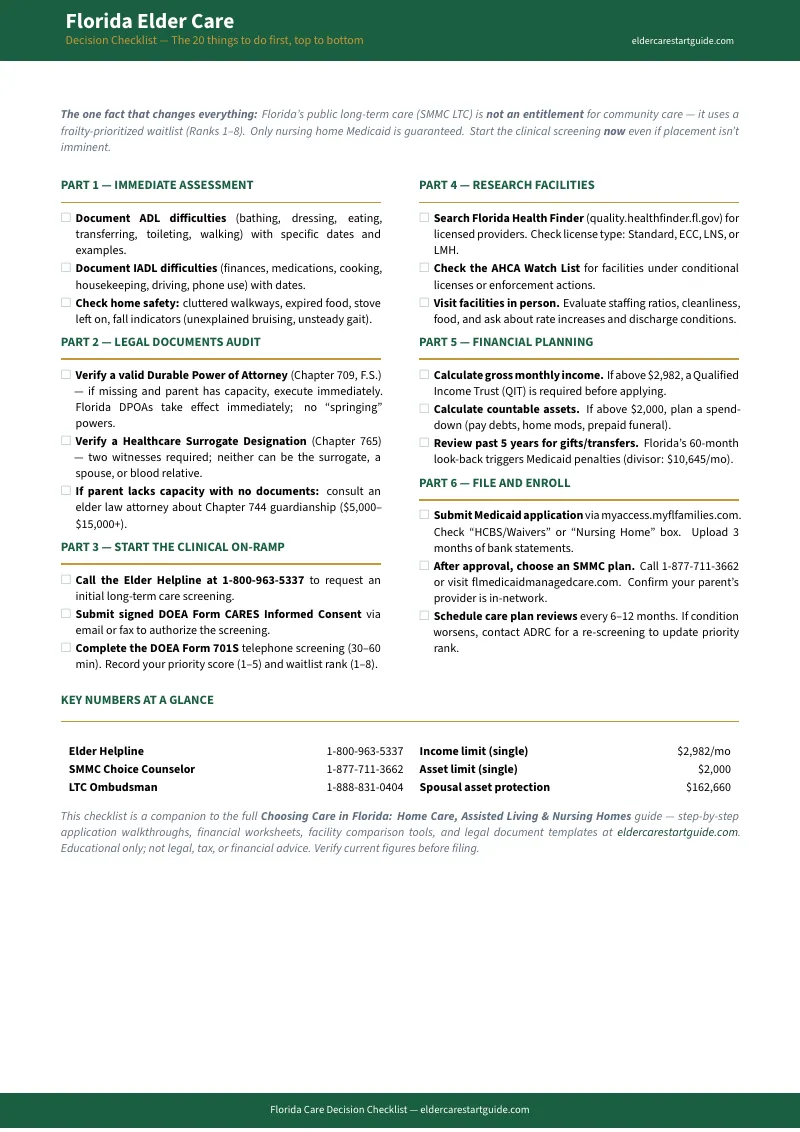
Not ready for the full guide? Download the free Florida Choosing Care Decision Checklist — a quick-start action plan that walks you through the immediate steps: safety assessment, legal document audit, the Elder Helpline call, and the CARES screening process. Enough to start the clinical on-ramp and understand what comes next.
You did not sign up for this. But your parent needs someone who understands the system — and the system is not going to explain itself. This guide does.