
Memory Care in DC Costs $10,077 a Month. The EPD Waiver Asset Limit Is $4,000. Nobody Mentioned the Prescription Order Form That Starts the Entire Eligibility Process.
The neurologist just confirmed what you've been dreading. Your parent has dementia, and their apartment in Ward 5 isn't safe anymore — they left the stove on twice last week, and the neighbor found them at the bus stop at midnight. You started researching memory care in the District and found the number: $10,077 per month average for a secured memory care unit. Premium communities in Northwest run $15,000 to $25,000. Your parent's savings won't last two years.
Someone mentioned Medicaid. You searched "DC Medicaid memory care" and landed on four different government websites — DACL, DHCF, District Direct, and the Department of Health — each describing a piece of the process, none showing you the full sequence. The social worker at the hospital said something about the EPD Waiver, but not that the entire process starts with a specific form — a Prescription Order Form — that must be signed by an approved DC Medicaid provider and uploaded to the DC Care Connect portal before Liberty Healthcare will even schedule the clinical assessment.
Missing that form delays everything by weeks. And every week of delay is another $2,500 in private-pay costs your family absorbs while waiting.
The DC Dementia Care Navigation System
This isn't a summary of Medicaid rules you could piece together from dacl.dc.gov, dhcf.dc.gov, and a dozen elder law firm blogs. The DC Dementia Care Navigation System maps the exact sequence of decisions, screenings, assessments, and filings your family needs — starting from wherever you are right now — so you don't burn through savings because you did things in the wrong order or missed a form nobody told you about.
The critical mistake most families make: they call DACL's general intake line, wait for a callback, and assume the process is moving forward. It isn't — not until an approved provider submits the Prescription Order Form through DC Care Connect. Without that form, Liberty Healthcare never schedules the interRAI assessment. Without the assessment, your parent can't be determined to need a nursing facility level of care. And without that clinical determination, the EPD Waiver application goes nowhere.
The guide puts you in the right order: secure legal authority before capacity fades, register for Silver Alert before a wandering crisis, get the Prescription Order Form submitted correctly, prepare the financial documentation for the $4,000 asset test and the Medically Needy spend-down, understand spousal protections, and choose between the right facility categories — Assisted Living Residences versus Community Residence Facilities — based on what your parent actually needs, not what has an opening.
What You Get — 10 PDFs
- 12-Chapter Guide (49 pages) — The complete DC Dementia Care Navigation System: how the District's multi-agency system works (DACL, DHCF, Liberty Healthcare, the Ward Lead Agencies), the first 30 days after diagnosis, the EPD Waiver application pathway step by step, Medicaid financial eligibility and spend-down strategies, spousal impoverishment protections (the community spouse keeps up to $162,660), memory care facility licensing and costs (ALR vs CRF), guardianship and conservatorship through DC Superior Court, estate recovery rules and the 30-day Undue Hardship Waiver window, care transitions from home to hospice, caregiver support programs, and a complete directory of every agency, court, and advocacy organization you need. Every dollar figure reflects 2026 District of Columbia regulations.
- EPD Waiver Application Tracker — Track every step from the Prescription Order Form through the Liberty Healthcare assessment to DACL case management, with deadline reminders and a key contacts section
- Spend-Down and Asset Worksheet — Calculate countable assets against the $4,000 limit, map allowable spend-down strategies, and determine income eligibility through the Medically Needy pathway
- Spousal Protection Calculator — CSRA and CMNA worksheets showing exactly how much the community spouse keeps, with worked examples and snapshot date documentation
- Facility Evaluation Checklist — Structured scorecard for touring memory care units covering licensing, staffing ratios, physical environment, costs, and discharge policies
- Guardianship Filing Checklist — Every document, court deadline, and post-appointment compliance obligation for guardian and conservator petitions through DC Superior Court
- Estate Recovery Response Planner — Navigate the 30-day Undue Hardship Waiver window with a step-by-step assessment of recovery scope, non-probate asset protections, and evidence requirements
- Agency Communication Log — Running record of every phone call, email, and meeting with government agencies, healthcare providers, and attorneys — essential evidence for escalations and disputes
- Key Contacts Fridge Sheet — Single-page directory of every DACL number, Ward Lead Agency, court address, legal aid organization, and critical form reference — print it and keep it by the phone
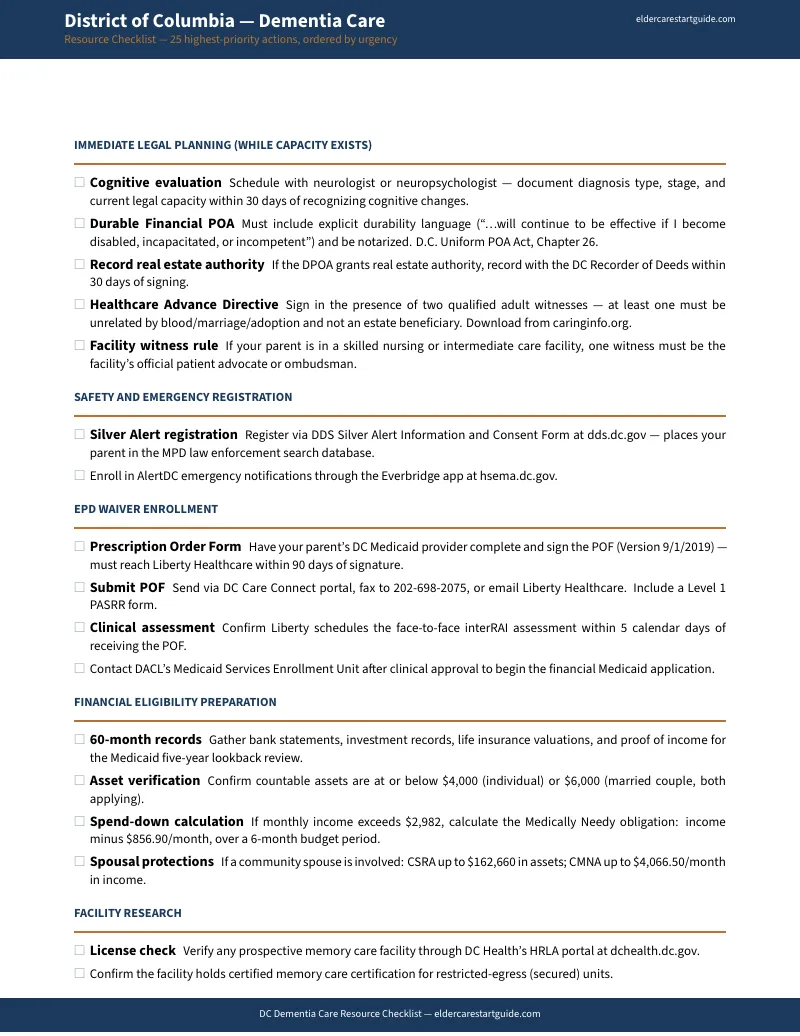
- Quick-Start Checklist (Free Download) — 25 actionable items organized into 7 priority categories: legal planning while capacity exists, Silver Alert registration, EPD Waiver enrollment steps, financial eligibility preparation, facility research, guardianship filing, and caregiver support resources. Know exactly what to do tonight, this week, and this month.
Who This Guide Is For
- Adult children in DC or managing care from out of state who need to navigate the District's multi-agency dementia care system without spending weeks figuring out which agency does what
- Families facing a hospital discharge where the parent can't safely return home and the discharge planner is pushing for a private-pay facility placement within 48 to 72 hours
- Caregivers who want to keep a parent at home through the EPD Waiver but don't understand the Prescription Order Form process, the Liberty Healthcare assessment, or the $4,000 asset limit
- Married couples where one spouse has dementia and the other needs to understand exactly how much of their joint savings DC law protects — and the difference between the CSRA ceiling and the income allowance
- Families who realized too late that no one has legal authority to make decisions — no power of attorney was executed, and now they're looking at a guardianship petition through the DC Superior Court Probate Division
- Out-of-state siblings coordinating a DC parent's care remotely and needing every DACL contact, Ward Lead Agency number, and filing deadline in one place
Why Free Information Isn't Getting You Anywhere
DACL.dc.gov publishes the EPD Waiver overview. DHCF.dc.gov lists eligibility limits. District Direct handles applications. The Department of Health licenses the facilities. But no single government page shows you the sequence — which form to submit first, which agency to contact when, what the clinical assessment actually evaluates, or how the Medically Needy spend-down works over a six-month budget period. You can spend hours clicking between agencies and still not know whether to start with the Prescription Order Form or the District Direct application.
The elder law firms in DC — Farr Law Firm, Right Size Law, the Elder & Disability Law Center — publish helpful blog posts about Medicaid planning. Every one ends with a call to schedule a $300-$500/hour consultation. A comprehensive Medicaid planning package runs $5,000 to $10,000. Their content is a loss-leader designed to sell legal services, not to give you a complete, executable sequence of steps.
A Place for Mom and Caring.com rank well on Google for DC memory care, but their business model is referral fees from senior living facilities. They are structurally incentivized to move your parent into a private-pay facility, not to help you qualify for the EPD Waiver or find a Ward Lead Agency that offers care management on a sliding scale.
This guide fills the gap between the government portal that gives you facts without sequence, the law firm that gives you sequence but only through a $5,000+ planning engagement, and the referral site that steers you toward placements that generate commissions.
Satisfaction Guarantee
If this guide doesn't give you a clear, actionable path to navigating dementia care in the District of Columbia, email [email protected]. We read every message.
— Less Than One Hour of an Elder Law Attorney's Time
DC elder law attorneys charge $300 to $500 per hour. A comprehensive Medicaid planning package runs $5,000 to $10,000. Private care management through Iona Senior Services bills at $195 per hour. A single procedural mistake — an EPD Waiver application submitted without the Prescription Order Form, a guardianship petition filed at the wrong court division, an asset transfer inside the 60-month lookback window — can cost your family thousands in delays, penalties, or unnecessary private-pay months.
This guide won't replace an attorney when you need one (and it tells you exactly when that is). But it will save you hours of research, prevent the most expensive mistakes, and ensure you walk into any conversation — with DACL, the Ward Lead Agency, the Probate Division, or an elder law firm — knowing exactly what District of Columbia law requires.
Download the free Quick-Start Checklist to see the 25 most urgent action items. When you're ready for the complete system, the full guide is waiting.