
The Bank Won't Release Your Parent's Money — And Nobody Told You Connecticut Requires Three Separate Legal Instruments
Your parent fell and broke a hip. The rehab facility needs a signed admission contract by end of day. You call the bank to transfer funds for the deposit — and they tell you your name isn't on the account. The hospital social worker says to "get a power of attorney" but doesn't mention that Connecticut requires two witnesses physically present at execution plus a notary acknowledgment. And even if you somehow get a financial POA signed this week, it won't help you talk to the doctors (that requires a separate healthcare representative appointment) or manage your parent's Social Security check (the SSA ignores state POAs entirely).
This is the legal authority gap. Being next of kin gives you zero legal power in Connecticut. Every financial decision, every medical conversation, every benefit application requires a specific legal instrument — and most families discover the gaps one humiliation at a time.
The Connecticut Legal Authority System
This kit maps every pathway to legal authority in Connecticut — both the voluntary documents your parent can sign today and the court-supervised conservatorship process when capacity is already lost. What separates it from the blank statutory forms on CTLawHelp or the generic templates on Nolo and FormSwift: it covers the full process architecture that Connecticut demands. How to coordinate the financial POA, healthcare representative appointment, living will, and MOLST into a single execution session. How to get banks to actually honor your documents when their compliance department pushes back. How to navigate Connecticut's unique DSS Authorized Representative form (W-3013N) that you'll need for every CHCPE and HUSKY C application. The state provides the forms for free — the process knowledge that makes them work is what this guide delivers.
What's Inside — 9 PDFs
- Complete Guide (guide.pdf) — 13-chapter, 52-page reference covering durable financial POA execution under CGS §§ 1-350 to 1-353b, healthcare representative appointment, living will, MOLST, representative payee and DSS authorized representative, voluntary and involuntary conservatorship through Connecticut Probate Court, HUSKY C Medicaid eligibility with the $1,600 asset cliff, spousal protections and CSRA, CHCPE tiers, medically needy pathways, pooled trusts, and the Community First Choice program
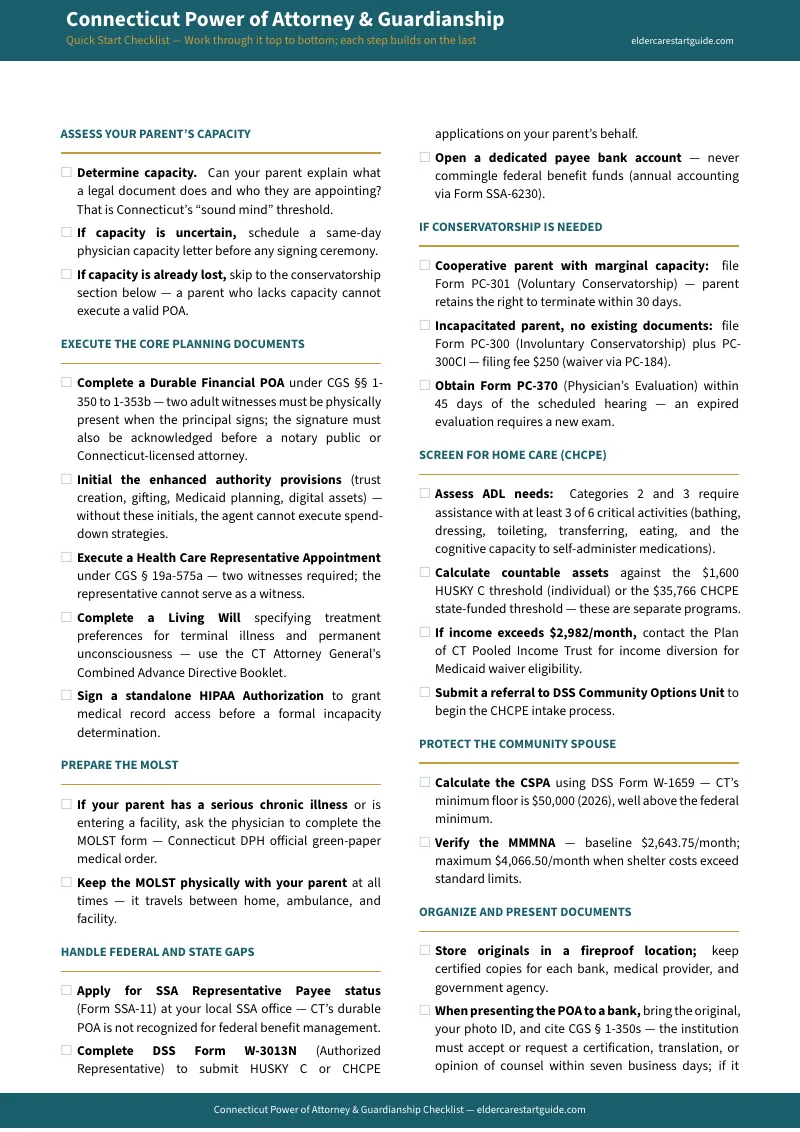
- Quick-Start Checklist (checklist.pdf) — 25-item, 2-page overview of every step, form, and deadline across both the voluntary (POA/healthcare rep) and court (conservatorship) pathways
- Legal Authority Decision Flowchart (legal-authority-decision-flowchart.pdf) — yes/no gates that send you to the voluntary documents, the conservatorship path, or the benefits fork
- Capacity Assessment Worksheet (capacity-assessment-worksheet.pdf) — print-and-write questions, quoted answers, and a physician-letter log for signing day
- Financial Eligibility Worksheet (financial-eligibility-worksheet.pdf) — countable vs. exempt asset inventory and HUSKY C spend-down calculation
- CHCPE Tier Comparison Worksheet (chcpe-tier-comparison-worksheet.pdf) — Categories 1, 2, 3, and 5 scored side by side against your parent's income, assets, and ADLs
- Spousal Protection Calculator (spousal-protection-calculator.pdf) — CSPA floor/cap and MMMNA write-in (DSS Form W-1659 companion)
- Conservatorship Cost Estimator (conservatorship-cost-estimator.pdf) — PC-300/PC-301 filing fee plus write-in quotes for marshal, physician, bond, and attorney costs
- Agency Communication Log (agency-communication-log.pdf) — landscape call/email log for DSS, probate court, banks, and Access Agencies
Who This Is For
- Adult children who need to manage an aging parent's finances, medical care, or benefit programs in Connecticut — and discovered that being next of kin gives them zero legal authority
- Families facing a hospital discharge or nursing facility admission with no legal authority to sign contracts or discuss the medical chart
- Caregivers who want to execute POA and healthcare directive documents while their parent still has capacity — before a crisis forces the conservatorship route through probate court
- Families whose parent has been diagnosed with dementia and need to understand whether they can still execute documents under Connecticut's "sound mind" capacity standard
- Caregivers preparing CHCPE or HUSKY C Medicaid applications who need DSS Authorized Representative status (Form W-3013N) — a step that standard POA documents don't cover
- Families trying to protect the at-home spouse from impoverishment when one parent enters a nursing facility, using the Community Spouse Resource Allowance and spousal needs protections
- Siblings who need a neutral reference to resolve disagreements about who should hold legal authority and how to handle a parent who refuses to sign
Why Free Resources Leave You Stuck
Connecticut's Attorney General and CTLawHelp provide the statutory forms. FormSwift generates template documents. But none of them tell you what to do when a bank branch manager rejects your perfectly valid statutory POA because it wasn't their preferred format. They don't explain that your financial POA has no authority over Social Security payments, HUSKY C applications, or CHCPE enrollment — each requires its own separate authorization with its own filing process. They don't walk you through the voluntary conservatorship pathway (Form PC-301) that lets a parent who refuses to sign a POA choose their own conservator without a public finding of incapacity. And they don't connect the legal documents to the financial crisis: Connecticut's $1,600 HUSKY C asset limit, the 60-month lookback, and the four CHCPE categories that could keep your parent at home instead of a $15,000-per-month nursing facility.
Elder law attorneys in Connecticut navigate all of this — at $336 to $550 per hour, or several thousand dollars for a conservatorship proceeding. Using this guide to understand which documents your parent actually needs, organize the paperwork, and identify whether your situation requires court involvement can save thousands in billable hours. For families with straightforward authority needs — parent has capacity, no contested siblings, no complex assets — the guide itself is enough.
Satisfaction Guarantee
If the guide doesn't help you identify at least one legal pathway, authorization form, or asset protection strategy you weren't already aware of, email [email protected] for a full refund, no time limit.
Start Securing Legal Authority for Your Parent Today
Download the free checklist to get the quick-start overview — or get the full guide for and have every form reference, execution checklist, capacity assessment tool, and step-by-step procedure you need to secure legal authority over your aging parent's care in Connecticut.