
The Hospital Says Your Parent Is Ready to Leave. You Know They're Not.
Your parent went into Yale New Haven, Hartford Hospital, Stamford Health, or a community hospital after a fall, a stroke, or a sudden decline. Now a discharge planner is telling you the acute stay is ending — often within 24 to 48 hours. And you're the one who has to figure out what happens next.
Where do they go? Will Medicare cover rehab? Why does the case manager keep mentioning "observation"? Can the hospital really send a frail parent home to a house with stairs, no grab bars, and nobody there during the day? What if they need a nursing home — and how would you ever pay over $15,500 a month without draining the family's savings?
Hospital discharge planners mean well, but they work under intense pressure to clear the bed, and they're legally barred from managing your family's financial planning. Connecticut's state portals — MyPlaceCT, DSS, the Area Agencies on Aging — hand you regulatory definitions, not action plans. Elder law attorneys in Connecticut average $384 an hour. And the national "senior living advisor" sites are lead-generation funnels that route your phone number to placement services earning facility commissions.
The Connecticut Discharge Defense System
This toolkit replaces the panic with a step-by-step system built specifically for Connecticut families — not a national Medicare overview with "Connecticut" pasted in. Acentra Health appeal contacts, CHCPE eligibility tracks, DSS asset thresholds, the 209(b) medically needy spend-down, and Connecticut's Patient-Designated Caregivers Act — organized in the order a crisis actually unfolds.
It's built for the adult child who became the family's care coordinator overnight — whether you're in New Haven, out in Litchfield County, or managing everything from another state while your parent sits in a hospital hundreds of miles from home.
What's Inside
Acentra Health Appeal Scripts
The exact process to challenge an unsafe discharge through Acentra Health, Connecticut's federally contracted BFCC-QIO for Region 1, including the direct appeal line (1-888-319-8452), the midnight filing deadline, and the automatic stay that pauses the discharge — and stops the billing clock — while an independent physician reviews the case. Covers both the standard QIO appeal and Immediate Advocacy Discharge Assistance (IADA) for urgent situations. Plus the key differences between Original Medicare QIO appeals and Medicare Advantage expedited appeals.
The Observation Status Trap — and How to Escape It
If your parent spent three nights in a hospital bed but was classified as "observation" instead of "inpatient," Medicare Part A won't cover a single day of skilled nursing rehab — because observation days don't satisfy the three-midnight rule. Connecticut law (C.G.S. Chapter 368v) requires hospitals to give verbal and written notice of observation status within 24 hours — stronger than the federal requirement. This section explains how to verify status, the script for asking the attending physician to write an inpatient order, and how to file a prospective appeal under the Alexander v. Azar class action ruling — while your parent is still in the hospital.
The "Responsible Party" Strikeout Template
Skilled nursing admissions coordinators routinely push adult children to sign as the "Responsible Party" or "Financial Representative." Here's what they don't tell you: federal law under the Nursing Home Reform Act (42 USC § 1396r) explicitly prohibits any Medicare- or Medicaid-certified facility from requiring a third-party personal financial guarantee as a condition of admission. This section gives you the exact wording to write in the contract margin so you sign solely as agent under Power of Attorney — with zero personal liability.
The CHCPE Navigator — Connecticut's Best-Kept Secret
Connecticut's Home Care Program for Elders is a dual-track system most families never hear about — and not knowing about it can cost tens of thousands in unnecessary spend-down. The state-funded tiers allow individual assets up to $48,798 and couple assets up to $65,064, with no income limit and only a 9% cost-share — dramatically more generous than the Medicaid waiver's $1,600 asset limit. This workbook walks you through Form W-1487 field by field, explains how DSS evaluates each CHCPE category (2, 3, and 5), maps the clinical functional assessment, and shows you which track to screen for first — before you spend down a dollar more than necessary.
209(b) Medicaid Spend-Down Blueprint
Connecticut is a 209(b) state — it doesn't use a Qualified Income Trust (Miller Trust) like most states. Instead, applicants with income above the limit use a medically needy spend-down over a six-month budget period. The guide explains the $1,600 countable asset limit, the Community Spouse Resource Allowance (up to $162,660), the Minimum Monthly Maintenance Needs Allowance ($4,066.50), the $1,130,000 home equity exemption, and the $15,526 monthly penalty divisor for the 60-month look-back. Plus the PLAN of Connecticut pooled trust option for protecting assets above the Medicaid threshold.
Connecticut Patient-Designated Caregivers Act
Under C.G.S. § 19a-504c, Connecticut hospitals must allow patients to designate a family caregiver, attempt to notify that caregiver before discharge, and provide a live or recorded clinical demonstration of post-discharge care tasks — wound care, medication administration, and equipment use. Most families don't know this law exists. This section gives you the statutory language to invoke if the hospital skips any of these requirements.
Legal Decision-Making — DPOA, Conservatorship, and Fee Structures
If your parent hasn't signed a Durable Power of Attorney, Connecticut's probate court conservatorship process is expensive and restrictive — with fee caps at $52/hour for conservator services and annual compensation capped at $1,200 for the first six months ($600/year after for community residents). This section covers what to sign while capacity still exists, the full fee schedule, the Contract Conservator Program ($90/month flat rate for indigent individuals), and how to avoid probate court entirely with proper advance planning.
Connecticut Resource Directory
Every contact you'll need: all five of Connecticut's Area Agencies on Aging mapped by region with direct phone numbers, CHOICES Medicare counseling, DSS regional offices, the Long-Term Care Ombudsman Program, MyPlaceCT portal navigation, and Community First Choice (CFC) contacts for self-directed home care.
First 72 Hours at Home Survival Guide
The highest-risk window for medication errors, falls, and readmission. A day-by-day checklist covering medication reconciliation, durable medical equipment delivery, home safety setup, follow-up appointment scheduling, and how to arrange home-delivered meals and respite through your regional AAA — the details that keep a discharge from becoming a readmission.
Who This Is For
- Adult children in Connecticut managing a parent's hospital discharge — first time or fifth time, the pressure is the same
- Out-of-state family members coordinating remotely for a parent in Hartford, New Haven, Bridgeport, Stamford, or rural Connecticut
- Families facing the observation-status surprise who just learned Medicare won't pay for rehab
- Families who don't know about the CHCPE and are about to spend down everything to the $1,600 Medicaid threshold — when state-funded home care with $48,798 in protected assets was available all along
- Families approaching Medicaid who need to understand Connecticut's 209(b) spend-down, the five-year look-back, and the PLAN pooled trust before savings run out
Why Free Tools Don't Cover This
National sites like A Place for Mom and Caring.com maintain big facility directories — but their business model depends on routing your phone number to sales advisors who earn commissions from placements. They won't tell you how to file a Medicare appeal through Acentra Health, screen for CHCPE eligibility, or refuse a guarantor signature.
Medicare.gov and AARP explain federal discharge rights accurately — but in abstract language that never connects to Connecticut's QIO phone number, your regional Area Agency on Aging, or the specific HUSKY C thresholds that apply here.
Connecticut's own MyPlaceCT and DSS portals contain the real rules — scattered across dozens of dense administrative pages that are nearly impossible to parse when you're standing in a hospital hallway deciding where your parent will sleep tomorrow.
This toolkit connects those fragmented pieces into a single action plan with the Connecticut-specific details already filled in.
Satisfaction Guarantee
If the toolkit doesn't give you the clarity and confidence to manage your parent's transition, email us for a full refund. No forms, no hoops, no time limit.
— Less Than a Single Hour of Professional Help
A Connecticut elder law attorney averages $384 per hour. A geriatric care manager runs $150–$250 per hour. A Medicaid planning package costs $3,000–$5,000. This toolkit handles the procedural and administrative work you can do yourself, and tells you exactly when it's time to bring in a professional.
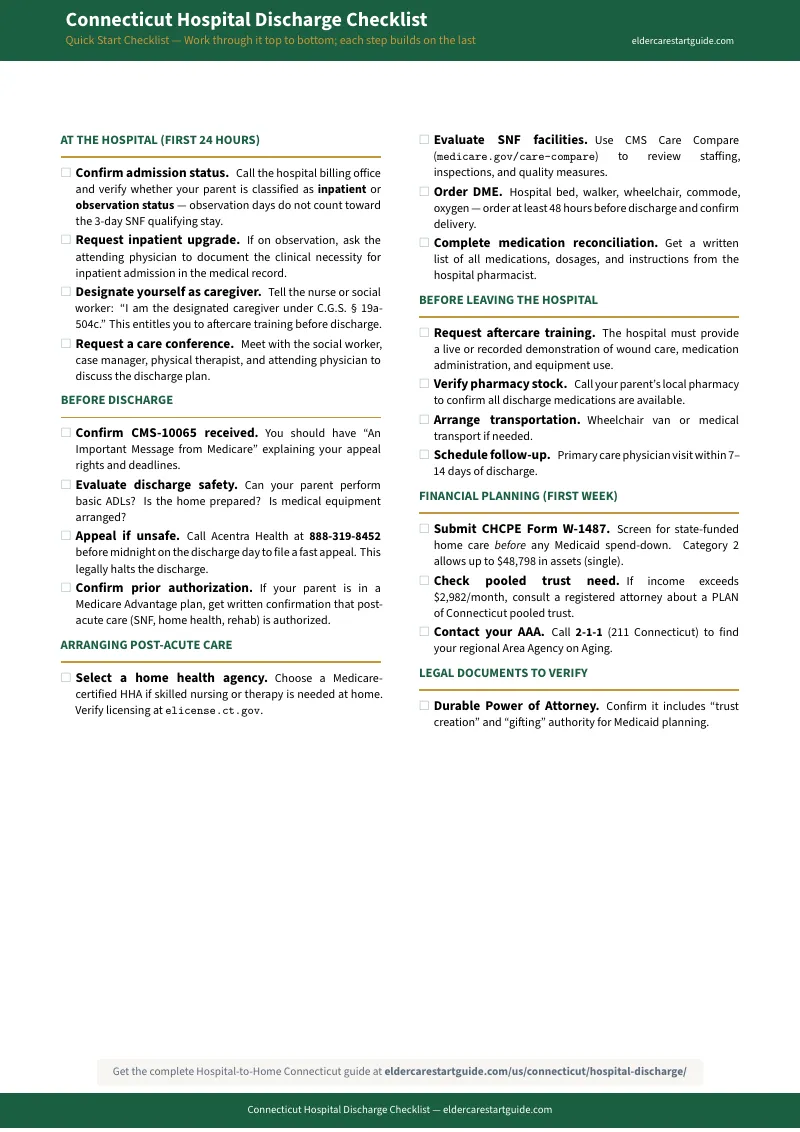
Download the free Connecticut Hospital Discharge Checklist to start, or get the complete toolkit — 10 printable PDFs including the full guide, discharge appeal scripts, observation status defense, CHCPE screening workbook, responsible party strikeout template, 209(b) spend-down blueprint, caregivers act guide, first 72 hours home checklist, and the Connecticut resource directory.