
Your Parent Needs to Stay Home. Connecticut Has Programs That Fund It — If You Can Navigate the System.
Your parent fell, or they didn't fall — they just left the stove on twice last week, stopped refilling prescriptions, and can't remember whether they paid the electric bill. Either way, you're the one who noticed, and now you're the one trying to figure out what to do about it.
You searched "home care Connecticut" and found out there's a program called CHCPE — the Connecticut Home Care Program for Elders — that covers in-home services through Medicaid waivers. You called the DSS Alternate Care Unit and learned about Category 2, Category 3, and Category 5 — but nobody explained which one your parent qualifies for, what happens when their income exceeds the $2,982 monthly cap, or why Connecticut doesn't allow Miller Trusts but does allow something called a Pooled Trust through PLAN of CT.
Meanwhile, you priced out private home care. Connecticut runs some of the highest care costs in the country — averaging $6,864 per month for just 44 hours a week of nonmedical help. A semi-private nursing home room: $15,208 per month. Assisted living: $9,118 per month. Your parent's savings won't survive a year of private-pay care at these rates.
The Connecticut Home Care Navigation System
This is not a list of eligibility rules you can find on the DSS portal. It is the process around the rules — the part that $336-to-$406-per-hour elder law attorneys explain in billable consultations and that overloaded Access Agency care managers never have time to walk you through.
The guide covers every step from crisis to stable home care: understanding the CHCPE tier system and why Category 2 gets you started without a Medicaid look-back, passing the Access Agency's in-home assessment, executing the Category 2-to-Category 3 pivot that protects your parent's savings while transitioning to Medicaid, sheltering excess income through a PLAN of CT Pooled Trust, getting paid as a family caregiver through Community First Choice, protecting the family home from estate recovery using the Child Caregiver Exception, securing legal authority before a parent loses capacity, and building a long-term care plan — organized in the order you will actually need them.
Connecticut's home care system is among the most generous in the country — Community First Choice has no waitlist, CHCPE Category 2 accepts assets up to $48,798, and the state-funded Respite Care Program provides up to $7,500 annually for families caring for a parent with dementia. But these programs are scattered across DSS, the Department on Aging, five regional Area Agencies, and a confusing web of Medicaid tiers that even state caseworkers struggle to explain in one sitting. This guide assembles the entire system into a single sequential process.
What's Inside
- CHCPE Application Roadmap — All Five Tiers Explained — The complete program structure in plain language: Category 2 (state-funded, $48,798 asset limit, no look-back), Category 3 (Medicaid waiver, $1,600 asset limit, 60-month look-back), and Category 5 (1915(i) State Plan Option for lower care needs). How to call the Alternate Care Unit, what happens during the Access Agency in-home assessment, and how to prepare documentation so nothing about your parent's condition is understated during evaluation.
- The Category 2 to Category 3 Pivot — Connecticut's most powerful planning tool. Category 2 gets your parent services immediately — no asset look-back, no waitlist, higher asset threshold — while you legally spend down toward the $1,600 Medicaid limit. The guide details every exempt expenditure: home modifications with receipts, irrevocable funeral contracts up to Connecticut's $10,000 limit, vehicle purchase, debt payoff, and the critical distinction between IRA principal in payout status (exempt) and principal not in payout (countable).
- Pooled Trust Setup Guide — Connecticut does not allow Miller Trusts. If your parent's monthly income exceeds the $2,982 waiver cap, the only approved shelter is a Pooled Income Trust administered by PLAN of CT. The guide walks through enrollment, how the trust holds and disburses surplus income for non-care living expenses, and how to coordinate trust deposits with the Medicaid application timeline.
- Paid Family Caregiver Programs — Community First Choice (CFC) is a Medicaid state plan entitlement with no waitlist. It allows your parent to hire adult children, grandchildren, and friends as paid personal care attendants through the state's fiscal intermediary. The guide covers who can and cannot be hired (spouses, Health Care Representatives, and Conservators are excluded), GT Independence credentialing (10+ business days), and the separate Adult Family Living (AFL) program that pays a tax-free stipend to live-in caregivers. It also covers Connecticut Paid Family and Medical Leave — up to 12 weeks of job-protected paid leave with a maximum weekly benefit of $1,016.40.
- Medicaid Asset Protection and Estate Recovery — Connecticut's Medicaid Estate Recovery program can seek reimbursement from your parent's estate after death, including the family home. The guide details the Child Caregiver Exception (adult child who lived in the home 2+ years and provided care delaying institutionalization), surviving spouse protections, the $1,130,000 primary home equity exemption, the strict 60-month transfer look-back period, and the current penalty divisor of $15,526 per month. Every strategy is documented with the evidence requirements DSS auditors expect.
- Legal Authority Toolkit — How to execute a Durable Financial Power of Attorney (statutory long form, not the short form) and an Appointment of Health Care Representative under Connecticut law while your parent still has capacity. Why the POA needs "hot powers" — gifting, trust creation, and spend-down authority — for Medicaid planning. And what happens if your parent has already lost capacity: the Probate Court Conservatorship process (Form PC-300, $250 filing fee, physician evaluation on Form PC-370 within 45 days), ongoing court-accounting requirements, and costs.
- Spousal Impoverishment Protections — For married couples, Connecticut protects the community spouse through a Resource Allowance of up to $162,660 in combined assets (with a $50,000 minimum floor) and a Monthly Maintenance Needs Allowance. The guide explains the snapshot date, how to calculate the allowance, and the Expanded Community Spouse Resource Allowance request for spouses whose income depends on shared assets.
- Home Safety, Respite, and Community Resources — A room-by-room home accessibility audit with Connecticut-specific funding sources for modifications through CFC and CHCPE. The Statewide Respite Care Program's eligibility criteria (Alzheimer's/dementia diagnosis, income ≤ $55,561, assets ≤ $147,715, up to $7,500/year). The five regional Area Agencies on Aging, Meals on Wheels enrollment, adult day health services, and non-emergency medical transportation under the Medicaid state plan.
- Appeals and Rights — If DSS denies eligibility or reduces your parent's care hours, the guide explains how to file an appeal with OLCRAH within 60 days of the Notice of Action date. File before the adverse action's effective date and current benefits stay active during the appeal. Includes what to document in the appeal letter and the hearing process timeline.
- 30-Day Action Plan — A day-by-day timeline from crisis to stable care: legal authority and crisis stabilization (Days 1–3), Alternate Care Unit intake and Category 2 application (Days 3–7), Access Agency assessment preparation (Days 7–14), financial documentation assembly and Pooled Trust enrollment if needed (Days 14–21), Medicaid application submission (Days 21–30). Each step cross-references the relevant guide chapter.
Plus: Printable Standalone Worksheets and References
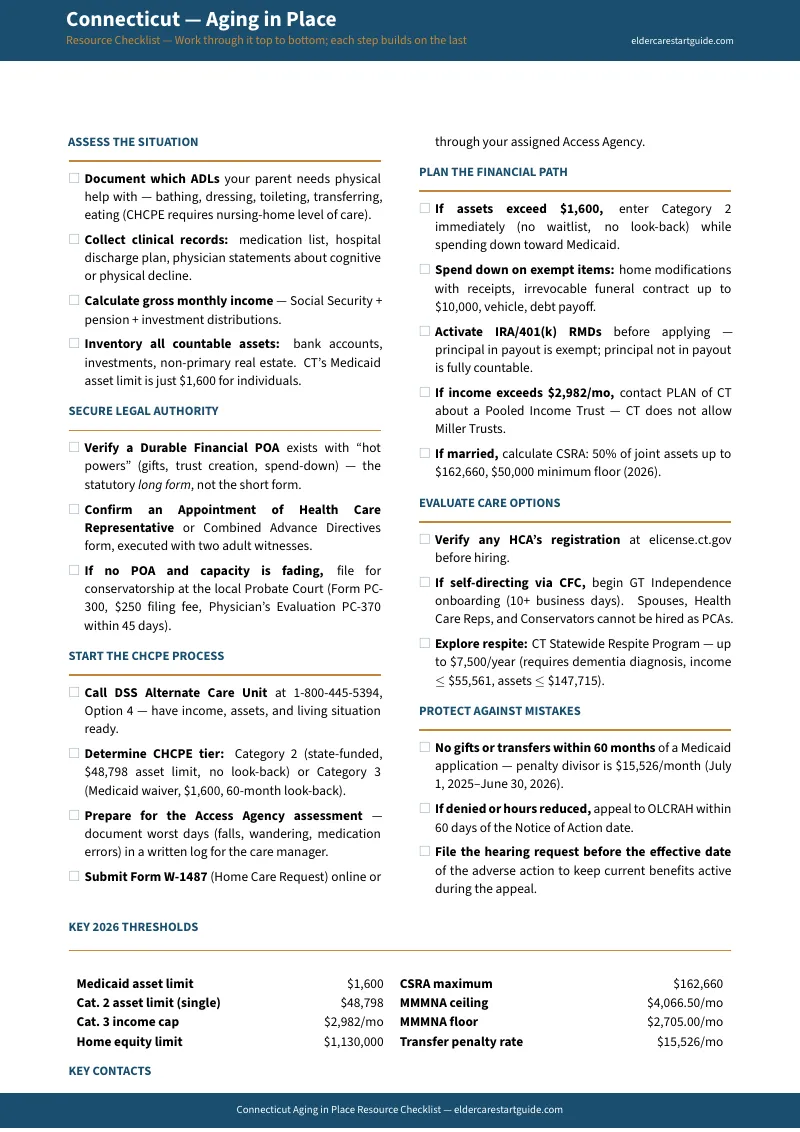
- Connecticut Aging in Place Resource Checklist — The 22-item action list that comes with the free download, covering legal authority, clinical assessment preparation, financial eligibility, home safety, and program applications.
- CHCPE Category Decision Worksheet — Walk income, countable assets, and nursing-facility level of care to choose Category 2, Category 3, a PLAN of CT Pooled Trust, or a CSRA calculation.
- Asset Inventory and Spend-Down Tracker — Classify every asset as exempt or countable, total against the $1,600 Category 3 floor, and log spend-down receipts for the 60-month look-back.
- Access Agency Assessment Preparation Sheet — Document your parent's worst days (falls, wandering, medication errors) in the format care managers evaluate, so nothing is understated during the in-home visit.
- Agency Communication Log — Date, agency, contact, method, what was promised, and follow-up — evidence if you file an OLCRAH appeal.
- Legal Authority Audit Checklist — Confirm the Durable Financial POA is the statutory long form with hot powers, plus Health Care Representative and conservatorship fallback (PC-300, $250).
- Family Caregiver Agreement Template — Written personal-care terms so payments to a relative are not reclassified as gifts in the look-back.
- Home Safety Assessment — Room-by-room checklist with Connecticut-specific CFC and CHCPE environmental modification funding sources.
- Family Care Plan Worksheet — Schedule caregiver coverage across family members, track CFC vs. AFL hours, and document care tasks for the Child Caregiver Exception.
- Key Contacts and Forms Reference — Fill in your assigned Access Agency and care manager; keep DSS, PLAN of CT, GT Independence, and form numbers (W-1487, W-1LTSS, PC-300) on one sheet.
Who This Is For
- Adult children whose parent is being discharged from the hospital and someone needs to figure out how to arrange home care that costs over $180,000 a year privately in Connecticut
- Families who saw the $1,600 Medicaid asset limit and assumed their parent doesn't qualify — without knowing about Category 2's $48,798 threshold or the Pooled Trust income shelter
- Caregivers who want to get paid for the care they're already providing but were told "you can't be a paid caregiver" — without being told about Community First Choice or Adult Family Living
- Families terrified that Medicaid will seize the family home after their parent dies — and who need to understand the Child Caregiver Exception and estate recovery protections before it's too late
- Anyone who called the Alternate Care Unit, heard "Category 2" and "Category 3," and still has no idea which one to apply for or what the difference means for their parent's savings
Why Not Free Government Resources?
The DSS portal publishes eligibility limits. MyPlaceCT has a directory of providers. Your regional Area Agency on Aging offers counseling appointments.
Here is what none of them provide:
- A step-by-step CHCPE tier comparison showing exactly when to start with Category 2 and when to pivot to Category 3 — not just the statutory asset limits that DSS publishes without explaining the planning strategy behind them
- A Pooled Trust enrollment guide showing how to contact PLAN of CT, calculate the monthly deposit, and coordinate timing with the Medicaid application — not a one-paragraph trust definition that says "consult an elder law attorney"
- An Access Agency assessment preparation strategy explaining how to document your parent's ADL limitations so the care manager's evaluation reflects reality — not the DSS fact sheet written for providers
- A side-by-side comparison of CFC self-direction vs. AFL stipend vs. CT PFML showing exactly who qualifies for each, what the pay is, and which exclusions apply — not scattered across four different state web pages
- An estate recovery analysis explaining the Child Caregiver Exception documentation requirements, the $1,130,000 equity exemption, and the timeline your family needs to meet — not a one-paragraph MERP notice from DSS
Government sites publish regulations. This guide compiles fragmented state, federal, and program-specific data into a single, sequential process you can follow from crisis to stable home care — without paying an elder law attorney $336 to $406 per hour to explain things you can learn yourself.
Your Parent's Safety Net
Every week you spend researching is a week your parent goes without the funded care they may already be entitled to. CHCPE applications are processed based on filing date — but only if you file.
Get the Connecticut Home Care Guide →
The free checklist gives you the 22-item action list to start immediately. The full guide gives you every chapter, every worksheet, every form reference, and the complete navigation system for keeping your parent safely at home in Connecticut.