
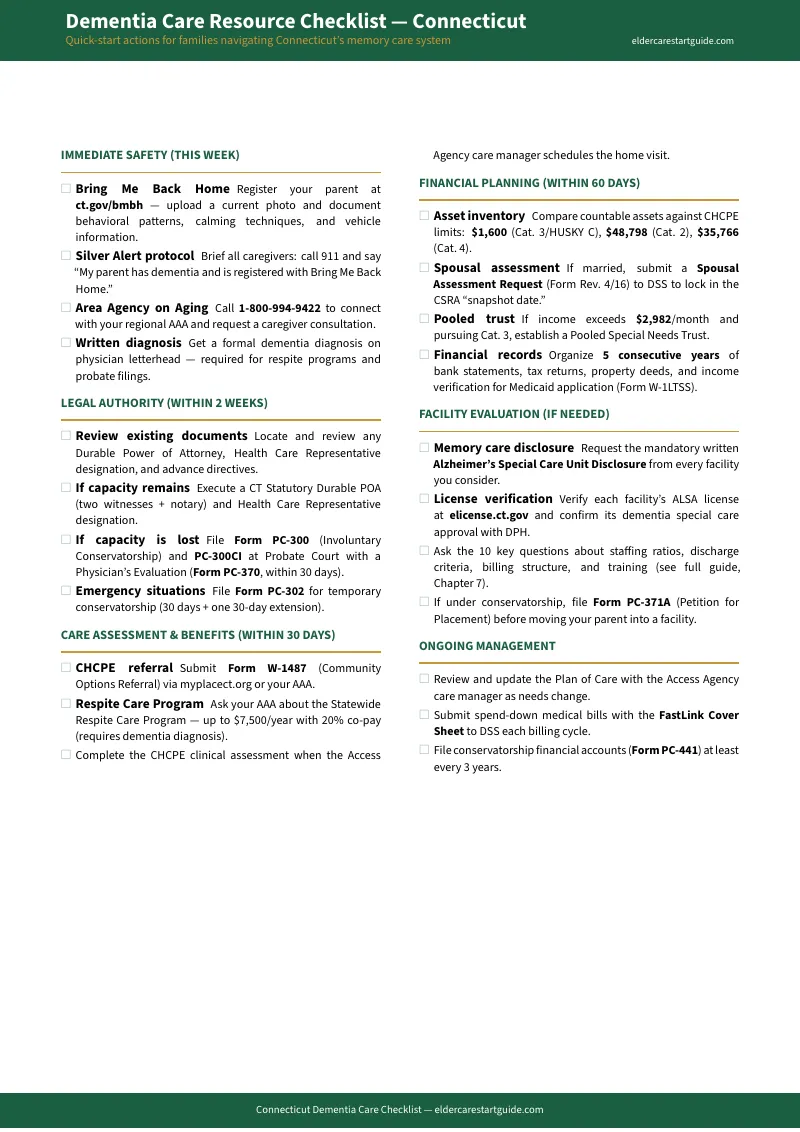
Your parent has dementia. Connecticut's care system has answers — buried in 14 agencies, 3 Medicaid tiers, and a probate court you never expected to need.
You're watching your parent lose pieces of themselves, and every day brings a new crisis you didn't see coming. The wandering episode that ended with a police call. The bills piling up because they can't manage money anymore. The siblings who have opinions about care but aren't the ones showing up at 6 AM.
Connecticut has some of the most expensive long-term care in the country — memory care runs $7,500 to $10,000 a month, skilled nursing tops $15,500 — and the state programs that could help are scattered across the Department of Social Services, five regional Area Agencies on Aging, the Department of Public Health, and the Probate Court system. Each one has its own forms, its own eligibility rules, and its own waiting periods. Miss a deadline or file with the wrong agency, and you lose months.
Meanwhile, the "free help" isn't free. National placement agencies like A Place for Mom earn commissions from the facilities they recommend — which means they steer families toward expensive private-pay communities and never mention the state-funded programs that could cut your costs by 80%. Elder law attorneys can navigate the system, but they charge $350–$500 an hour, with Medicaid planning packages starting at $3,500.
The Connecticut Dementia Care Roadmap — every program, form, and deadline in one system
This is a 10-PDF toolkit built specifically for Connecticut families dealing with a parent's dementia diagnosis. The 43-page core guide translates the state's complex care infrastructure into a step-by-step sequence: what to do first, which programs to apply for, which forms to file, and exactly when each deadline hits. Eight standalone printable worksheets let you screen for CHCPE eligibility, calculate Medicaid spend-down penalties, vet memory care facilities, track conservatorship filings, and plan care transitions — all designed to print and fill in by hand.
The core of the system is the CHCPE Eligibility Pathway — a structured screening process for Connecticut's Home Care Program for Elders, which most families don't discover until after they've already spent down savings on private care. CHCPE has three distinct tiers with completely different asset limits, income rules, and cost-sharing structures. Category 2 alone — the state-funded tier with no income limit and no look-back period — could save a middle-income family tens of thousands in private-pay costs. But you have to know it exists, and you have to apply correctly.
What's inside
- Emergency Safety Protocol — how to register with Connecticut's Bring Me Back Home database, activate a Silver Alert, and build a wandering response plan before the next crisis hits
- Legal Authority Toolkit — the exact sequence for securing a Durable Power of Attorney and Health Care Representative designation while your parent still has capacity, plus the full Probate Court conservatorship pathway (Forms PC-300, PC-301, PC-302) if capacity is already lost
- CHCPE Three-Tier Screening — a side-by-side breakdown of Category 1 (Medicaid home care), Category 2 (state-funded, no income cap, $48,798 asset limit), and Category 3 (Medicaid waiver, $1,600 asset limit) with the specific financial thresholds, cost-share calculations, and application steps for each
- Medicaid Spend-Down Calculator — how to calculate penalty periods using Connecticut's 2026 divisor of $15,526 per month, which assets are countable versus exempt, and the state-approved pathways for spending down legally (prepaid burial contracts, home modifications, debt payoff)
- MRC/ALSA Facility Audit — Connecticut uses a two-layer licensing model that most families don't understand until they're already signing a contract. The guide explains how Managed Residential Communities (housing) and Assisted Living Services Agencies (healthcare) work together, how to verify licenses through DPH, and the 10 disclosure questions required under CGS § 19a-562
- Community Spouse Protection — how the Community Spouse Resource Allowance works in Connecticut, home equity exemption rules, and how to avoid the estate recovery lien that families fear most
- Care Decision Framework — an objective clinical checklist based on Connecticut's ADL safety benchmarks that helps your family decide when home care is no longer safe, without turning the decision into an emotional battleground between siblings
- Complete Forms Directory — every probate form, DSS application, AAA referral contact, and state portal URL you need, organized by the stage of care you're in
Who this is for
- Adult children in Connecticut who are the primary caregiver for a parent with Alzheimer's or a related dementia
- Families who need to establish legal authority (POA, conservatorship) before their parent loses cognitive capacity
- Caregivers trying to figure out which Connecticut programs their parent qualifies for — and in what order to apply
- Anyone facing a care transition and trying to protect family assets from Connecticut's strict $1,600 Medicaid limit
Why not just use free resources?
Connecticut's state agencies — DSS, My Place CT, the regional AAAs — provide accurate information, but it's scattered across dozens of PDFs, written in administrative language, and organized by agency jurisdiction rather than by what families actually need to do next. Public case managers are legally prohibited from advising on proactive asset protection if your parent's assets exceed state limits. They can tell you the rules; they can't tell you the strategy.
National sites like A Place for Mom and Caring.com have polished interfaces, but their business model runs on facility commissions. They'll help you find a private-pay memory care community. They won't mention CHCPE Category 2 — the state-funded program with no income limit that could keep your parent at home for a fraction of the cost.
This guide fills the gap between free-but-fragmented government information and expensive-but-comprehensive attorney consultations. It organizes what public agencies publish into a sequence you can follow, adds the strategic context they can't provide, and costs less than 15 minutes of an elder law attorney's time.
Satisfaction guarantee
If the guide doesn't help you navigate Connecticut's dementia care system more clearly, email us for a full refund. No forms, no hoops.
Get started
Download the free Connecticut Dementia Care Resource Checklist to see how we organize the information. When you're ready for the full system — the 43-page guide plus 8 standalone printable worksheets — the complete toolkit is .