
Your Parent's Bank Won't Let You Pay Their Bills — And Being Next of Kin Changes Nothing
Your parent had a stroke. The hospital is preparing to discharge them to a skilled nursing facility by Friday. You need to sign the admission contract, access their checking account for the deposit, and authorize a care plan with their doctor. You have none of the legal authority to do any of it. The bank says you're not on the account. The facility says they need a legally authorized representative. The hospital social worker says you need to "get your paperwork in order" — but doesn't tell you which paperwork or how.
This is the legal authority gap. California law does not give adult children any automatic power over an aging parent's finances, medical care, or living arrangements. Every decision — from paying a utility bill to choosing a nursing home — requires either a signed Power of Attorney (executed while your parent still has capacity) or a court-appointed conservatorship (after capacity is lost). And the gap between those two pathways is where most families get stuck.
The California Legal Authority Navigator
This guide maps both legal pathways — voluntary authority through POA and healthcare directives, and court authority through conservatorship — with every form, fee, deadline, and agency contact specific to California. What separates it from the free statutory forms on the California Courts website or the generic templates on Nolo: it covers what happens after you sign the documents. How to get banks to actually honor your POA when their compliance department pushes back. How to secure the specific IHSS and Medi-Cal authorization forms that a standard POA doesn't cover. How to protect the family home from estate recovery using California's probate-only MERP rules. The forms are free — the process knowledge that makes them work is what this guide delivers.
What's Inside — 10 PDFs
- Complete Guide (guide.pdf) — 15-chapter reference covering durable POA execution, Advance Health Care Directives, capacity evaluation, conservatorship, Medi-Cal and IHSS authorization, representative payee, estate recovery defense, facility evaluation, and a master action plan with every statute, form, and deadline specific to California
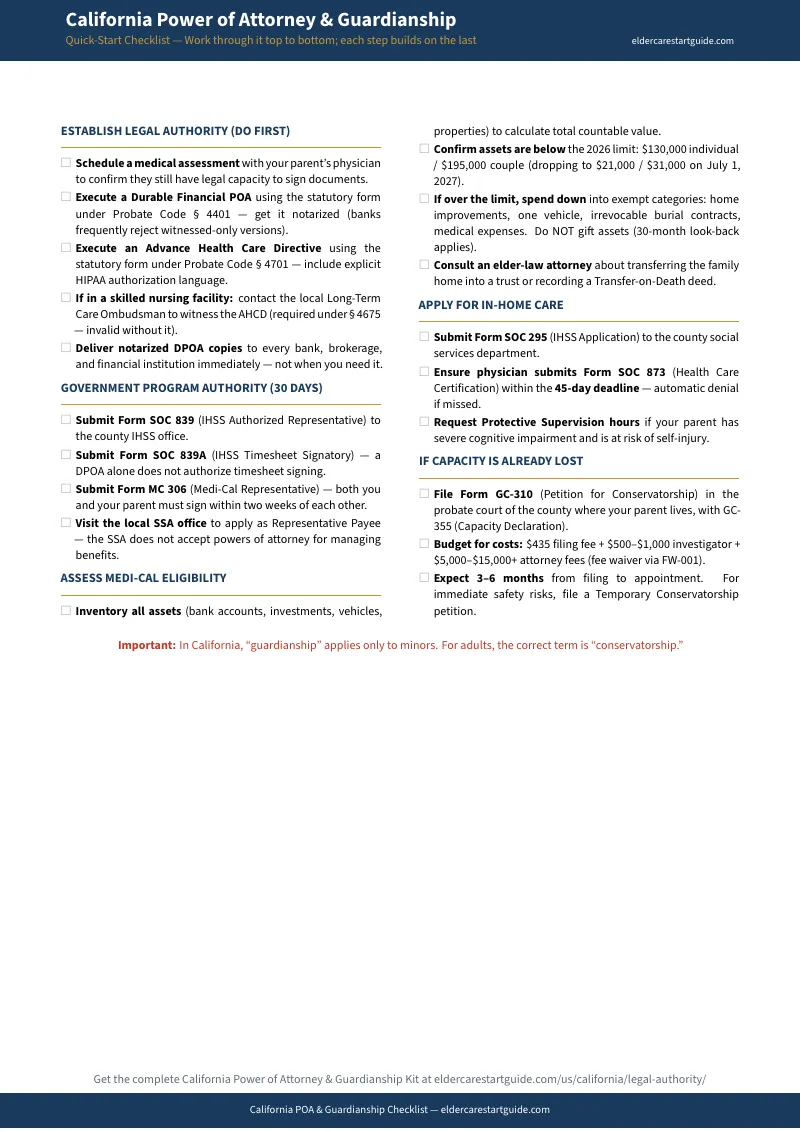
- Quick-Start Checklist (checklist.pdf) — one-page overview of every step, form, and deadline across both the voluntary (POA) and court (conservatorship) pathways
8 Standalone Printable Worksheets
- Capacity Evaluation Worksheet — Probate Code § 811 mental function assessment based on the Andersen v. Hunt sliding scale. Bring to your parent's physician appointment to document their ability to sign POA documents during a clear moment
- Conservatorship Cost Projector — filing fees, court investigator costs, attorney fee ranges, bond premiums, and a step-by-step filing checklist with every GC-series form. Budget the full cost before filing
- Estate Recovery Defense Worksheet — maps which assets pass through probate (exposed to California's MERP) and which bypass it. Covers living trust shielding, TOD deeds, IHSS exemption, caregiver child exemption, and hardship waiver procedures
- Emergency Authority Flowchart — visual decision tree for hospital discharge crises: does your parent have capacity? Is there an existing POA? Which documents to execute first, when to file for temporary conservatorship
- California Elder Law Forms Reference — every form in one place: Probate Code statutory forms, Judicial Council GC-series, SOC 839/839A, MC 306, SSA representative payee application, and POLST. Filing locations and purposes at a glance
- Medi-Cal Eligibility Worksheet — 2026 asset limits ($130,000/$195,000), countable vs. exempt asset inventory, legitimate spend-down strategies, and the July 2027 cliff that cuts limits to $21,000/$31,000
- IHSS Application Guide — step-by-step SOC 295 application, the 45-day SOC 873 deadline, authorized hours by impairment level, family provider enrollment, and in-home assessment preparation tips
- Facility Evaluation Checklist — bring to every RCFE and SNF tour. Research tools (CDSS Care Facility Search, Cal Health Find, Medicare Nursing Home Compare), scoring grid, and complaint filing contacts
Who This Is For
- Adult children who need to manage an aging parent's finances, medical care, or benefit programs in California — and discovered that being next of kin gives them zero legal authority
- Families facing a hospital discharge with no legal authority to sign skilled nursing facility admission paperwork or authorize a care plan
- Caregivers who want to execute POA and healthcare directive documents while their parent still has capacity — before a crisis forces the conservatorship route
- Families whose parent has been diagnosed with dementia and need to understand whether they can still execute documents under California's sliding-scale capacity standard
- Anyone navigating the IHSS enrollment process who was told they need a conservatorship — when SOC 839 designation may be all that's required
- Families trying to protect the family home from Medi-Cal estate recovery and need to understand California's probate-only MERP rules and the available exemptions
- Siblings who need a neutral reference to resolve disagreements about who should hold power of attorney, how to handle a parent who refuses to sign, or whether to pursue conservatorship
Why Free Resources Leave You Stuck
California's Self-Help Center provides the statutory forms. Nolo and LegalZoom generate template documents. But none of them tell you what to do when Chase Bank's compliance department rejects your perfectly valid POA because it wasn't drafted on their preferred form. They don't explain that your standard Financial POA has no authority over IHSS timesheets, Medi-Cal eligibility, or Social Security benefits — each requires its own separate authorization form with its own filing process. They don't walk you through California's sliding-scale capacity standard that could mean your parent with early dementia can still sign a POA today, avoiding a $5,000+ conservatorship proceeding next year.
Elder law attorneys navigate all of this — at $300 to $600 per hour, or $3,000 to $10,000 for a conservatorship. Using this guide to understand which documents your parent actually needs, organize the paperwork, and identify whether your situation requires court involvement can save thousands. For families with straightforward authority needs — parent has capacity, no contested siblings, no complex assets — the guide itself is enough.
Satisfaction Guarantee
If the guide doesn't help you identify at least one legal pathway, authorization form, or asset protection strategy you weren't already aware of, email us for a full refund. No forms, no waiting period.
Start Securing Legal Authority for Your Parent Today
Download the free checklist to get the quick-start overview — or get the full guide for and have every worksheet, form reference, capacity evaluation tool, and step-by-step procedure you need to secure legal authority over your aging parent's care in California.