
Your Parent Is Being Discharged Tomorrow. The Plan Feels Wrong.
The discharge planner says your parent is "medically stable." But they can't stand without help, the medication list has changed four times this week, and nobody has explained who's going to manage wound care at home. The attending physician mentioned something about "observation status" — and now you're learning that the entire hospital stay might not count toward Medicare rehab coverage.
You have less than 48 hours. The hospital wants the bed back. And everything you find online is either a 400-page DHCS policy manual or a lead-gen directory trying to steer your parent into a private-pay nursing home at $12,000 a month.
The California Discharge Protection System
This isn't a generic pamphlet about "planning ahead." It's a structured system for the 48-to-72-hour window when you're in the middle of a discharge crisis — built specifically for California law, California Medi-Cal rules, and the California agencies you'll actually be calling.
The guide gives you the legal framework, decision sequences, and exact scripts to advocate for your parent's safety during every transition: hospital to home, hospital to rehab, rehab to skilled nursing, and the IHSS and waiver pathways that let your parent stay home with professional support. It covers the 2026 Medi-Cal asset limits, the July 2027 cliff, estate recovery protection, POLST, conservatorship, and every form you need to file — organized by the order you'll actually need them.
What's Inside
- The Commence Health Appeal Protocol — Pre-written language and step-by-step process for filing a fast-track appeal with California's BFCC-QIO at 1-877-588-1123. The hospital cannot charge your parent or force them out while the appeal is active — but most families don't know this right exists until the discharge is already happening.
- Observation Status Decision Tree — If your parent was classified "outpatient under observation," Medicare won't cover SNF rehab. This section explains how to identify the misclassification, use the two-midnight rule, request a physician override, and file an appeal through Commence Health or under the permanent Alexander v. Azar ruling.
- CARE Act Compliance Checklist — California's Senate Bill 675 requires hospitals to designate a family caregiver, notify them before discharge, and provide live clinical instruction on every post-discharge care task. This section gives you the exact statutory references to invoke and what to do if the hospital skips a step.
- SNF Vetting Scorecard and Admission Agreement Guide — A structured framework for comparing facilities using Cal Health Find citation data and staffing ratios, plus a clause-by-clause walkthrough of the CDPH Standard Admission Agreement. You'll know exactly which paragraphs to sign, which to cross out (the "responsible party" guarantor clause), and which to refuse outright (mandatory arbitration — prohibited under Health and Safety Code § 1599.81).
- Medi-Cal 2026 Asset Protection Worksheets — The reinstated non-MAGI asset limits explained in plain language: $130,000 individual / $195,000 couple, the 30-month look-back window phasing in through 2028, Community Spouse Resource Allowance of $162,660, and the July 2027 cliff to $21,000/$31,000. Includes a spend-down tracker and the probate-only estate recovery rule that shields assets in funded revocable living trusts.
- IHSS Application and Assessment Preparation — Step-by-step guide to applying for In-Home Supportive Services while your parent is still hospitalized. Covers Form SOC 295, the county social worker's Functional Index Rankings assessment, and the specific forms (SOC 873, SOC 821, SOC 321) that maximize authorized hours — up to 283 hours per month with protective supervision.
- HCBA and Assisted Living Waiver Roadmaps — Complete enrollment pathways for California's two key Medi-Cal waiver programs. The HCBA waiver includes Reserve Capacity priority for parents hospitalized 60+ consecutive days — bypassing the standard waitlist. The ALW covers care in licensed RCFEs across 15 designated counties.
- Hospital-to-Home 72-Hour Timeline — Hour-by-hour tracker for the critical first three days at home: medication reconciliation, DME delivery confirmation, home health intake, follow-up scheduling, and the red flags that require immediate medical attention.
- Legal Authority Quick-Start — DPOA, Advance Health Care Directive, POLST requirements under Senate Bill 1088, and the conservatorship petition process (including Forms GC-310, GC-312, GC-335) when no advance documents exist.
- Dispute Resolution and Escalation Guide — What to do when Medicare denies coverage, a facility attempts involuntary discharge, or a Medi-Cal redetermination goes wrong. Covers the NOMNC appeal process through Commence Health, state fair hearing rights, and the Long-Term Care Ombudsman program.
- Medication Reconciliation Worksheet — Side-by-side comparison form tracking every medication change during hospitalization — pre-admission, hospital changes, and discharge prescriptions — with space for pharmacist notes on interactions and dosing conflicts.
- Emergency Contacts Reference Sheet — One-page printable with every critical number: Commence Health, DHCS, CDSS IHSS office, Long-Term Care Ombudsman, SHIP counselors, county Area Agency on Aging, and fill-in fields for your family's contacts.
Who This Is For
- Adult children in California managing a parent's hospital discharge — especially if the timeline feels rushed or the plan feels incomplete
- Families who need to halt an unsafe discharge and don't know they have the legal right to appeal
- Caregivers comparing rehab, skilled nursing, and home care — and unsure which Medicare or Medi-Cal programs apply
- Anyone starting the IHSS application who wants to maximize authorized hours on the first assessment
- Families navigating the 2026 Medi-Cal asset limits and worried about losing the family home to estate recovery
Why Not Just Use Free Resources?
The DHCS website has the policy manuals. Medicare.gov has the forms. CANHR publishes detailed legal factsheets. But during a medical crisis, you don't need raw policy — you need a decision framework that tells you what to do first, what to say when you call, and which mistakes will cost your family thousands.
Free resources don't tell you that hospitals are financially incentivized to discharge quickly under DRG flat-rate payments, that observation status quietly eliminates your rehab coverage, or that signing a nursing home admission agreement as "responsible party" can make you personally liable for tens of thousands of dollars. State employees at DHCS and county welfare offices are legally prohibited from advising you on how to structure assets for Medi-Cal eligibility — they explain the rules, not the strategy. And lead-gen directories that offer "free senior living guidance" are paid referral commissions by the facilities they recommend, which is why they never mention IHSS, HCBA waivers, or your right to appeal.
This guide organizes California-specific rules into actionable steps you can follow under pressure — from the first notification of discharge through the Medi-Cal application and beyond.
The Alternative Is Expensive
An elder law attorney in California charges $371 to $500+ per hour, with full Medi-Cal planning engagements running $5,000 to $15,000. A private geriatric care manager charges $150 to $300 per hour. A single day of uncovered SNF care runs $350 to $600. This guide doesn't replace legal counsel for complex asset protection — but it prevents the common mistakes that make legal counsel necessary, and gives you the structure to handle the first 72 hours yourself.
Satisfaction Guarantee
If the guide doesn't give you a clearer path forward within the first 24 hours of your parent's discharge, email us for a full refund. No hoops, no forms.
— Less Than One Hour of Professional Advocacy
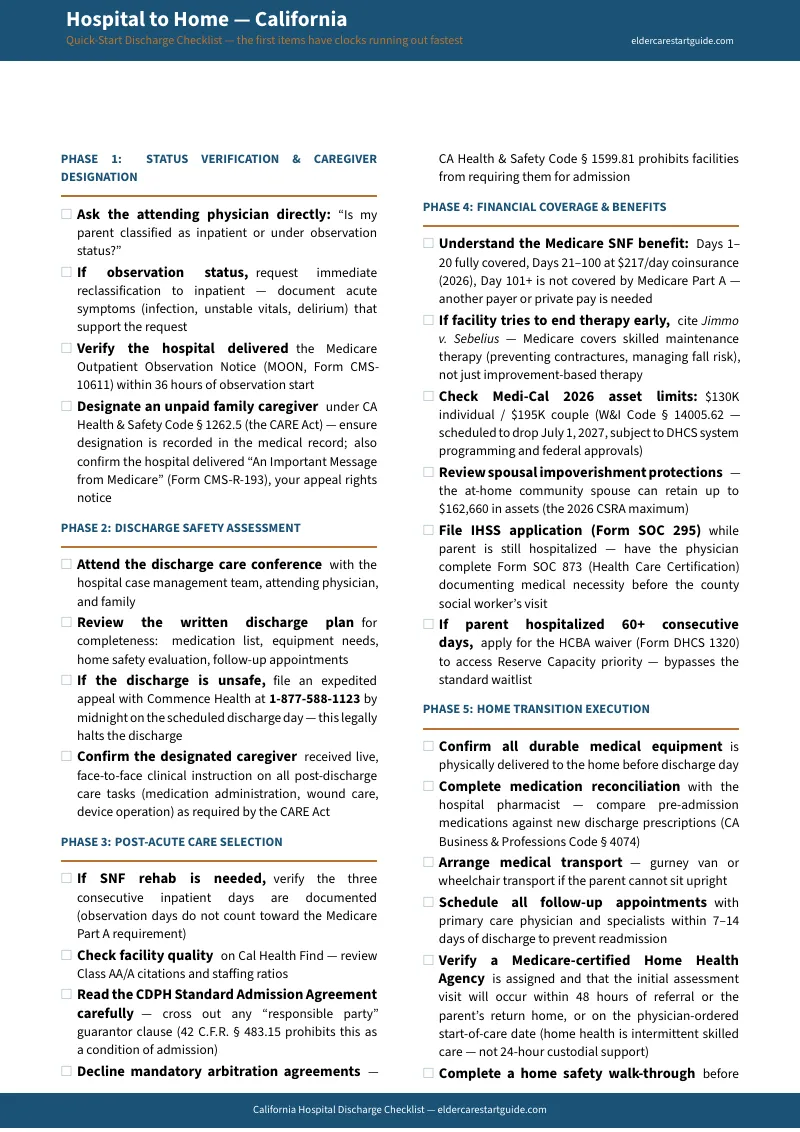
For a fraction of what a single consultation costs, you get the complete system: Commence Health appeal scripts, observation status decision tree, SNF vetting scorecard, IHSS assessment preparation, Medi-Cal financial worksheets, estate recovery protection steps, waiver program roadmaps, and every template you need to navigate your parent's transition safely.
Download the free one-page checklist to see the framework, or get the full guide with all 14 chapters plus 9 standalone printable tools — the discharge appeal worksheet, facility comparison checklist, admission agreement review guide, Medi-Cal asset inventory worksheet, IHSS assessment preparation sheet, medication reconciliation grid, 72-hour timeline tracker, agency communication log, and emergency contacts reference sheet.