Your Parent's Home Care Costs $7,627 a Month. The Assisted Living Waiver Has an 18,000-Person Waitlist. Nobody Told You About the IHSS Protective Supervision Expansion That Covers 283 Hours a Month.
Your parent fell last week. The ER visit turned into an admission, and now the discharge planner is calling every day. They want your parent out in 48 to 72 hours, and they're suggesting an assisted living facility that costs $7,000 a month in Sacramento — or $8,500 in the Bay Area. You started searching for alternatives and hit a wall of referral sites, law firm blogs, and government portals that each give you a different piece of the picture without explaining the order.
Here's the problem nobody mentions during the discharge scramble: California reinstated Medi-Cal asset limits on January 1, 2026, under Assembly Bill 116. The current individual limit is $130,000 in countable assets. That sounds manageable. But starting July 1, 2027, that limit is scheduled to drop to $21,000. Any financial decision you make today needs to account for that cliff, and the 30-month look-back period means transfers you make in the next two and a half years will be scrutinized. Meanwhile, IHSS can authorize up to 283 hours per month of in-home care — including the expanded Protective Supervision category for parents with dementia — but the application requires a Medi-Cal determination first, and that determination requires meeting the asset limits you haven't mapped yet.
The sequence matters more than any individual rule. Get it wrong, and a single disqualifying transfer can trigger a penalty calculated by dividing the transferred amount by California's Average Private Pay Rate of $14,440 per month — turning a well-intentioned gift to a grandchild into months of ineligibility.
The California Care Navigation System
This isn't a summary of Medi-Cal rules you could piece together from DHCS.ca.gov, CANHR fact sheets, and a dozen elder law firm blogs. The California Care Navigation System maps the exact sequence of assessments, screenings, applications, and legal documents your family needs — starting from wherever you are right now — so you don't spend down savings, commit to a facility, or skip a critical program because you did things in the wrong order.
The most common mistake California families make: they accept a facility placement before screening for IHSS and the Assisted Living Waiver. They drain savings toward the $130,000 limit without realizing the 2027 cliff requires planning for $21,000. They assume "next of kin" gives them legal authority and discover at the bank or the facility intake office that without a Durable Power of Attorney and an Advance Health Care Directive, they can't sign admission papers, access medical records, or pay care bills from their parent's accounts. And by the time they learn a Power of Attorney must be signed while the parent still has mental capacity, it may be too late for anything short of a probate court conservatorship.
The guide puts you in the right order: assess functional decline, establish legal authority while you still can, map every care option from IHSS through skilled nursing, understand what's countable and what's exempt under the 2026 rules, screen for the Assisted Living Waiver and MSSP before committing to private-pay placement, protect the family home from estate recovery, and know exactly when free resources end and professional help begins.
What You Get — 8 PDFs
- 15-Chapter California Care Decision Guide — The complete California Care Navigation System: recognizing decline, every care option (IHSS, board-and-care homes, assisted living RCFEs, memory care, skilled nursing), facility vetting through the CDSS Community Care Licensing Division, the 2026 Medi-Cal asset rules and 2027 cliff, spousal impoverishment protections ($162,660 community spouse resource allowance), the 30-month look-back period, IHSS mechanics including the Protective Supervision expansion, Assisted Living Waiver and MSSP, estate recovery protection under SB 833, legal authority (DPOA, AHCD, conservatorship), hospital discharge rights and the Commence Health appeal process, the long-term care ombudsman, Area Agencies on Aging, and professional referral thresholds. Every dollar figure reflects 2026 California regulations.
- Care Options Comparison Table — Every California care level on one landscape sheet: who it serves, oversight agency, 2026 costs, payment sources, and typical wait times. Plus regional cost variation across seven metro areas. Print and bring to family meetings or discharge conversations.
- Facility Tour Checklist — Licensing checks, staffing questions, environment walk-through items, care communication questions, and contract red flags to review during every in-person facility visit.
- Financial Snapshot Worksheet — Map income, countable assets, exempt assets, and spousal protections against the 2026 Medi-Cal limits. Includes the care runway calculator so you know how many months of private-pay care your parent's savings will cover.
- Legal Authority Checklist — Track which legal documents are in place (DPOA, AHCD, POLST, trust, TOD deed), with California-specific execution requirements and a distribution checklist for certified copies.
- 90-Day Placement Timeline — The complete enrollment workflow from safety assessment through facility transition, organized into seven milestone phases you can post on the fridge and check off as you go.
- Forms and Resources Directory — Every California eldercare form (SOC 295, MC 210, GC-310, and more), key websites (CDSS facility search, CDPH Cal Health Find), and phone numbers on one printable reference sheet.
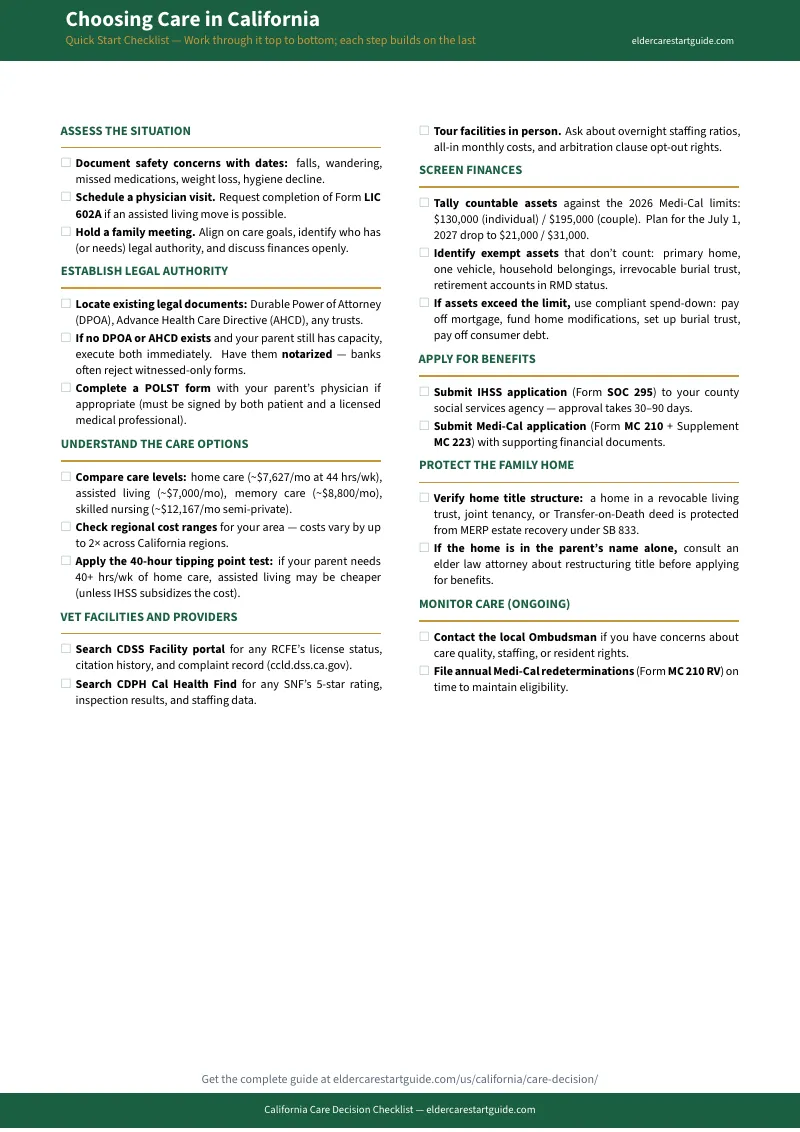
- Quick-Start Checklist (Free Download) — 20 actionable items organized across 7 sections: situation assessment, legal authority, care options, facility vetting, financial screening, home protection, and ongoing quality monitoring. Know exactly what to do tonight, this week, and this month.
Who This Guide Is For
- Adult children in California whose parent has had a fall, a hospitalization, or a noticeable cognitive decline — and who need to choose the right level of care before the next crisis forces a decision under pressure
- Families navigating the 2026 Medi-Cal asset limit reinstatement who need to understand what's countable, what's exempt, and how to plan for the July 2027 threshold drop to $21,000
- Caregivers comparing IHSS home care, the Assisted Living Waiver (with its 18,000-person waitlist), board-and-care homes, assisted living, and skilled nursing across different California regions — from $4,200 a month in the Central Valley to $8,500 in the Bay Area
- Anyone facing a hospital discharge timeline of 48–72 hours who needs to know their legal right to appeal through Commence Health and how to evaluate a post-acute facility's citation history before agreeing to a transfer
- Out-of-state siblings coordinating a California parent's care remotely and needing every DHCS, CDSS, AAA, and ombudsman contact in one place
Why Free Information Isn't Getting You Anywhere
DHCS.ca.gov publishes the official Medi-Cal eligibility guidelines. The numbers are accurate. But they don't tell you the sequence. They don't explain that screening for IHSS and the Assisted Living Waiver before committing to a nursing home can save the difference between $1,420 a month in ALW room-and-board and $12,167 a month in private-pay skilled nursing. They don't warn you about the 2027 asset limit cliff or explain which transfers made during the 2024–2025 zero-asset-test window are permanently protected from look-back penalties.
A Place for Mom and Caring.com rank well on Google, but their business model is referral commissions from contracted facilities. They are structurally incentivized to move your parent into a private-pay placement, not to help you navigate IHSS, the ALW waitlist, or small board-and-care homes that don't pay referral fees. They will never mention that a six-bed RCFE in a residential neighborhood costs $3,000 to $6,000 a month when their commission depends on steering you toward a $7,000 to $8,500 community.
California elder law attorneys publish helpful blog posts that end with a call to schedule a $300 to $500/hour consultation. A comprehensive Medi-Cal planning package runs $5,000 to $15,000. Their content is a loss-leader designed to sell legal services, not to give you a complete, executable sequence you can work through before deciding whether you need an attorney at all.
This guide fills the gap between the government portal that gives you rules without sequence, the referral site that steers you toward placements you may not need, and the law firm that gives you sequence only through a five-figure retainer.
Satisfaction Guarantee
If this guide doesn't give you a clear, actionable path to choosing and paying for your parent's care in California, email [email protected]. We read every message.
— Less Than One Hour of an Elder Law Attorney's Time
California elder law attorneys charge $300 to $500 per hour. A Medi-Cal planning package runs $5,000 to $15,000. A single procedural mistake — a look-back penalty triggered by a gift during the 30-month window, an IHSS application filed without a valid Medi-Cal determination, a facility placement accepted without checking the CDSS citation database — can cost months of eligibility and tens of thousands of dollars in private-pay care.
This guide won't replace an attorney when you need one (and it tells you exactly when that is). But it will save you hours of research, prevent the most expensive mistakes, and ensure you walk into any conversation — with the county IHSS office, the facility admissions coordinator, your local Area Agency on Aging, or an elder law firm — knowing exactly what California law requires.
Download the free Quick-Start Checklist to see the 20 most urgent action items. When you're ready for the complete system, the full guide is waiting.