
Your Parent Needs Help. Arkansas Law Says You Can't Touch Anything.
You've been driving your parent to every doctor's appointment, picking up their prescriptions, calling the electric company when the bill is late — and then the bank freezes their account because you're "not an authorized signer." The DHS caseworker tells you she can't process the ARChoices application because you have no legal standing to sign the DCO-152. The hospital won't share a diagnosis because HIPAA doesn't care that you're family.
Being next of kin gives you zero legal authority in Arkansas. Not over bank accounts. Not over medical records. Not over care placement. Until you have the right documents executed correctly under Arkansas law, every institution that matters will lock you out.
The Arkansas Legal Authority System
This isn't a stack of blank forms with a cover page. The Arkansas Legal Authority System maps the exact sequence of filings, signings, and registrations you need — starting from wherever you are right now.
If your parent still has cognitive capacity, the kit walks you through executing the Durable Financial Power of Attorney under the Uniform Power of Attorney Act (A.C.A. Title 28, Chapter 68) — including the "hot powers" that must be individually initialed under § 28-68-301. Miss even one, and your Medicaid planning strategy fails before it starts. You also get the Healthcare Power of Attorney with the exact two-witness attestation required under § 20-6-103, the HIPAA release, and the living will.
If capacity is already gone, the kit covers the full court pathway: filing a guardianship or conservatorship petition in the Circuit Court, the mandatory medical evaluation, the court-appointed Attorney Ad Litem, emergency temporary guardianship for imminent danger, and the annual reporting cycle that follows.
What You Get — 12 PDFs
- The Complete Arkansas POA & Guardianship Guide — 15 chapters covering both legal pathways, from the initial capacity assessment through ongoing court reporting. Every form reference, witness rule, filing fee, and deadline is Arkansas-specific.
- DPOA Execution Checklist — Print-and-bring checklist for executing the statutory form power of attorney, including every "hot power" that must be individually initialed for Medicaid planning.
- Healthcare Directive Checklist — Step-by-step for the Advance Care Plan (Healthcare POA + Living Will), HIPAA release, and POLST form, with witness restrictions and distribution list.
- Capacity Assessment Framework — The decision tree that determines your parent's entire legal path: voluntary POA if capacity exists, court guardianship if it doesn't, with a clinical documentation checklist.
- Guardianship Filing Checklist — Every step of the Circuit Court guardianship process: petition, clinical evaluation, service of notice, hearing, bond, and Letters of Guardianship.
- Conservatorship Checklist — The voluntary alternative when your parent can consent but cannot physically manage finances, with a side-by-side comparison to guardianship.
- ARChoices & Medicaid Application Checklist — The complete DHS application process: legal standing, financial eligibility, 60-month document gathering, Miller Trust, functional assessment, and service plan.
- Medicaid Eligibility Quick Reference — The 2026 financial thresholds on one page: income cap, asset limits, CSRA, MMMNA, home equity exemption, and a fillable section for your parent's numbers.
- Official Forms Directory — Every form referenced in the guide with its source agency and where to get it, plus key agency contact numbers. Print it and keep it in your care binder.
- Post-Appointment Deadlines — The reporting calendar every guardian must follow: inventory within 60 days, annual financial accounting, annual personal report, with a fillable section for your appointment dates.
- Emergency Procedures — What to do when your parent is in immediate danger: emergency contacts, OLTC complaint filing, and the emergency guardianship petition process with the 90-day limitation.
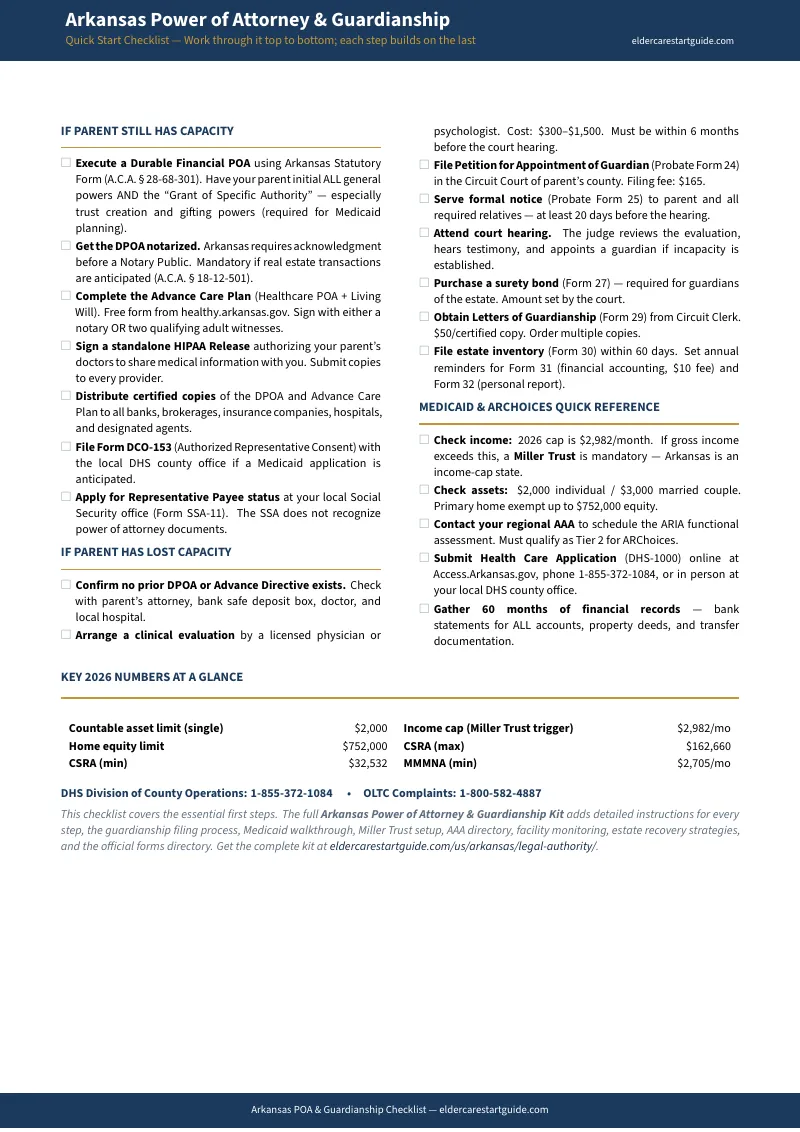
- Quick-Start Checklist (Free Download) — 20 actionable items organized by four scenarios: capacity intact, capacity lost, Medicaid application, and emergency. Know exactly what to do tonight, this week, and this month.
Who This Kit Is For
- Adult children in Arkansas who need legal authority to manage an aging parent's healthcare, finances, or living arrangements
- Families facing a hospital discharge with no signed POA — and a care facility demanding someone "authorized" to sign admission paperwork
- Caregivers told their parent has early-stage dementia who want to execute documents while the capacity window is still open
- Families whose parent has already lost capacity and must navigate the Circuit Court guardianship process
- Anyone trying to apply for ARChoices, Living Choices, or nursing facility Medicaid and being told by DHS they lack legal standing
Why Free Online Forms Aren't Enough
Yes, Arkansas provides blank statutory forms. The forms are not the problem. The problem is that a blank form doesn't tell you:
- Which "hot powers" to initial — and what happens when you skip one that your Medicaid planning strategy requires
- That your healthcare POA witnesses cannot be the designated agent, and at least one must be unrelated by blood, marriage, or adoption and not entitled to any portion of your parent's estate
- How to handle a parent who has good days and bad days — the "lucid interval" signing strategy and how to build a capacity paper trail
- That the Social Security Administration will reject your state POA and require a completely separate Representative Payee appointment
- How to sign a facility admission contract as an agent without accidentally making yourself personally liable for the bills
The gap between having a form and having a system is the gap between a document that gets rejected at the bank and one that works the first time you present it.
Satisfaction Guarantee
If the kit doesn't give you a clear, actionable path to legal authority for your parent in Arkansas, email [email protected]. We read every message.
— Less Than One Hour of an Elder Law Attorney's Time
Arkansas elder law attorneys charge $200–$500 per hour. A standard estate planning package runs $3,500 or more. A contested guardianship case can cost upwards of $10,000 in legal fees alone.
This kit won't replace an attorney when you need one — and it tells you exactly when that is (Chapter 13). But it will save you hours of scattered research, prevent the filing mistakes that get documents rejected, and ensure you walk into any conversation — with a bank, a DHS caseworker, a hospital, or a lawyer — knowing exactly what Arkansas law requires.
Download the free Quick-Start Checklist to see the 20 most urgent action items. When you're ready for the complete system, the full kit is waiting.