
The Hospital Says Your Parent Is Ready to Leave. You Know They're Not.
Your parent went into Banner, HonorHealth, Dignity Health, or one of Arizona's tribal or rural hospitals after a fall, a stroke, or a sudden decline. Now a discharge planner is telling you the acute stay is ending — often within 24 to 48 hours. And you're the one who has to figure out what happens next.
Where do they go? Will Medicare cover rehab? Why does the nurse keep saying "observation"? Can the hospital really send a frail parent home to a house with no grab bars and no caregiver lined up? What if they need a care home — and how would you pay for it without draining every dollar they've saved?
Hospital social workers are pressed to clear the bed. Arizona's state portals hand you regulatory definitions, not action plans. Elder law attorneys charge $300–$500 an hour. And the national "senior living advisor" sites earn commissions from the facilities they recommend — they'll never tell you how to file a Medicare appeal or refuse a guarantor signature.
The Arizona Discharge Defense System
This toolkit replaces the panic with a step-by-step system built for Arizona families — not a national Medicare overview with "Arizona" pasted in. Arizona appeal contacts, ALTCS thresholds, the Pre-Admission Screening process, and Arizona's own legal authority statutes, organized in the order a crisis actually unfolds.
It's built for the adult child who became the family's care coordinator overnight — whether you're in Maricopa County, Pima County, or managing everything from another state while your parent sits in a hospital room a time zone away.
What's Inside
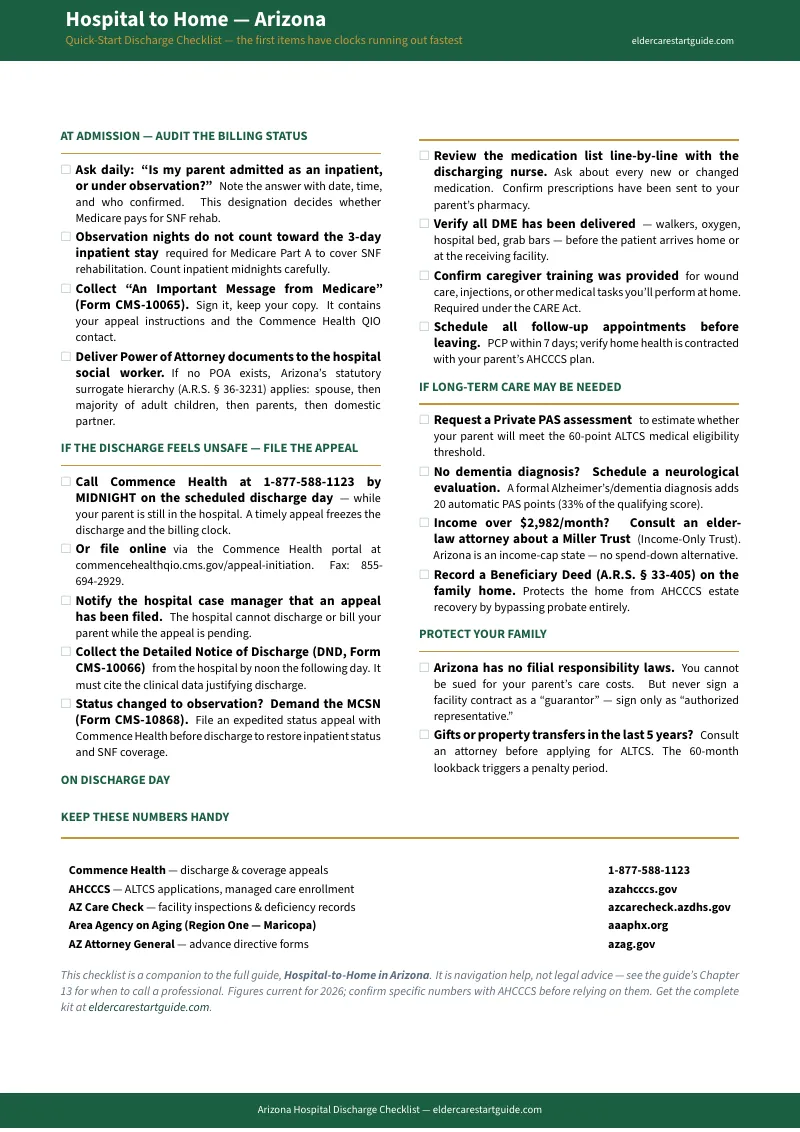
The complete toolkit includes a 14-chapter guide, a quick-start checklist, and 8 standalone printable worksheets — 10 PDFs total.
Discharge Appeal Scripts
The exact process to challenge an unsafe discharge through Commence Health, Arizona's federally contracted BFCC-QIO, including the direct appeal line (1-877-588-1123), the midnight-of-discharge filing deadline, and the automatic stay that halts the discharge — and stops the billing clock — while a QIO physician reviews the case. Plus word-for-word scripts for demanding a care-team meeting and a written discharge plan. Included as a standalone printable you can bring to the hospital bedside.
The Observation Status Trap — and How to Escape It
If your parent spent three nights in a hospital bed but was classified as "observation" instead of "inpatient," Medicare Part A won't cover a single day of skilled nursing rehab — because observation days don't satisfy the three-midnight rule. The MOON notice you were handed is the warning sign. This section explains how to verify status, the script for asking the attending physician to write an inpatient order, the CMS-10868 Change of Status Notice, and how to file a fast appeal before a recovery turns into a five-figure bill. Included as a standalone bedside reference card.
The "Responsible Party" Refusal Template
Skilled nursing admissions coordinators routinely push adult children to sign as the "Responsible Party" or "guarantor." Here's what they don't tell you: Arizona has no filial responsibility law — adult children cannot be legally compelled to pay a parent's care bills — and federal law (42 USC § 1396r) bans any Medicaid-certified facility from requiring a third-party payment guarantee as a condition of admission. This section gives you the exact wording to write on the contract so you sign solely as agent under Power of Attorney, with zero personal liability. Included as a standalone printable to bring to facility admission.
The ALTCS Eligibility Workbook
Arizona's Long-Term Care System (ALTCS) is the single managed program that funds nursing home stays, assisted living, and home-based care — but it requires passing both a financial screen (2026 limits: $2,000 countable assets, $2,982/month income cap) and a 60-point Pre-Admission Screening. This fillable workbook walks through both tracks: what counts as a countable asset, how to set up a Miller Trust if income exceeds the cap, spousal impoverishment protections allowing a community spouse to keep up to $162,660, and how to prepare for the PAS so the screener sees the worst days, not the best. Included as a standalone printable workbook.
ALTCS-Pending Placement Strategy
Your parent needs a care home, but the ALTCS application takes 60 to 90 days. Larger assisted living communities reject ALTCS-pending residents unless you can pay privately for 3 to 36 months. This section explains the smaller residential adult care home model — facilities that are far more likely to accept ALTCS-pending clients with only a 2-month private-pay deposit — and gives you the negotiation script and the ALTCS managed care plan contacts (Mercy Care, Banner–University Family Care, UnitedHealthcare) to arrange retroactive reimbursement.
Estate Protection Checklist
After a parent on ALTCS passes, the state can seek reimbursement from their estate for every dollar Medicaid paid. This section covers the Arizona Beneficiary Deed (A.R.S. § 33-405) to transfer the home outside probate, TEFRA lien rules, the spousal and dependent-child recovery exemptions, and the small-estate affidavit threshold (A.R.S. § 14-3971) — the tools that protect the family home when used before the crisis, and the limits of what you can do once it's already underway. Included as a standalone printable checklist.
Arizona Resource Directory
Every contact you'll need: Commence Health's QIO line and online portal, all of Arizona's Area Agencies on Aging (including the Pima Council on Aging, Area Agency on Aging Region One, and the Inter Tribal Council of Arizona), AHCCCS and ALTCS intake, ADHS facility license lookup (AZ Care Check), the Long-Term Care Ombudsman, and non-emergency medical transport — all on one printable page.
Discharge Planner Questions
14 structured questions to ask the discharge planner before agreeing to anything — covering admission status, discharge readiness, post-discharge coordination, equipment, and what to say if you disagree with the discharge. Included as a standalone printable to bring to the discharge meeting.
Medication Reconciliation Worksheet
The highest-risk window for medication errors is the first 48 hours at home. This fillable worksheet helps you compare pre-hospital and discharge medications side by side, verify prescriptions with the pharmacy, and create a single updated medication list. Included as a standalone printable.
Who This Is For
- Adult children in Arizona managing a parent's hospital discharge — first time or fifth time, the pressure is the same
- Out-of-state family members coordinating remotely for a parent in Phoenix, Tucson, Scottsdale, Mesa, Chandler, Gilbert, or rural and tribal Arizona
- Families facing the observation-status surprise who just learned Medicare won't pay for rehab
- Families approaching ALTCS who need to understand the financial and medical eligibility screens before savings run out
- Families worried about estate recovery who want to protect the family home
Why Free Tools Don't Cover This
National sites like A Place for Mom and Caring.com maintain large facility directories — but their business model depends on routing your phone number to sales advisors who earn commissions from placements. They won't tell you how to file a Medicare appeal, prepare for the ALTCS screening, or refuse a guarantor signature.
Medicare.gov and AARP explain federal discharge rights accurately — but in abstract language that never connects to Commence Health's Arizona phone number, your regional Area Agency on Aging, or the specific ALTCS thresholds that apply here.
Arizona's own AHCCCS and ADHS pages contain the real rules — scattered across dozens of dense administrative pages that are nearly impossible to parse when you're standing in a hospital hallway deciding where your parent will sleep tomorrow.
This toolkit connects those fragmented pieces into a single action plan with the Arizona-specific details already filled in.
Satisfaction Guarantee
If the toolkit doesn't give you the clarity and confidence to manage your parent's transition, email us for a full refund. No forms, no hoops, no time limit.
— Less Than a Single Hour of Professional Help
An Arizona elder law attorney charges $300–$500 per hour. A geriatric care manager runs $150–$250 per hour. An ALTCS planning firm charges $2,000–$5,000. This toolkit handles the procedural and administrative work you can do yourself, and tells you exactly when it's time to bring in a professional.
Download the free Arizona Hospital Discharge Checklist to start, or get the complete toolkit with the full guide, worksheets, scripts, and Arizona resource directory.