Your Parent Has Dementia — And Arizona Runs a System No Other State Uses
The diagnosis hits, and within days you're drowning in acronyms: ALTCS, AHCCCS, PAS, QIT, HB 2764. You search for "memory care Arizona" and get ads from placement agencies collecting commissions from the facilities they recommend. You call AHCCCS and receive a 47-page policy manual. You ask a neighbor who went through it and they say "get an elder law attorney" — but the retainer is $6,000 to $15,000, and you don't even know what questions to ask yet.
Meanwhile, the situation at home is escalating. Your parent wandered out the front door at 2 AM last Tuesday. They left the stove on twice this month. They refuse to shower. You're documenting behaviors you never imagined writing down, and you have no idea whether any of it matters for the state assessment that determines if Arizona will pay for care.
Here's the problem no one tells you: Arizona's long-term care system works nothing like other states. There is no separate nursing home Medicaid and home care waiver to choose between. Everything runs through ALTCS — a single managed-care program with one application, one clinical screening, and one set of financial rules. If you don't understand this structure, you will either pay $5,400+ per month out of pocket indefinitely or get denied and not understand why.
The ALTCS Dementia Navigator: One Clear Path Through Arizona's Entire System
The Arizona Dementia & Memory Care Guide translates Arizona's unique long-term care system into a single step-by-step plan built specifically for families navigating a dementia or Alzheimer's diagnosis. It starts with securing legal authority while your parent still has capacity, walks through documenting care needs for the PAS clinical screening, covers the Miller Trust workaround for over-income families, and ends with choosing a facility that meets Arizona's new memory care licensing standards.
This is not a generic national guide with "check your state's Medicaid rules" footnotes. Every threshold, form reference, and regulatory citation is specific to Arizona's 2026 programs.
What's Inside
ALTCS Eligibility Decoded — Arizona's 2026 financial limits laid out plainly: $2,982/month gross income cap, $2,000 countable asset limit for individuals, $162,660 Community Spouse Resource Allowance for married couples. The guide explains what counts as a "countable" resource, what's exempt (your parent's primary home up to $752,000 in equity, one vehicle of any value), and how to identify gaps between where your parent stands and what ALTCS requires.
PAS Score Self-Assessment Worksheet — the Pre-Admission Screening is the clinical gatekeeper that decides whether Arizona considers your parent sick enough for long-term care. You need 60 points. A formal dementia diagnosis is worth 20. The remaining 40 come from documented ADL deficits (bathing, dressing, transferring, toileting) and behavioral challenges (wandering, aggression, resistiveness, disorientation). The guide includes a self-scoring worksheet based on the official AHCCCS criteria — so you can estimate your parent's score and know exactly which behaviors to document before the state assessor arrives.
The Miller Trust Blueprint — if your parent's gross monthly income exceeds $2,982, Arizona says they're ineligible. Full stop. No spend-down allowed. But there's a legal workaround: a Qualified Income Trust (also called a Miller Trust). The guide walks through the exact banking and legal steps — opening a zero-balance trust account, routing your parent's Social Security and pension through it, and satisfying AHCCCS's monthly reporting requirements. For many families, this single chapter saves the cost of a $3,000+ elder law consultation.
Memory Care Facility Audit Checklist — Arizona licenses memory care under "Directed Care Services," the highest tier of assisted living licensing. Under HB 2764, facilities must provide 8 hours of initial dementia training per staff member, 4 hours annually, run elopement drills twice a year, and maintain secured physical layouts. The guide gives you the exact questions to ask facility managers, shows you how to check their citation history through the ADHS License History Search database, and explains what each licensing level (Supervisory, Personal, Directed) actually means for your parent's daily care.
Legal Authority Action Plan — three documents can prevent a $10,000+ guardianship proceeding: Healthcare POA, Mental Health Care POA (A.R.S. § 36-3281 — unique to Arizona, authorizes inpatient psychiatric admission), and Durable Financial POA. The guide covers execution requirements, the capacity standard from Goelleher v. Horton, and what to do during lucid intervals if dementia has already progressed. It also covers the orange-paper DNR requirement — Arizona's specific rule that a Do Not Resuscitate form must be printed on orange paper and posted visibly for first responders to honor it.
Estate Recovery Defense Strategies — after your parent dies, AHCCCS will file claims against their probate estate to recoup long-term care costs. The guide covers which assets are vulnerable, how a Beneficiary Deed transfers the home outside probate, the caregiver child exemption (two years of in-home care before placement can shield the property), and the 60-month lookback rules for prior asset transfers.
Caregiver Compensation Through ALTCS — once your parent is enrolled, ALTCS's Home and Community Based Services can pay a family member as the in-home caregiver. The guide covers how to request this through the health plan, typical pay rates, and training requirements. For families managing care at home, this turns unpaid labor into a funded arrangement.
Arizona Safety Programs — enrollment in the SAFE Alert system (Arizona's updated Silver Alert, renamed September 2025), the Area Agency on Aging respite voucher program ($2,400 for families not on ALTCS), and the Arizona Caregiver Coalition's Adult Day Health Center Respite Program (up to 150 hours annually).
10 Standalone Printable Worksheets — pull out what you need and bring it with you. Included: PAS Score Self-Assessment (pas-self-assessment.pdf), ALTCS Financial Eligibility Tracker (financial-eligibility-tracker.pdf), Miller Trust Setup Checklist (miller-trust-setup.pdf), Memory Care Facility Audit (facility-audit.pdf), Legal Authority Checklist (legal-authority-checklist.pdf), Estate Recovery Risk Assessment (estate-recovery-assessment.pdf), Caregiver Compensation Request Template (caregiver-compensation-template.pdf), Home Safety Audit (home-safety-audit.pdf), Emergency Contact and Key Numbers Sheet (emergency-contacts.pdf), and a Family Decision Framework (family-decision-framework.pdf) for resolving sibling disagreements with clinical criteria instead of opinions.
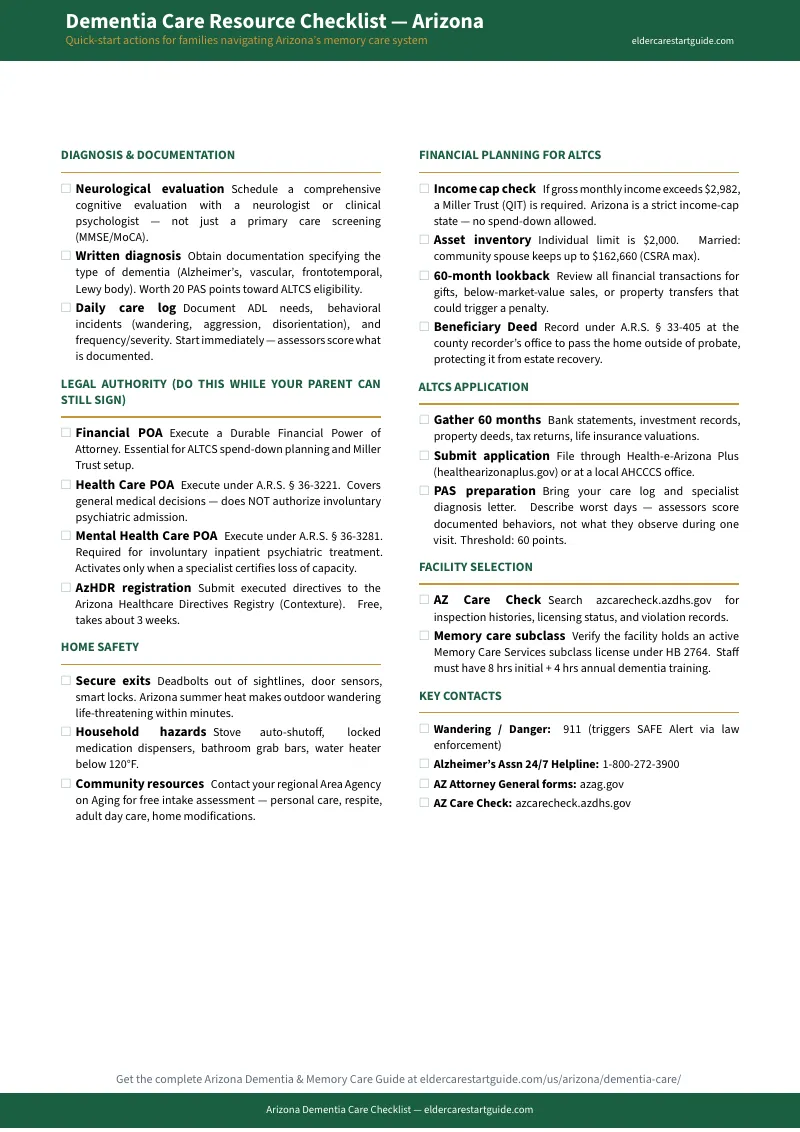
Plus: The Arizona Dementia Care Checklist — a one-page printable reference with every critical action item, program contact, regulatory reference, and deadline in priority order.
Who This Is For
- The adult child facing a fresh diagnosis — your parent was just diagnosed with Alzheimer's or dementia and you need to understand legal authority, safety planning, and the ALTCS timeline before capacity fades further
- The family caregiver at the breaking point — you've been managing everything at home and it's no longer sustainable, but you don't know whether ALTCS will pay for placement or how to find a facility that's actually licensed for memory care
- The "over-income" family — someone told you your parent earns too much for Medicaid and you assumed that was final, but you haven't heard about the Miller Trust
- The sibling group stuck in disagreement — one sibling wants to keep your parent home, another is pushing for placement, and no one has legal authority to make decisions. You need the PAS scoring criteria to ground the discussion in clinical reality
- The family staring at a hospital discharge deadline — the discharge planner says your parent can't go home and you have 48 to 72 hours to find a placement, understand payment, and figure out who has the authority to sign
- The long-distance child — your parent lives in Arizona and you're coordinating from another state, needing every program, threshold, and contact number in one place
Why Not Piece It Together for Free?
AHCCCS publishes its policies online. The ADHS facility database is searchable. Arizona's POA statutes are in the public record. The information exists — but it's written in regulatory language, scattered across seven different state agency websites, and organized by bureaucratic category rather than by what you actually need to do next.
The state doesn't tell you that your parent's "bad day" behaviors are the ones you should be documenting for the PAS assessment. It doesn't explain that being $100 over the income limit doesn't mean you're locked out — it means you need a Miller Trust. It doesn't warn you that HB 2764 created specific licensing tiers and that not every "memory care" facility actually holds the directed-care license.
"Free" referral services like A Place for Mom earn placement commissions of 50–100% of the first month's rent. They will recommend the facilities in their network — not the ones that accept ALTCS, not the ones with the cleanest inspection records, and certainly not the option of keeping your parent at home with paid family caregiving through ALTCS.
An elder law attorney charges $300–$500 per hour, with comprehensive ALTCS planning packages running $6,000–$15,000. If your parent's estate is complex, you may need one. But the guide ensures you walk into that first consultation with organized records, a clear understanding of what ALTCS requires, and specific questions to ask — rather than paying $400 an hour while the attorney explains the basics.
The Arizona Dementia & Memory Care Guide is 100% independent — no placement commissions, no facility partnerships, no sponsored recommendations. It organizes Arizona's public system into one clear action plan for .
100% Satisfaction Guarantee
If the guide does not help you navigate Arizona's dementia care system more confidently, email us for a full refund. No conditions, no time limit.