
You Know Something Is Wrong. You Don't Know What to Do Next.
Your parent fell again last week. The fridge is full of expired food. The mail is piling up. You can see the decline — but every time you try to research what comes next, you end up drowning in AHCCCS policy manuals, facility sales pitches, or lead-gen sites that want your phone number before they'll show you a single option.
Meanwhile, the decisions keep stacking up: Is home care enough, or do they need a facility? What's the difference between assisted living and skilled nursing? Can ALTCS actually pay for any of this? And is it true the state can take the house?
The Arizona Care Decision System
This is a structured assessment-to-placement system built specifically for Arizona families deciding what level of care an aging parent needs. It doesn't give you a list of "senior living options" and leave you to figure out the rest. It walks you through each decision in order — clinical assessment, care level comparison, facility vetting, financial eligibility, legal documentation, and asset protection — using Arizona's own regulatory framework, cost data, and agency contacts.
Arizona's care system works differently from most states. Instead of separate Medicaid nursing home and community waiver programs, Arizona runs a single managed system called ALTCS through AHCCCS. That means one application, one set of eligibility rules, and one program that covers everything from home care to skilled nursing — but also a more complex qualification process that trips up families who follow generic national advice.
What's Inside
- Clinical Assessment Framework — A self-scoring ADL worksheet modeled on Arizona's Pre-Admission Screening (PAS) tool. It breaks the 60-point functional, cognitive, and behavioral scoring matrix into clear questions so you can estimate whether your parent meets the clinical threshold before you involve a caseworker.
- Care Level Comparison Engine — Side-by-side breakdowns of home care ($35/hour average), adult day care ($95/day), assisted living ($6,250/month average), and skilled nursing — with Arizona-specific data showing where costs cross over and when 24/7 home care actually exceeds residential care.
- Facility Vetting via AZ Care Check — Step-by-step instructions for using the ADHS AZ Care Check portal to search inspection histories, enforcement actions, civil penalties, and Statements of Deficiencies. Includes a comparison scorecard for evaluating both large Assisted Living Centers (11+ beds) and small Assisted Living Homes (10 or fewer) across staffing, licensing level, and complaint history.
- ALTCS Eligibility and Application Guide — The complete qualification path: income limits ($2,982/month), asset limits ($2,000 countable), the PAS medical threshold, the 60-month lookback audit, and step-by-step instructions for the ALTCS application. Covers what ALTCS pays for (care) and what it doesn't (room and board in assisted living).
- Miller Trust Setup — If your parent's income exceeds the ALTCS cap, Arizona law allows a Qualified Income Trust to redirect excess income and maintain eligibility. This section covers the mechanics: when a Miller Trust is needed, what it must contain, and how to set it up correctly.
- Estate Recovery and Asset Protection — Arizona's AHCCCS estate recovery program is limited to the probate estate. This section explains how the Arizona Beneficiary Deed (A.R.S. § 33-405) allows property to transfer outside probate at death, plus the Community Spouse Resource Allowance rules that protect a married couple's assets.
- The Three Powers of Attorney — Arizona requires three separate legal documents: Financial, Healthcare, and Mental Healthcare POAs. The critical distinction: a standard healthcare power of attorney does not grant authority to place an unwilling parent in memory care or behavioral health. Without a Mental Healthcare POA, you may face emergency guardianship proceedings costing thousands of dollars.
- Hospital Discharge Crisis Protocol — A 72-hour action plan for when your parent is hospitalized and the discharge planner says "we need the bed." Covers discharge coordination requirements, the 48-hour facility contact window, your appeal rights, and what to demand before signing any discharge paperwork.
- Respite and AAA Directory — A complete directory of Arizona's regional Area Agencies on Aging with direct helplines, including Maricopa's 24-hour Senior Help Line. Covers free programs (caregiver respite, meals, elder abuse prevention) and how ALTCS HCBS waivers cover respite care to prevent caregiver burnout.
- Special Situations Guide — Protocols for the hardest scenarios: a parent who refuses care, dementia-related wandering or aggression, sibling disagreements about placement, and what happens when you discover unsafe living conditions and need to act immediately.
Who This Is For
- Adult children in Arizona who can see their parent declining but don't know whether home care, assisted living, or nursing care is the right level
- Families facing a sudden care crisis — a fall, a hospitalization, a cognitive event — who need to make placement decisions under pressure
- Caregivers who are burning out and need to evaluate whether transitioning to professional care is the right call
- Anyone starting the ALTCS application process who wants to avoid the financial and documentation mistakes that cause denials and delays
- Families trying to protect a parent's home and assets while qualifying for state-funded long-term care
Why Not Just Use Free Resources?
The AHCCCS website has the ALTCS policy manual — all 800+ pages of it. The ADHS portal lists licensed facilities. Medicare.gov has nursing home ratings. But none of these tools tell you what to do first, what each decision costs your family, or which mistakes trigger a five-year penalty period on your parent's ALTCS application.
And the "free" placement sites? A Place for Mom, Caring.com, and similar referral networks earn $3,000–$8,000 per placement commission from the facilities they recommend. They're not showing you every option — they're showing you the ones that pay them. They rarely mention ALTCS-funded placements, adult day care, or the home care path, because those don't generate referral fees.
This guide organizes Arizona-specific rules, costs, and agency contacts into a decision sequence you can follow under pressure — from the first signs of decline through placement, financial qualification, and legal protection.
The Alternative Is Expensive
An elder law attorney in Arizona charges $350–$500 per hour, with full ALTCS planning engagements running $3,000–$8,000. A private geriatric care manager charges $100–$250 for an initial assessment. This guide doesn't replace legal counsel for complex trust or estate planning — but it prevents the common mistakes that make legal counsel necessary, and gives you the structure to handle the assessment, comparison, and application process yourself.
Satisfaction Guarantee
If the guide doesn't give you a clearer decision framework within 24 hours of downloading it, email us for a full refund. No forms, no hoops.
— Less Than One Hour With a Care Manager
For a fraction of what a single professional consultation costs, you get the complete decision system: clinical assessment, care level comparisons with Arizona cost data, facility vetting tools, ALTCS eligibility and application instructions, asset protection strategies, legal document checklists, and every template and contact directory you need to navigate your parent's care transition safely.
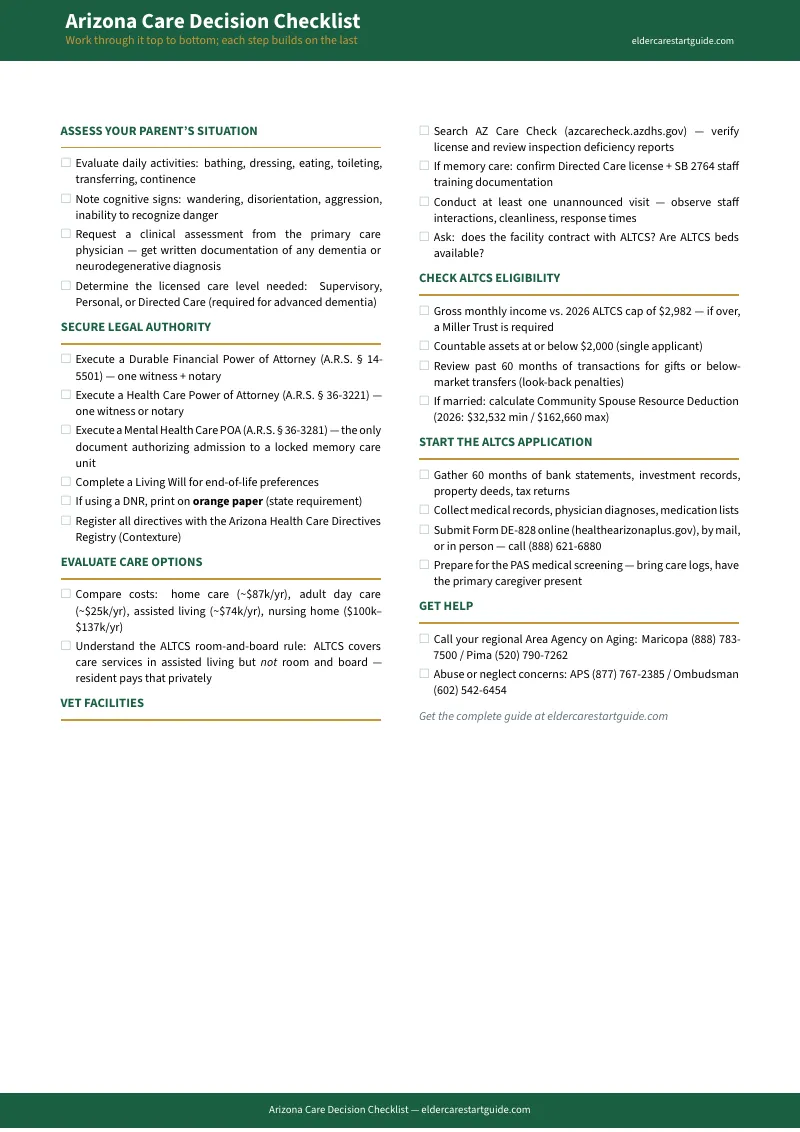
Download the free decision checklist to see the framework, or get the full guide with all 12 chapters plus 9 standalone printable tools — the care needs assessment, care setting comparison card, facility tour scorecard, ALTCS document checklist, financial snapshot and lookback audit, Beneficiary Deed checklist, POA authority matrix, essential contacts fridge sheet, and hospital discharge crisis roadmap.