
Your Parent Is Being Discharged Tomorrow. The Plan Feels Wrong.
The discharge planner says your parent is "medically stable." But you can see they're not ready — they can't stand without help, the medication list has changed twice this week, and nobody has explained who's going to manage wound care at home. And "home" might be in a remote Alaska community where the nearest clinic is a bush plane away.
You have less than 48 hours. The hospital wants the bed. And everything you find online is either a 300-page CMS policy manual or a lead-gen site trying to sell you a nursing home placement in a state that has the fewest nursing home beds per capita in the country.
The Alaska Discharge Navigator
This isn't a generic pamphlet about "planning ahead." It's a structured system for the 48-to-72-hour window when you're in the middle of a discharge crisis — built specifically for Alaska law, the Division of Senior and Disabilities Services, and the Alaska agencies, ADRCs, and tribal health organizations you'll actually be calling.
The guide gives you the legal framework, decision sequences, and exact scripts to advocate for your parent's safety during every transition: hospital to home, hospital to rehab, rehab to skilled nursing, and the ALI waiver path that lets them stay home with nursing-level support through the Aging and Disability Resource Centers.
What's Inside
- The 48-Hour Discharge Protocol — A step-by-step sequence for the first two days after you hear "we're discharging your parent." Covers who to call, what to document, and which forms to request before you leave the hospital — including your rights under federal discharge planning regulations (42 CFR § 482.43).
- QIO Appeal Scripts — Pre-written language for filing a fast-track appeal with Acentra Health (Alaska's BFCC-QIO) at 1-888-868-3234. Hospitals cannot charge your parent extra or force them out while the appeal is active — but most families don't know this right exists.
- Observation Status Decision Tree — If your parent was classified "outpatient under observation," Medicare won't cover SNF rehab. This section explains how to identify the reclassification, request a physician override, and file a prospective appeal under the Alexander v. Azar class action ruling — including the 2026 updated MOON form (CMS-10611) requirements.
- Alaska's Post-Acute Care Map — With the fewest SNF beds per capita in the nation, Alaska families often face transfers to facilities hundreds of miles away. This section covers medical transport logistics, the Medicaid Non-Emergency Medical Travel benefit, tribal health referral networks (Southcentral Foundation, YKHC, Norton Sound, ANTHC), and what to do when the nearest available bed is in a different region entirely.
- SNF Vetting Scorecard — A structured comparison framework with the specific questions to ask Alaska facilities about staffing ratios, therapy schedules, discharge timelines, and Medicare coverage policies. Includes red flags that signal a facility will rush your parent out at day 20.
- ALI Waiver Roadmap — The complete enrollment pathway for Alaska's Alaskans Living Independently waiver: calling your regional ADRC, the Consumer Assessment Tool (CAT) evaluation, how SDS determines Nursing Facility Level of Care, the specific ADL scoring rules (bathing and dressing are excluded from the three-ADL threshold), and person-centered service plan development.
- Long-Term Care Medicaid Financial Planning — Alaska is an income-cap state with a $2,982 monthly income limit. This section covers the Qualified Income Trust (Miller Trust) pathway, the $2,000 countable asset limit, the Community Spouse Resource Allowance (up to $162,660), the $752,000 home equity threshold, the five-year look-back period, and Alaska's $22,400 penalty divisor — the highest in the country.
- Pioneer Homes Waitlist Strategy — Alaska's state-run assisted living system has six locations (Anchorage, Fairbanks, Juneau, Sitka, Palmer, Ketchikan) with chronological waitlists that can stretch years. This section explains eligibility, the payment-ability assessment, and why getting on the list early can prevent a crisis-mode scramble later.
- Legal Authority Gap Closer — Many Alaska families rely on a "springing" durable power of attorney that only activates with formal physician certification of incapacity — nearly impossible to secure during a fast-moving discharge. This section covers which legal documents you need, how to get them, the difference between a financial POA and an Advance Health Care Directive under Alaska law, and when guardianship through the Alaska Superior Court becomes the only option.
- Medication Reconciliation Worksheet — A structured form for tracking every medication change during hospitalization, ensuring nothing is missed or duplicated at discharge.
- Call Scripts and Letter Templates — Pre-written language for conversations with discharge planners, attending physicians, ADRC coordinators, SNF admissions staff, and SDS caseworkers.
Who This Is For
- Adult children in Alaska managing a parent's hospital discharge — especially if the timeline feels rushed or the plan feels incomplete
- Families who need to halt an unsafe discharge and don't know they have the right to appeal
- Caregivers comparing rehab, skilled nursing, and home care — and unsure which Medicare or Medicaid programs apply in Alaska
- Anyone starting the ALI waiver process who wants to avoid mistakes that trigger denial or delay
- Families coordinating care from the Lower 48 who need Alaska-specific phone numbers, agencies, and deadlines
- Families navigating tribal health referral networks alongside Medicare and Medicaid
Why Not Just Use Free Resources?
The SDS website has the policy manuals. Medicare.gov has the forms. But during a medical crisis, you don't need raw policy — you need a decision framework that tells you what to do first, what to say when you call, and which mistakes will cost your family thousands.
Free resources don't tell you that hospitals are incentivized to discharge quickly, that observation status quietly eliminates your rehab coverage, or that one improper asset transfer can create a five-year Medicaid penalty period calculated at the highest rate in the country. They give you information without sequence or priority. And they won't explain why the CAT assessment scoring excludes bathing and dressing from the three-ADL threshold — a detail that catches families off guard when an otherwise-struggling parent scores below the eligibility cutoff.
This guide organizes Alaska-specific rules into actionable steps you can follow under pressure — from the first notification of discharge through the waiver application and beyond.
The Alternative Is Expensive
An elder law attorney in Alaska charges $300–$500 per hour, with full Medicaid planning engagements running $5,000–$15,000. A private geriatric care manager charges $100–$250 for an initial assessment plus $50–$150 per hour ongoing. This guide doesn't replace legal counsel for complex asset protection — but it prevents the common mistakes that make legal counsel necessary, and gives you the structure to handle the first 72 hours yourself.
Satisfaction Guarantee
If the guide doesn't give you a clearer path forward within the first 24 hours of your parent's discharge, email us for a full refund. No hoops, no forms.
— Less Than One Hour of Professional Advocacy
For a fraction of what a single consultation costs, you get the complete system: legal rights, appeal scripts, ALI waiver preparation, facility comparison tools, Pioneer Homes waitlist strategy, and every template you need to navigate your parent's transition safely.
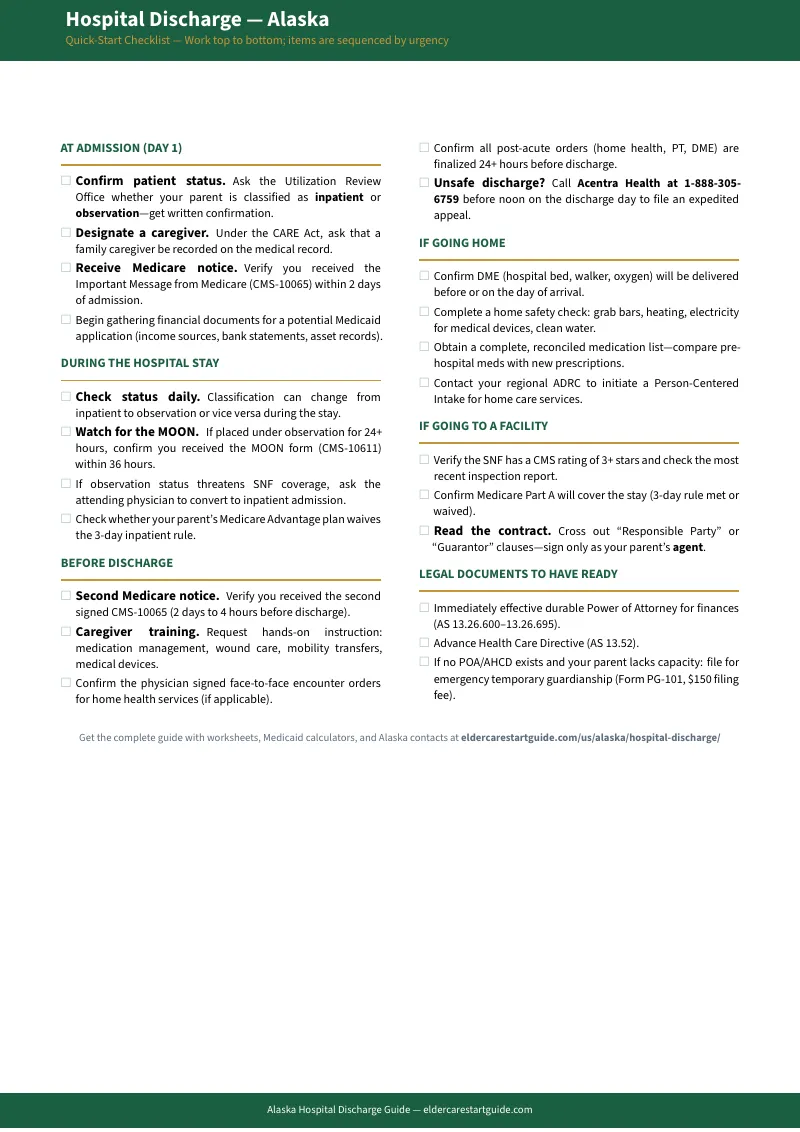
Download the free one-page checklist to see the framework, or get the full guide with all 14 chapters plus 9 standalone printable tools — the 48-hour discharge protocol, QIO appeal scripts, observation status decision tree, SNF vetting scorecard, ALI waiver roadmap, Medicaid eligibility worksheet, medication reconciliation worksheet, call scripts and letter templates, and emergency contacts fridge sheet.