
Alaska's Medicaid Waiver System Has a 47-Step Application Process. No One Hands You the Sequence.
Your parent needs help at home. Maybe it started with a fall. Maybe the kitchen is getting dangerous. Maybe a neighbor called you because your parent hasn't been outside in days. Whatever the trigger, you're now facing Alaska's long-term care system — and discovering that keeping a parent safely at home here is nothing like doing it in the Lower 48.
Nursing home care in Alaska runs $27,831 per month. Assisted living averages $9,882. But non-medical home care — the kind that lets your parent stay in their own house — costs roughly $7,245 per month, and much of it can be covered by Medicaid if you know how to apply. The problem is that "knowing how to apply" means navigating the Division of Senior and Disabilities Services, the Division of Public Assistance, your regional ADRC, a nurse-led CAT assessment, a 60-month financial look-back, and a care coordination system that nobody explains in plain English.
State websites publish the regulations. They don't publish the strategy.
The Alaska Home Care Navigation System
This guide translates Alaska's elder care bureaucracy into a day-by-day action sequence. It covers what to do, what to gather, who to call, and what to say — from your first ADRC intake call through an approved waiver with services running in your parent's home.
Where government portals give you program descriptions and regulatory citations, this guide gives you the preparation steps that determine whether your parent's application succeeds on the first pass or stalls for months. The Consumer Assessment Tool doesn't measure what your parent can't do — it measures what the nurse observes. If your parent minimizes their struggles during the assessment (and most do), the system allocates fewer hours. The guide shows you how to document functional limitations before the visit so the assessment reflects your parent's actual needs.
What You Get
- 14-chapter step-by-step guide (guide.pdf, 43 pages) — the complete Alaska aging-in-place system organized by the decisions you face in order: legal authority, ADRC intake, Medicaid financial eligibility, the CAT clinical assessment, program selection (ALI waiver, CFC, PCS), Support Plan development, estate recovery protections, tribal health resources, home modifications, caregiver support, and appeals
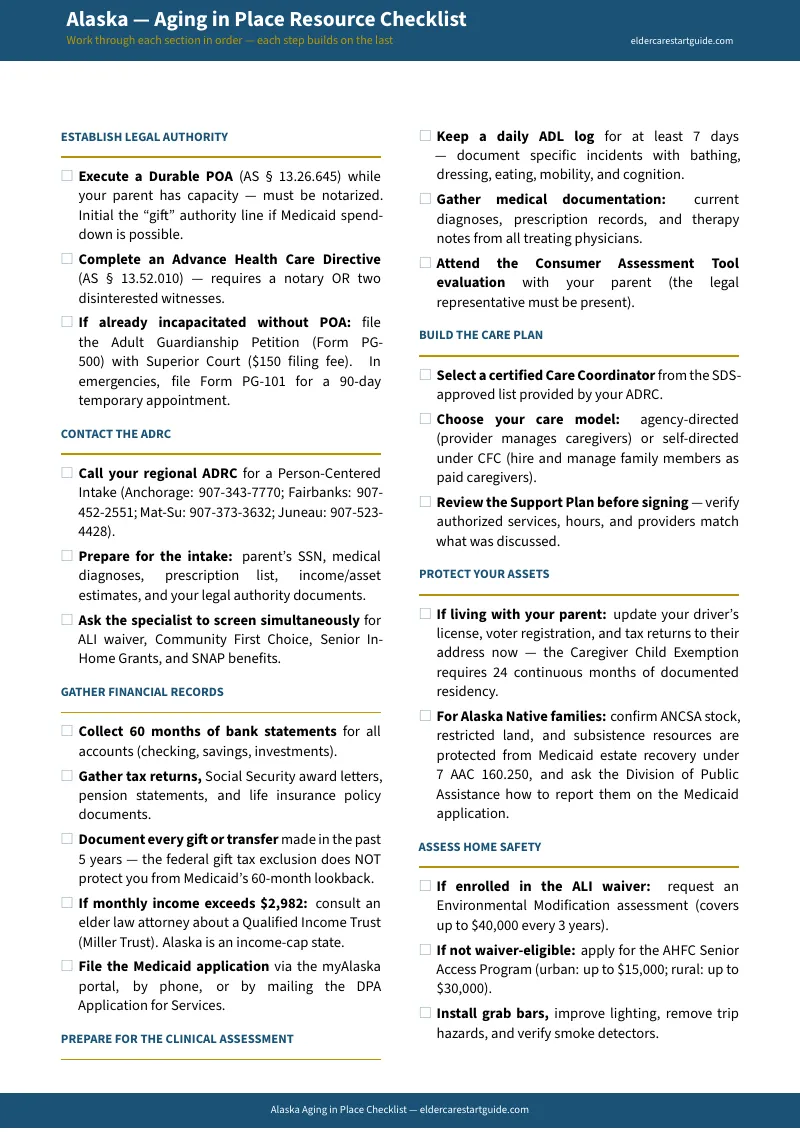
- 23-item quick-start checklist (checklist.pdf) — printable single-page reference covering the immediate steps from recognizing your parent needs help through getting services in place
- 6 standalone printable tools — ADL Daily Tracking Log (14-day functional care log for the CAT evaluation), 60-Month Financial Document Checklist (asset inventory and income tally against Alaska's 2026 Medicaid limits), Care Provider Comparison Worksheet, Agency Communication Log, Caregiver Child Residency Documentation Tracker (24-month evidence log for estate recovery exemption), and Support Plan Review Checklist
What's Inside the Guide
- The ADRC intake preparation sequence — exactly what information your regional ADRC coordinator needs at the Person-Centered Intake, organized so you don't scramble for documents during the interview
- Medicaid financial eligibility worksheets — countable vs. exempt asset audit, income calculation against the $2,982/month limit, spousal protections (up to $162,660 CSRA), and a compliant spend-down planner that stays within the 60-month look-back rules
- CAT assessment preparation guide — how to document your parent's daily functional limitations so the nurse assessor scores what your parent actually experiences, not the polite version they perform during a one-hour visit
- Program comparison framework — ALI waiver vs. Community First Choice vs. Personal Care Services: what each covers, who qualifies, and how to choose based on your parent's needs and your family's situation
- Consumer-Directed PCA setup instructions — how to hire a family member (adult children, other relatives — not spouses) as a paid personal care assistant through CDPCS, including training requirements, background check process, and fiscal intermediary enrollment
- Estate recovery protection strategies — the Caregiver Child Exception documentation kit, home equity exemption rules, spousal protections, and the specific records (utility bills, voter registration, physician statements) that prove eligibility
- Alaska Native and tribal health resource directory — how Southcentral Foundation, ANTHC, Bristol Bay Native Association, and regional health corporations coordinate with state Medicaid programs, plus tribal-specific estate recovery exemptions under Section 5006 of ARRA
- Home modification funding guide — Environmental Modifications (E-Mods) under the ALI waiver, AHFC Senior Citizens Housing Development Fund, and assistive technology resources through Centers for Independent Living
- Appeals and escalation procedures — what to do when a waiver is denied, services are reduced, or a provider isn't following the care plan
Who This Is For
- You're an adult child helping a parent stay safely at home in Alaska, and you need to understand which state programs apply and how to access them
- Your parent was hospitalized and the discharge team is pressing you to choose between a nursing facility and going home — but nobody explained the home care funding options
- You live in the Lower 48 and your parent lives alone in Alaska — you're coordinating care long-distance and need a structured system to work through remotely
- You're an Alaska Native family navigating both the tribal health system and state Medicaid, and you need to understand how the two coordinate
- You want to be paid as your parent's caregiver through Medicaid's Consumer-Directed program but don't know the application steps
- Your parent's Medicaid application was denied or delayed, and you need the appeals process explained in plain language
Why Not Just Use the State Websites?
Alaska's Division of Senior and Disabilities Services publishes program regulations. The Division of Public Assistance publishes financial eligibility criteria. The ADRCs provide in-person Options Counseling. These are all legitimate, free resources — and you should use them.
What none of them provide is a unified action plan that sequences the steps across all three agencies in the order a family actually encounters them. The state's materials assume you already understand the system. This guide assumes you're starting from a kitchen-table crisis and need to know what to do first, second, and third.
An elder law attorney in Alaska charges $300 to $500 per hour. If your situation involves complex estate planning or contested guardianship, hire one. But for the 80% of families whose parent qualifies for standard Medicaid home care benefits, this guide covers the preparation, application, and coordination process that would otherwise take multiple consultations to piece together.
Satisfaction Guarantee
If the guide doesn't help you navigate Alaska's home care system more effectively, email [email protected] for a full refund — no time limit.
Start with the Free Checklist
Download the 23-item Quick-Start Checklist — a printable single-page reference covering the immediate steps from recognizing your parent needs help through getting services in place. If the checklist gives you one step you wouldn't have known to take, the full guide gives you every step, every preparation sequence, and every protection strategy.
Get the Full Alaska Home Care Guide
For , you get the complete 14-chapter guide, quick-start checklist, and 6 standalone printable tools — everything an Alaska family needs to navigate the ADRC intake, qualify for Medicaid home care benefits, set up a care plan, and protect their assets through the process.