Your Parent's Nursing Home Costs $8,150 a Month. The Asset Limit Is $2,000. And Alabama Won't Let You Spend Down Excess Income — You Need a Miller Trust Nobody Explained.
The rehab facility just told you Medicare's 100-day skilled nursing window is closing. Your parent can't go home safely. The nursing home wants $8,150 per month — private pay — and the social worker mentioned "Medicaid" as if it were a simple form. You started searching online.
You found the numbers: $2,982 monthly income cap, $2,000 in countable assets. Your parent's Social Security and pension combine to $3,200 a month. In most states, the excess $218 could be "spent down" on medical expenses. Not in Alabama. Alabama is a strict income-cap state — exceed $2,982 by a single dollar, and the application is automatically denied. No exceptions, no deductions, no workarounds.
Except one. A Qualified Income Trust — a Miller Trust — funnels that excess income through a dedicated bank account with Alabama named as the beneficiary. Set it up correctly, and the income cap vanishes. Set it up wrong — wrong bank, wrong language, wrong trustee — and the caseworker rejects the application, your parent keeps paying $8,150 a month, and you start the process over from zero.
The Alabama Medicaid Asset Protection System
This isn't a summary of Alabama Medicaid rules you could piece together from medicaid.alabama.gov, three elder law blogs, and a forum thread. The Alabama Medicaid Asset Protection System maps the exact sequence of decisions, trust structures, spend-down methods, and filing deadlines your family needs — starting from wherever you are right now — so you don't drain savings because you did things in the wrong order.
The critical mistake most Alabama families make: they start liquidating assets before understanding what's exempt, what's countable, and what triggers a five-year lookback penalty. They give money to a child without realizing the transfer creates a penalty period during which the family pays the full $8,150 per month out of pocket. They assume Medicaid will cover assisted living, not knowing that Alabama is one of only two states in the country that doesn't cover assisted living room and board under any waiver. They don't learn about the probate-only estate recovery rule until after the state has already filed a claim against the house.
The guide puts you in the right order: assess legal authority first, calculate whether a Miller Trust is needed, map what's countable and what's exempt, execute the spend-down with approved methods, evaluate waiver alternatives to nursing home placement, then file with the Alabama Medicaid Agency with everything organized.
What You Get — 12 PDFs
- 15-Chapter Guide with 3 Appendices — The complete Alabama Medicaid Asset Protection System: what Medicare does and doesn't cover, the three eligibility tests (clinical, income, and assets), legal authority and powers of attorney, step-by-step Miller Trust setup, spousal protections (CSRA up to $162,660, MMMNA up to $4,066.50/month), the five-year lookback with penalty calculations, approved spend-down strategies, the full application process, the Elderly and Disabled Waiver and Personal Choices Program, Alabama's assisted living vs. memory care licensing, probate-only estate recovery with the 30-day notice window under Act 2019-489, Medicaid-compliant annuities, appeal procedures, ongoing compliance, and building a professional team. Every dollar figure reflects 2026 Alabama regulations.
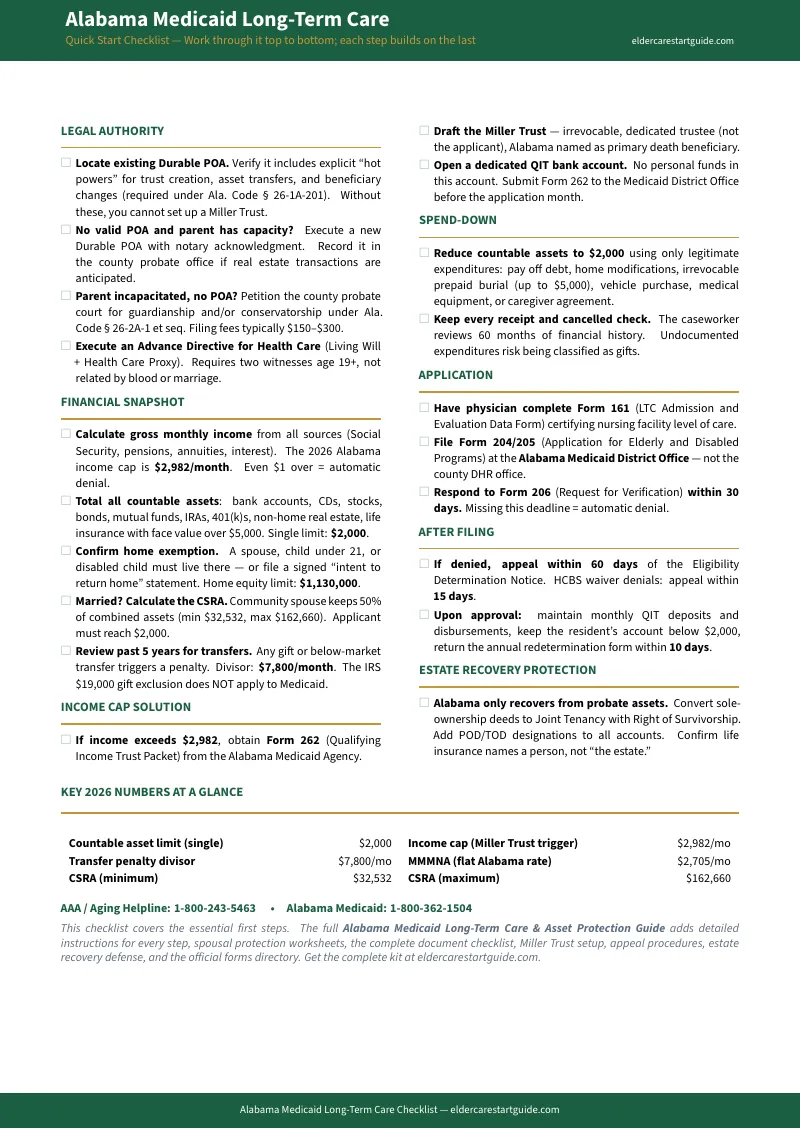
- Quick-Start Checklist (Free Download) — 20 actionable items across 7 sections: establish legal authority, assess eligibility against income and asset limits, address the income cap with a Miller Trust, execute the spend-down, gather required documents, submit the application, and protect assets from estate recovery.
- 10 Standalone Printable Worksheets — Pull out and use at the kitchen table, the bank, the attorney's office, or the Medicaid district office:
- Miller Trust (QIT) Setup Guide — step-by-step trust creation with monthly ledger
- Spousal Protection Worksheet — CSRA and MMMNA calculations for married couples
- Five-Year Lookback Audit — map every transfer and calculate potential penalty periods
- Approved Spend-Down Strategies — Alabama-legal methods with documentation tracker
- Application Document Checklist — every form and record the Medicaid Agency requires
- Estate Recovery Defense — probate-bypass strategies and Act 2019-489 procedures
- Waiver and Home Care Comparison — E&D Waiver vs. SAIL vs. nursing home side-by-side
- 2026 Financial Thresholds — all dollar amounts and deadlines on one page
- Alabama Medicaid Forms Directory — every form name, number, and where to get it
- Important Contacts Directory — phone numbers plus a fillable professional team tracker
Who This Guide Is For
- Adult children in Alabama who need to figure out how to pay for a parent's long-term care — nursing home or home-based — without losing the family home and retirement savings
- Families facing a hospital discharge with no Medicaid application started and a facility demanding private-pay rates of $8,150 or more per month
- Anyone whose parent earns more than $2,982 per month and needs to understand how a Miller Trust works in Alabama — the setup, the bank account, the monthly deposits, and the distribution rules
- Married couples where one spouse needs nursing home care and the other needs to know exactly how much of their joint savings and monthly income Alabama law protects
- Families who made financial transfers in the last five years and need to determine whether those gifts will trigger a Medicaid penalty — and what exemptions apply
- Caregivers who want to keep a parent at home through the Elderly and Disabled Waiver or Personal Choices Program but don't understand the referral list, the clinical assessment, or the self-directed care option that pays family members as caregivers
Why Free Information Isn't Getting You Anywhere
Medicaid.alabama.gov publishes the official financial guidelines. The numbers are accurate. But they don't tell you the order. They don't explain that Alabama's income cap has no spend-down exception, that the Miller Trust must use specific irrevocable language, or that the state's estate recovery is limited to probate assets — meaning properly structured ownership can protect the family home entirely.
Alabama elder law firms publish helpful blog posts about Medicaid planning. Every one ends with a call to schedule a consultation at $300 to $500 per hour. Their content is designed to pull you into a $1,500–$5,000 planning engagement, not to give you a complete, executable sequence of steps.
A Place for Mom and Caring.com rank well on Google, but their guides are national templates with Alabama numbers dropped in. They don't explain that Alabama is one of two states with no assisted living waiver coverage. They don't cover the Personal Choices Program that pays family caregivers through a self-directed budget. They are lead-generation platforms for facility referral fees, not planning tools.
This guide fills the gap between the government portal that gives you facts without sequence, the law firm that gives you sequence but only through a multi-thousand-dollar engagement, and the referral site that steers you toward facility placements that may not be necessary.
Satisfaction Guarantee
If this guide doesn't give you a clear, actionable path to paying for your parent's long-term care in Alabama, email [email protected]. We read every message.
— Less Than One Hour of an Elder Law Attorney's Time
Alabama elder law attorneys charge $300 to $500 per hour. A comprehensive Medicaid planning package runs $1,500 to $5,000. A single procedural mistake — a Miller Trust with the wrong beneficiary language, a gift to a grandchild inside the five-year lookback, a missed 30-day estate recovery deadline — can cost your family months of private-pay nursing home bills at $8,150 per month.
This guide won't replace an attorney when you need one (and it tells you exactly when that is). But it will save you hours of research, prevent the most expensive mistakes, and ensure you walk into any conversation — with the Alabama Medicaid Agency, the nursing facility, your Area Agency on Aging, or an elder law firm — knowing exactly what Alabama law requires.
Download the free Quick-Start Checklist to see the 20 most urgent action items. When you're ready for the complete system, the full guide is waiting.