
Your Parent Is Losing Capacity — and Every Week You Wait, Your Options Get More Expensive and More Public
The hospital discharge planner needs you to sign admission paperwork. The bank won't let you touch your parent's account to pay the mortgage. Your sister in Mobile thinks you're overreacting. And the attorney you called wants $3,000 to $6,000 for an uncontested guardianship that will take 60 to 90 days — during which you have no legal authority to do anything.
This is what happens when families wait. The window to execute a simple, private power of attorney closes when your parent can no longer understand what they are signing. Once it closes, the only path to legal authority runs through Alabama's probate court — a formal, public proceeding with filing fees, a court-appointed Guardian ad Litem, mandatory physician evaluations, and ongoing reporting obligations that last as long as your parent lives.
The Alabama Legal Authority System
This kit maps both paths — the private documents you can execute today if your parent has capacity, and the court process you'll need to navigate if they don't — through every relevant Alabama statute, form requirement, and administrative system. Every instruction, threshold, and contact resource is specific to Alabama's Uniform Power of Attorney Act, the Natural Death Act, the Uniform Guardianship and Protective Proceedings Act, the Alabama Medicaid Agency, and the 13 regional Area Agencies on Aging.
What separates this from a generic online POA template: national document builders give you a form. They don't tell you that Alabama Code § 26-1A-201 silently blocks your agent from creating trusts, making gifts, or changing beneficiaries unless the document explicitly authorizes each "hot power" individually. They don't tell you that an unnotarized POA carries no statutory presumption of genuineness under § 26-1A-105, and most Alabama banks will refuse to honor it. They don't explain how to use the Agent's Certification Form at § 26-1A-302, which is what banks actually expect to see when your agent walks in with the document. And they give you zero guidance on how that POA interacts with Alabama's Medicaid income cap, the Miller Trust requirement, or estate recovery rules — the financial systems that determine whether your parent keeps the family home.
What's Inside — 14 Printable PDFs
- The Complete Guide — thirteen chapters covering the durable financial POA (execution requirements, notarization protocol, hot powers, Agent's Certification Form), the advance directive for health care (witness eligibility rules, HIPAA integration, proxy acceptance), guardianship and conservatorship (probate court petition process, GAL appointment, filing fees by county, care plan and inventory deadlines), the 2027 reforms under Act 2026-488, Medicaid long-term care (the $2,982 income cap, $2,000 asset limit, Miller Trust setup using Form 262, the E&D Waiver), the 60-month lookback and transfer penalties, estate recovery and MERP (probate-only reach, title structures that bypass it), ALF vs. SCALF licensing verification, paid family caregiving through the Personal Choices Program, and a complete contacts directory
- Capacity Assessment Tool — a standalone worksheet that walks you through the cognitive and functional indicators that matter under the Troy Health v. McFarland capacity standard, so you can evaluate your parent's readiness to execute documents before scheduling a signing session
- Financial Snapshot for Medicaid Screening — a printable income and asset calculator that maps your parent's specific numbers against Alabama's strict thresholds — the $2,982 gross monthly income cap, $2,000 countable asset limit, $1,130,000 home equity exemption — and flags whether a Miller Trust is needed
- Guardianship Preparation Worksheet — the documents you need to assemble, the forms to file, and the court-specific requirements (filing fees, notice periods, bond calculations) organized into a preparation timeline so you don't discover a missing piece at the hearing
- Key Contacts & AAA Directory — all 13 of Alabama's regional Area Agencies on Aging with county coverage areas, the statewide Aging and Disability Resource Center, hotline numbers, and the specific state agencies involved in Medicaid, guardianship, and facility licensing
- Decision Flowchart — a one-page diagram mapping your parent's capacity status to the correct legal path (POA vs. guardianship/conservatorship)
- POA Execution Checklist — step-by-step for executing a valid Durable Financial POA, including notarization protocol and hot powers authorization
- Advance Directive Checklist — witness eligibility verification, proxy acceptance steps, and document distribution list
- Guardianship Filing Tracker — tracks every filing, deadline, service of process, and post-appointment obligation through probate court
- Conservatorship Financial Inventory — structured form for the 90-day asset inventory required of all conservators under Ala. Code § 26-2A-147
- Miller Trust Monthly Ledger — tracks QIT deposits, disbursements, and running balance for each calendar month of Medicaid coverage
- Facility Comparison Worksheet — side-by-side comparison of ALF vs. SCALF licensing, staffing, pricing, and Shirley's Law compliance for facilities under consideration
- Agency Communication Log — records every call, email, and in-person contact with probate courts, the Medicaid Agency, ADSS, DHR, ADPH, facilities, and attorneys — your evidence trail for appeals and escalations
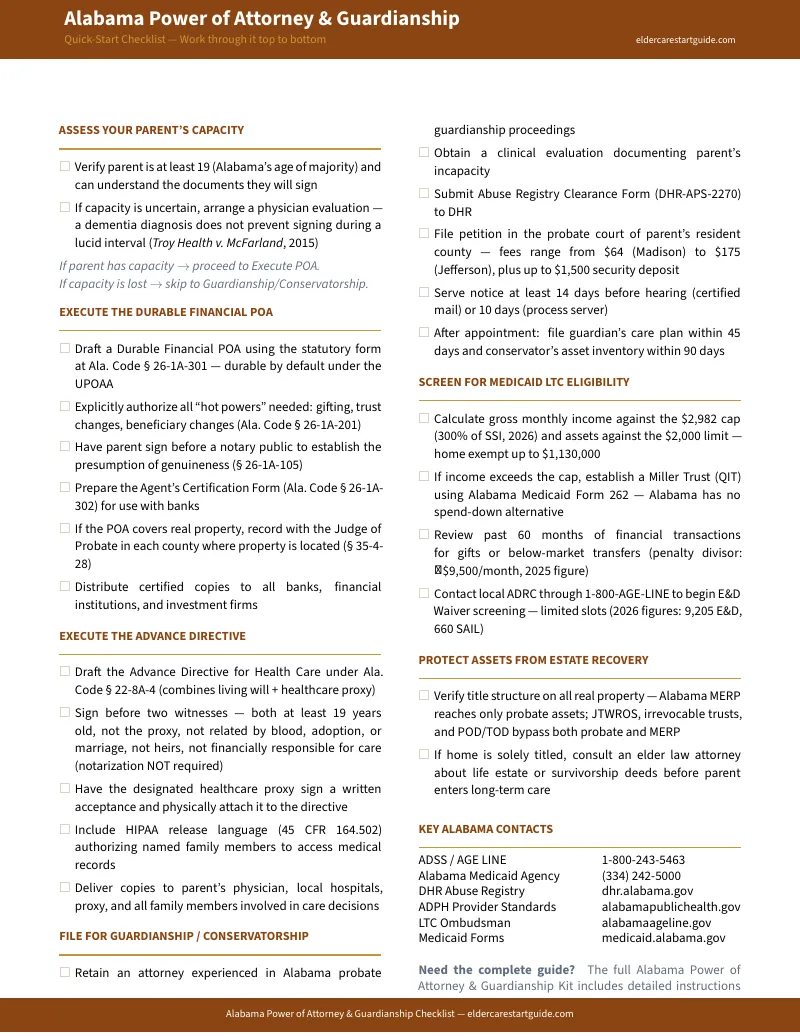
- 25-Item Quick-Start Checklist — the full sequence of critical actions from capacity assessment through POA execution, guardianship filing, and Medicaid application — each item linked to the relevant Alabama statute or agency
Who This Is For
- Adult children who can still get a POA signed — your parent has capacity now, but you need to know exactly how Alabama's UPOAA works so the document doesn't get rejected by banks, medical providers, or government agencies
- Families past the POA window — your parent can no longer understand the documents, and you need to navigate Alabama's probate court guardianship or conservatorship process, understanding the costs, timeline, and ongoing obligations before you file
- Siblings in disagreement — one of you handles daily caregiving, another is out of state questioning every decision, and you need the legal framework for co-agent designations, fiduciary duties, and successor agents that can bring the family into alignment before a judge imposes a solution
- Caregivers navigating Medicaid — your parent needs long-term care, their income is near the $2,982 cap, and you need to understand whether a Miller Trust is required and how to set one up without disqualifying the application
- Families worried about the home — your parent is entering a nursing facility and you don't know whether Alabama's estate recovery program can claim the family home after death, or what title structures actually protect it
- Anyone confused about Alabama's advance directive — the state combines the living will and healthcare proxy into a single document with specific witness requirements that differ from the POA's notarization rules, and getting either one wrong means the document may not be honored when it matters most
Why Free Resources Don't Get You There
Alabama's state agencies publish eligibility criteria, waiver descriptions, and regulatory codes. But these resources are written for administrators and surveyors, not for a family member standing in a hospital hallway trying to figure out who has the legal right to make decisions. You can find the statutory POA form in the Alabama Code, but you won't find instructions explaining which "hot powers" to authorize, why the Agent's Certification Form matters for bank acceptance, or how a POA interacts with Medicaid's income cap and the Miller Trust requirement.
National legal document platforms like Nolo and Rocket Lawyer will generate a technically valid POA template. But they don't tell you that the same form needs to explicitly authorize Miller Trust creation if your parent's income might cross the Medicaid cap — an omission that can cost thousands in attorney fees to fix later. They don't explain how to coordinate the financial POA with the healthcare advance directive's separate execution requirements, or how both documents interact with Alabama's guardianship process if you eventually need court authority for decisions the documents don't cover.
Elder law attorneys provide expert guidance — at $200 to $500 per hour. For complex asset structures, contested guardianships, or Medicaid planning with significant estate values, professional counsel is essential. But you shouldn't be paying attorney rates to learn what a "hot power" is, how witness eligibility works for advance directives, or whether your parent's income triggers the Miller Trust requirement. Using this guide to prepare your documents and organize your financial records before your first consultation can save hours of billable time.
Satisfaction Guarantee
If the guide doesn't help you identify at least one legal requirement, execution step, or Medicaid threshold you weren't already aware of, email us for a full refund. No forms, no waiting period.
Secure Your Family's Legal Authority
Download the free checklist to get the essential action items — or get the full toolkit for and have all 14 printable PDFs: the complete 13-chapter guide, standalone worksheets and checklists for every step, financial calculators, filing trackers, and contact directories you need to secure legal authority for your parent in Alabama.