
The Hospital Says Your Parent Is Ready to Leave. Nobody Explained What Happens Next.
The discharge planner says your parent is going home tomorrow. They can barely stand. The hospital's social worker hands you a stack of referral forms and asks which skilled nursing facility you'd like. You've never evaluated a nursing home in your life. The SNF admissions coordinator pushes a contract across the table and asks you to sign as "Responsible Party." Medicare covered the first 20 days of rehab for free, but the daily co-pay just jumped to $217 — and on day 101, coverage stops completely. The private-pay rate in Alabama averages $8,649 a month.
Then comes the Medicaid conversation. Alabama is one of the strictest income-cap states in the country: if your parent's gross monthly income exceeds $2,982 by a single dollar, they are automatically disqualified from Medicaid long-term care. No spend-down, no exception. The only path forward is a Qualified Income Trust — a Miller Trust — and nobody at the hospital mentioned it. The state will audit five years of bank statements, property transfers, and gifts. One well-meaning transfer to a grandchild three years ago could trigger a penalty that leaves your family paying out of pocket for months.
Elder law attorneys in Alabama charge $300 to $500 an hour. A complete asset protection planning package runs $7,000 to $15,000. You shouldn't need to spend that just to understand the process.
— The Alabama Hospital Transition Planner
This is the Alabama Hospital Transition Planner — a step-by-step guide that takes the entire post-hospital transition process in Alabama and maps it into a sequential system you can follow from crisis to coverage. It covers every decision point between "the hospital says Mom can't go home" and "the discharge appeal is filed, the SNF contract is reviewed, the Miller Trust is established, the waiver application is in, and the home is protected."
It's not a national overview with Alabama mentioned in a sidebar. It's not a one-page eligibility checklist from a referral service that earns commissions from the facilities it recommends. This is the specific regulatory, financial, and legal process for Alabama — the observation status trap, the QIO appeal timeline, Alabama's administrative code on discharge planning, the income cap, the Miller Trust setup using Form 262, the E&D Waiver intake through your regional AAA, the SCALF rules, the estate recovery scope — organized in the order you'll actually need them.
What's Inside — 12 Printable PDFs
- Complete 13-Chapter Guide (guide.pdf) — the full Alabama hospital-to-home transition process from discharge day through long-term care planning. Covers observation status traps and how to challenge them, discharge planning rights under Alabama Administrative Code rule 420-5-7-.25 and the federal CARE Act, the QIO fast appeal through Acentra Health, SNF coverage and the day-100 cliff, SCALF admission rules, home health and DME coordination, Alabama Medicaid eligibility and the income cap, Miller Trust setup with Form 262, the 60-month lookback and transfer penalties, E&D Waiver and Personal Choices program, estate recovery protections, guardianship when no POA exists, worksheets, and a directory of all 13 regional AAAs with direct phone numbers.
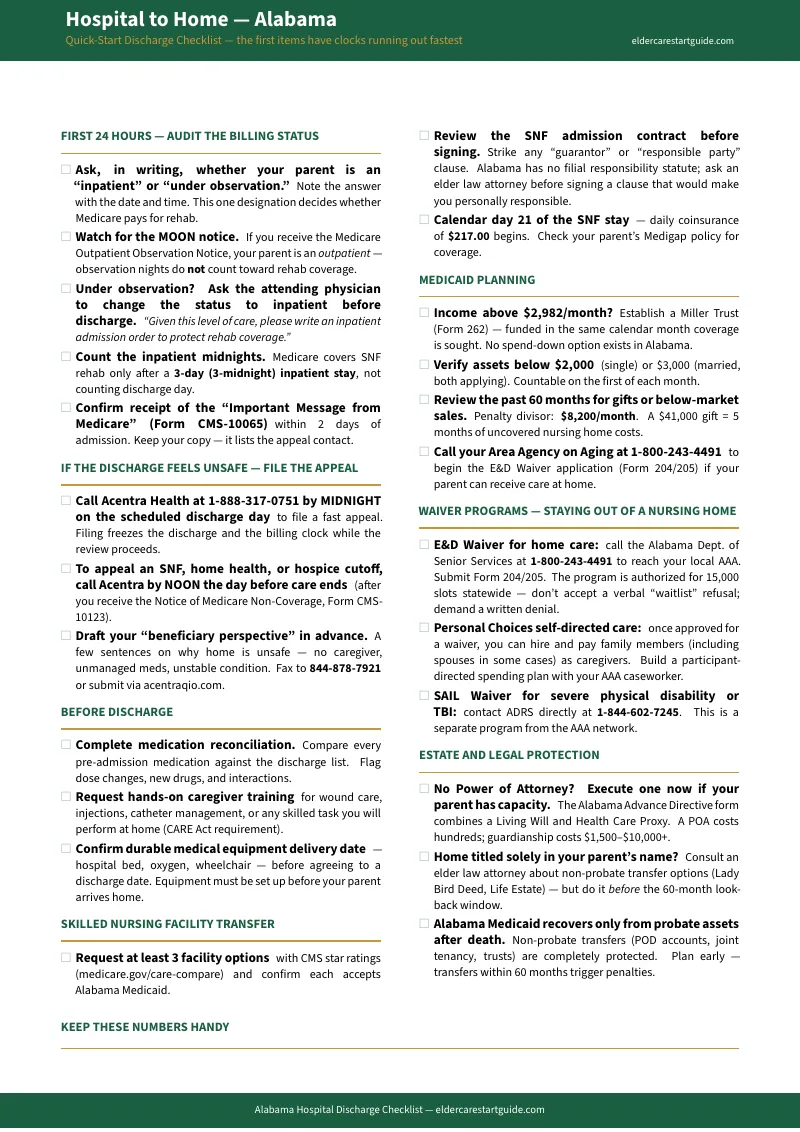
- Hospital Discharge Checklist (checklist.pdf) — a 26-item, priority-ordered reference covering the first 24 hours through discharge day, facility transfer, and home setup. Every critical action item, phone number, and deadline at a glance — designed to be printed and carried into the hospital.
- Discharge Safety Checklist — verify every element the hospital must address before your parent leaves: equipment delivery, home health orders, medication reconciliation, caregiver training, and follow-up appointments.
- Medication Reconciliation Worksheet — a side-by-side comparison form for pre-admission and discharge medications, with columns for dose changes, new interactions, and pharmacist verification.
- Observation Status Verification Log — a daily tracker to document your parent's admission classification, the staff member who confirmed it, and any reclassification requests.
- Miller Trust Setup Checklist — step-by-step walkthrough for establishing a Qualified Income Trust using Alabama Form 262, opening the dedicated bank account, and tracking monthly funding.
- Medicaid Application Document Tracker — every document required for Alabama Medicaid long-term care applications (Form 204/205), organized by category with checkboxes for gathering bank statements, insurance policies, property deeds, and income verification.
- Transfer Penalty Calculator — identify and calculate potential 60-month look-back penalties before submitting the Medicaid application, with a transfer inventory and cure options.
- SNF Admission Contract Audit — a protective review form for nursing home admission agreements: identify and challenge guarantor clauses, evaluate facility ratings, and verify Medicaid acceptance terms.
- Agency Communication Log — a structured record of every call, email, and meeting with hospitals, nursing facilities, home health agencies, AAAs, and Medicaid offices.
- E&D Waiver Intake Preparation Worksheet — document the specific physical and cognitive care needs required to demonstrate nursing facility level of care during the AAA functional assessment.
- Personal Choices Budget Planner — a financial planning template for the self-directed care option, including caregiver wage calculations, the medical savings plan, and spending plan categories.
Who This Is For
- Adult children managing a parent's hospital discharge in Alabama — especially after a stroke, fall, cardiac event, or surgery that requires post-acute rehabilitation
- Families facing an unsafe discharge and needing to file an appeal before the discharge deadline
- Families who just discovered their parent was under observation status and may not qualify for Medicare-covered SNF rehab
- Adult children being asked to sign a nursing home "Responsible Party" contract and unsure what they're agreeing to
- Families hitting Alabama's $2,982 income cap and needing to set up a Miller Trust before the Medicaid application
- Caregivers trying to keep a parent at home through the E&D Waiver or exploring whether they can get paid through the Personal Choices program
- Families worried about losing the family home to Medicaid estate recovery after a parent's death
Why Not Just Use Free Resources?
Alabama publishes Medicaid rules across the Department of Senior Services, Alabama Medicaid, the 13 regional Area Agencies on Aging, CMS, and Acentra Health. The information exists — it's scattered across agencies that don't coordinate with each other, written in regulatory language, and organized by bureaucratic function instead of by what you need to do next.
National referral services like A Place for Mom will find you a facility for free. But they earn commissions from the facilities they recommend, so they steer toward private-pay assisted living and memory care. They don't cover Miller Trust setup, the E&D Waiver intake process, estate recovery protections, or the Personal Choices self-directed care option because there's no referral fee attached. This guide covers every option — including the ones nobody gets paid to tell you about.
Elder law attorneys provide excellent planning — at $7,000 to $15,000 for a full engagement. This guide gives you the same step-by-step process, the same checklists, and the same asset protection strategies so you can manage the transition yourself. If you do need an attorney for a specific issue — a contested guardianship, a complex trust — you'll know exactly which issue to hire them for instead of paying for a full engagement.
Satisfaction Guarantee
If the guide doesn't help you navigate your parent's hospital transition more confidently, email us within 30 days for a full refund. No forms, no questions.
Get Started Now
Download the free Hospital Discharge Checklist to get the most critical action items, phone numbers, and deadlines on one printable page. When you're ready for the full process — the discharge appeal walkthrough, the observation status challenge, the SNF contract audit, the Miller Trust setup, the waiver intake strategy, and the estate recovery protections — get the complete Alabama Hospital Transition Planner.