
The hospital discharge planner just said your parent can't go home without a care plan. You have days — not weeks.
Your parent fell, or the doctor just confirmed what you've been dreading. The discharge coordinator is asking for a documented care plan. You need in-home help, but you don't know what Alabama Medicaid covers, how the Elderly and Disabled Waiver works, whether your parent's income is too high, or which of the 13 regional agencies to call first. You're Googling between meetings, comparing information from government sites written in regulatory language that assumes you already understand the system.
Meanwhile, a private elder law attorney in Alabama charges $246 per hour on average, with flat-fee Medicaid planning packages running $6,000 to $15,000. The free referral platforms — A Place for Mom, Caring.com — are paid commissions by the facilities they recommend, which means their "free" advice systematically steers families toward institutional placements instead of home care. And the Alabama Medicaid Agency website provides the raw administrative code but no guidance on sequencing, no help with documentation, and no strategy for keeping the family home out of estate recovery.
You don't need a referral to a facility. You need to understand how Alabama's home care system actually works — the waivers, the eligibility rules, the asset protections, and the self-directed care option — before you sign anything or spend your parent's savings on private-pay help.
The Alabama Home Care Navigation System
This is a 14-chapter guide built specifically for Alabama's elder care system — where Medicaid operates as an income-cap state with no spend-down option, where all home and community-based services route through 13 regional Area Agencies on Aging, and where a Qualifying Income Trust is required if your parent earns even one dollar over the $2,982 monthly cap.
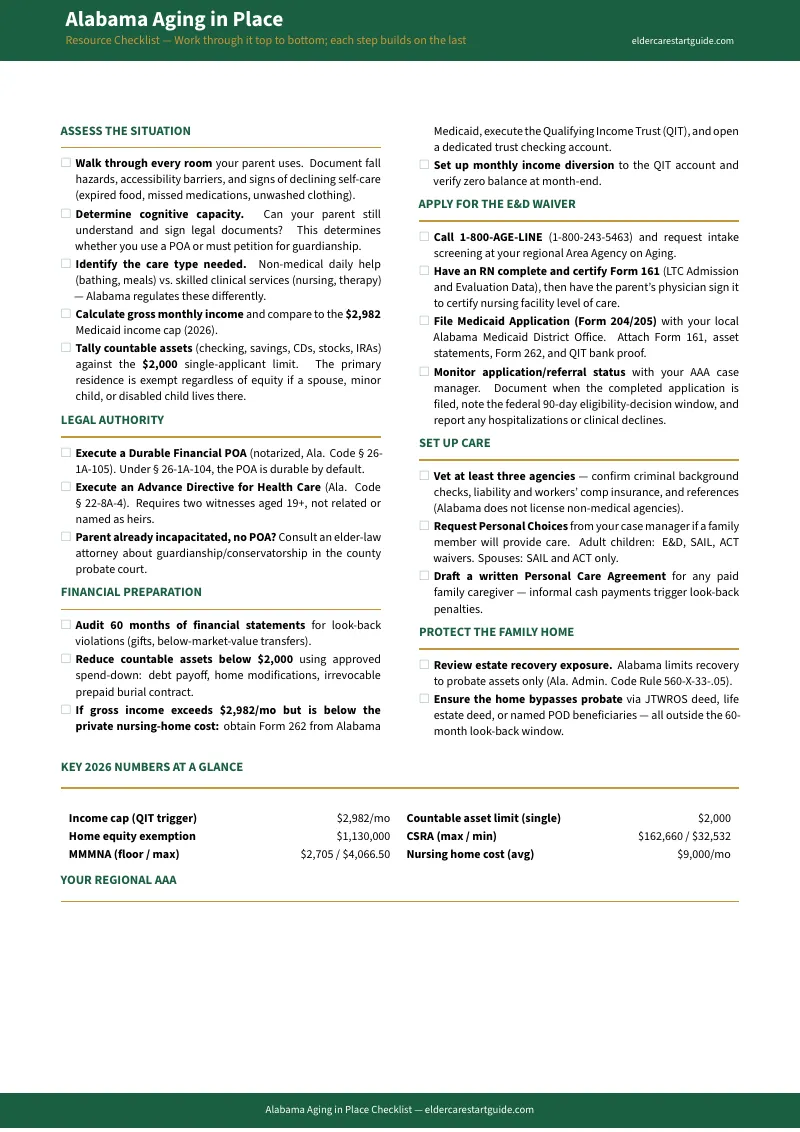
At its core is the Alabama Home Care Navigation System — a structured method that walks you from "I think my parent needs help at home" through to a fully established care arrangement with the correct legal authority, financial protections, and waiver enrollment completed in the right order. It handles the part that every free resource skips: understanding which waiver to apply for (E&D, SAIL, or ACT), how to prepare your parent for the in-home functional assessment, when to set up a Miller Trust versus when one isn't needed, and how to protect the family home from Medicaid estate recovery using Alabama's probate-only rule.
What's inside — the 14-chapter guide, checklist, 9 printable worksheets, and the complete Alabama home care system
- The E&D, SAIL, and ACT Waiver Comparison — every Alabama HCBS waiver mapped side by side, with eligibility criteria, covered services, and application paths. The Elderly and Disabled Waiver covers personal care, homemaker help, respite, adult day health, and home modifications. The SAIL Waiver serves individuals with physical disabilities. The ACT Waiver handles hospital-to-home transitions. You'll know which waiver fits your parent's situation before you call the first agency.
- Form 262 QIT Complete Setup Guide — a step-by-step walkthrough of Alabama's Qualifying Income Trust process, from opening the trust checking account with a bank using your parent's Social Security Number (including how to handle common bank confusion about EINs) to funding it monthly and verifying deposits with the local Medicaid office. Because missing one monthly deposit can trigger an eligibility review.
- The Personal Choices Self-Direction Playbook — how to get your parent into Alabama's 1915(j) self-directed option, where traditional agency rules are replaced by a monthly budget you control. This covers requesting self-direction through your AAA, building a Monthly Spending Plan, hiring family members as paid caregivers (including a spouse), and working with a Financial Management Services Agency like GT Independence for payroll, background checks, and electronic time tracking.
- Alabama Estate Recovery Shield — how Medicaid estate recovery works under Alabama's strict probate-only rule (Ala. Admin. Code Rule 560-X-33-.05), which assets the state can reach after your parent's death, and which ones it cannot. Includes the joint tenancy strategy, payable-on-death designations, the Caregiver Child Exemption (transferring the home to an adult child who provided care for at least two years), and the 30-day hardship waiver application window.
- Legal Authority Templates and Checklists — what you need to sign Medicaid applications, speak with banks, and direct medical care. Covers the Alabama Uniform Power of Attorney Act requirements for Durable Financial and Medical Powers of Attorney, including the high-risk authorities (modifying trusts, changing beneficiaries) that require specific grants under Alabama Code § 26-1A-201.
- The 60-Month Look-Back Audit — a structured worksheet to review every financial transaction in the look-back window before filing. Identifies which transfers trigger penalties, which are exempt, and how the state calculates the penalty period using the $9,000 monthly private-pay divisor. One uncompensated transfer can delay benefits for months — this audit catches problems before the state does.
- Area Agency on Aging Navigation Map — all 13 regional AAAs with their counties, contact information, and intake processes. Explains how to use the 1-800-AGE-LINE entry point, what happens after the case manager conducts the in-home assessment, and how to hold your agency to the federal 90-day processing deadline.
- Home Modification and Safety Checklist — the clinical documentation process for getting grab bars, wheelchair ramps, and bathroom conversions approved and funded through the E&D and SAIL waivers, plus the ongoing evaluation requirements the state uses to measure effectiveness.
- Caregiver Support and Respite Planning — Alabama CARES program resources (respite, medical supplies, education through regional AAAs), the difference between unskilled and skilled respite under the E&D Waiver, and a family communication framework for resolving sibling conflicts about care responsibilities.
Who this is for
The adult child in Alabama who just realized their parent can't manage alone — and is sorting through conflicting advice from hospital discharge planners, government websites, and free referral services. The family caregiver who's already doing the work full-time but isn't getting paid and didn't know Personal Choices lets you hire yourself. The spouse trying to figure out whether Medicaid will pay for home care or whether their income is one dollar too high. And the proactive planner who sees their parent declining and wants to get the legal authority, financial protections, and waiver applications in place before a crisis forces a nursing home admission that costs $9,000 a month.
Why not use the free resources?
Because the free resources are designed for different purposes, and none of them does what this guide does.
The Alabama Medicaid Agency website (medicaid.alabama.gov) publishes the administrative code and application forms. Chapter 560-X-36 alone runs dozens of pages of regulatory language written for case managers, not family members trying to make decisions during a hospital stay. The site provides no guidance on which waiver to choose, how to prepare for the functional assessment, or how to protect the family home.
The Alabama Department of Senior Services (alabamaageline.gov) maintains brochures and county-level directories. Useful for finding your regional AAA, but the staff are legally restricted from providing strategic filing advice, asset-protection guidance, or help coordinating care across multiple programs.
A Place for Mom and Caring.com offer free facility matching — funded by referral commissions from the facilities they recommend. Their business model systematically steers families toward institutional placements rather than home care, because home care doesn't generate placement fees. Families that could keep a parent safely at home with an E&D Waiver never hear about that option.
This guide has no facility affiliations, no placement commissions, and no referral agreements. It helps you navigate every home care option in Alabama — including the self-directed path that lets you get paid as your parent's caregiver — using the state's own eligibility rules and administrative procedures.
An honest guarantee
Work through the Alabama Home Care Navigation System. If the guide does not make the state's waiver system, financial requirements, and home care options clearer and more navigable than any combination of government websites, free referral services, or initial professional consultations — email us within 30 days for a full refund. The risk of trying it is a fraction of one elder law attorney billable hour. The risk of missing the right waiver, triggering a look-back penalty, or defaulting into a $9,000-per-month nursing home because nobody explained the home care alternative is measured in tens of thousands of dollars.
For — less than fifteen minutes of attorney time — you get the 14-chapter guide, the diagnostic checklist, 9 standalone printable worksheets, and the Alabama-specific waiver navigation, asset protection, and self-directed care strategies that the free resources leave out.
Stop piecing together care from government brochures and conflicting Google results. Get the guide, follow the system, and keep your parent safely at home with the right protections in place.