In Alabama, Your Parent Can't Stay in an Assisted Living Facility if They Start to Wander — and Medicaid Won't Pay for the One That Can Handle Them
Your parent needs more help than you can provide. You're researching options in Alabama and the first thing you learn is a regulatory distinction that most families discover too late: a standard Assisted Living Facility licensed under Ala. Admin. Code § 420-5-4 is legally prohibited from restricting a resident's exit. If your parent wanders, exhibits exit-seeking behavior, or can't react safely to an emergency, they must be in a Specialty Care Assisted Living Facility — a SCALF, licensed under § 420-5-20 — which costs substantially more than the $4,425/month ALF average due to mandatory secure design and higher staffing ratios.
And here's the financial trap: Alabama is one of only three states where Medicaid does not cover assisted living at all. Not standard ALFs, not SCALFs. The state's only home-based Medicaid alternative is the Elderly and Disabled Waiver — but qualifying requires meeting the Nursing Facility Level of Care standard and navigating a strict $2,000 asset limit, a $2,982 monthly income cap that may require a Miller Trust, and a 60-month financial lookback. Hospital discharge planners are pushing for quick decisions. Commission-based referral services are calling within hours. And every state website you find is written in administrative code for surveyors, not for a family member trying to figure out what their parent actually needs.
The Alabama Care Decision System
This guide maps the complete care decision pathway through Alabama's elder care system — from the initial needs assessment through care setting comparisons, Medicaid eligibility, the E&D Waiver application, ALF vs. SCALF licensing verification, facility vetting, and ombudsman advocacy. Every cost figure, asset threshold, waiver rule, and contact resource is specific to Alabama's Department of Public Health, the Alabama Medicaid Agency, the 13 regional Area Agencies on Aging, and the Long-Term Care Ombudsman Program.
What separates this from government portals and placement referral sites: it connects the systems that Alabama treats as separate bureaucratic processes. Your parent's clinical assessment, their waiver application, the licensing category of the facility you're touring, the MERP exposure of the family home after death, and the legal authority documents that must be executed before capacity declines all interact — and families routinely discover mid-crisis that they missed a step that's now impossible to undo. The guide shows how these pieces fit together so you can sequence each decision correctly.
What's Inside — Printable PDFs
- The Complete Guide — twelve chapters covering every stage of the care decision: recognizing decline through ADL and IADL tracking, Alabama's full care spectrum with cost comparisons (home care at ~$61,776/year, ALF at $4,425/month, nursing homes at $8,334–$8,787/month), clinical assessments including the NF Level of Care standard and PASRR screening, legal authority (Durable POA notarization under § 26-1A-105, Healthcare Advance Directives, guardianship and conservatorship), Medicaid financial eligibility including the Miller Trust, the E&D Waiver, estate recovery under Alabama's probate-only MERP rule, facility licensing and vetting through the ADPH deficiency portal, crisis hospital discharge, annual Medicaid redetermination, planning worksheets, and a complete contacts directory for all 13 AAAs
- Care Needs Assessment Worksheet — a standalone printable for evaluating your parent's ADLs, IADLs, and cognitive concerns that mirrors what Alabama state assessors measure, so you walk into any professional evaluation already knowing where your parent stands
- Care Setting Comparison Card — home care, adult day, standard ALF, SCALF/memory care, and nursing homes compared side by side with Alabama-specific costs, the home-to-facility tipping point calculation, and Medicaid coverage for each setting
- Financial Snapshot & Lookback Audit — a standalone worksheet for income sources, countable assets, exempt property, spousal protections (CSRA and MMMNA), and the full 60-month transfer audit with Alabama's estate recovery rules
- Crisis Roadmap — a one-page guide for the hospital discharge window: who to call, what to request from the discharge planner, legal priorities, and how to resist a rushed placement when Medicare's skilled nursing benefit is running out
- Facility Vetting Checklist — a printable for desktop research (ADPH License Lookup, CMS Care Compare, complaint hotlines) and unannounced tours with the questions to ask about licensing category, staffing, safety, and costs
- Facility Tour Comparison Scorecard — a side-by-side scorecard to rate and compare up to three facilities on cleanliness, staffing ratios, inspection history, emergency protocols, activity programming, and overall impression
- Essential Contacts & Ombudsman Directory — every state agency, all 13 regional AAAs with county coverage areas, online portals, key state forms, and the formal complaint process including direct hotlines
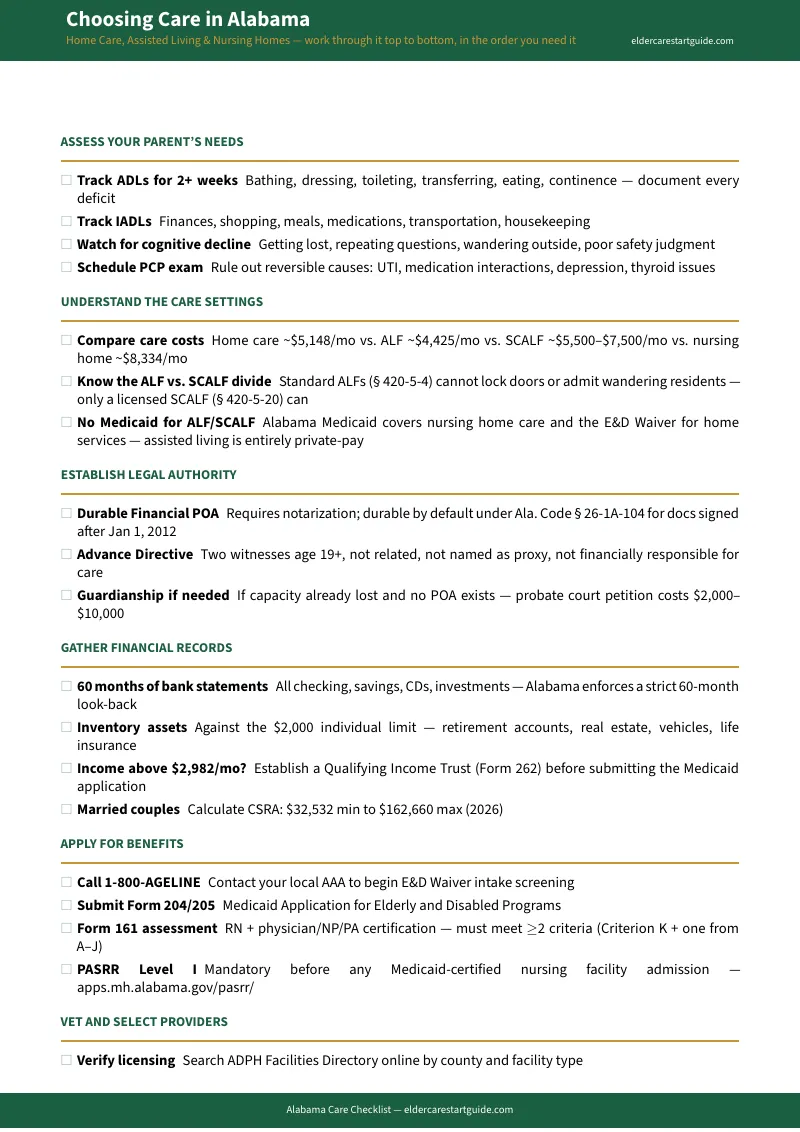
- 24-Item Decision Checklist — a printable quick-start covering every key action from needs assessment through post-placement monitoring
Who This Is For
- Adult children watching a parent's slow decline — missed medications, skipped meals, unexplained bruises — who need a structured way to evaluate whether it's time for outside help
- Families in a hospital discharge crisis, with Medicare's skilled nursing benefit running out and a discharge planner pushing for a quick decision about what comes next
- Anyone comparing home care vs. assisted living vs. nursing home care in Alabama and trying to understand the cost math — especially why private-pay home care can exceed facility costs once needs cross approximately 30 hours per week
- Families trying to determine if their parent qualifies for the Elderly and Disabled Waiver and what the Nursing Facility Level of Care assessment actually measures
- Siblings who disagree about what level of care is appropriate and need a clinical framework based on documented ADL deficits rather than competing opinions
- Anyone confused about the ALF vs. SCALF distinction — and worried that the assisted living facility they're touring might not be legally licensed to handle their parent's memory care needs
- Families trying to protect a surviving spouse's assets during the Medicaid application, or concerned about estate recovery claims on the family home after a parent's death
Why Free Resources Leave You Stuck
Alabama ADPH publishes facility directories, licensing rules, and complaint hotline numbers. The Alabama Medicaid Agency posts eligibility criteria and waiver descriptions. But these resources are designed for providers and administrators — Ala. Admin. Code § 420-5-4 and § 420-5-20 are not family planning guides. You can find the E&D Waiver eligibility standard buried in the administrative code, but you won't find a walkthrough that connects the clinical assessment to the financial application to the legal authority preparation in a sequence a family can follow.
Senior living referral services will match you with assisted living communities for free — because the facilities pay them the equivalent of one month's rent ($3,000–$8,000) as a commission. They recommend only facilities within their paid network, which means they routinely omit non-participating homes, non-profit options, and state-subsidized programs like the E&D Waiver. Their recommendations are shaped by their revenue model, not your parent's needs.
Elder law attorneys and certified Medicaid planners provide expert guidance — at $300 to $500 per hour. For families navigating Miller Trust setup, complex asset structures, or contested guardianship, professional counsel is essential. But you shouldn't be paying attorney rates to learn the difference between ALF and SCALF licensing in Alabama or to understand how the income-cap Medicaid model works. Using this guide to organize your records and understand the system before your first consultation can save hours of billable time.
Satisfaction Guarantee
If the guide doesn't help you identify at least one care setting, waiver program, or vetting step you weren't already aware of, email us for a full refund. No forms, no waiting period.
Start Navigating Alabama Elder Care with Confidence
Download the free checklist to get the care decision overview — or get the full toolkit for and have all the printable PDFs: the complete guide, standalone worksheets, comparison tools, vetting checklists, and contact directories you need to choose the right care for your parent in Alabama.