
The OPG Rejected 133,000 Applications Last Year. Most Were Clerical Errors That Cost £46 Each to Fix — While the Parent's Bank Account Stayed Frozen and Care Fees Kept Accruing at £1,000 a Week.
You downloaded the blank LPA forms from GOV.UK. Two documents — Property and Financial Affairs, Health and Welfare — and they looked manageable. Your parent signed. Then the certificate provider signed. Then the attorneys signed. Except the signing order is wrong: it should be donor first, then certificate provider, then attorneys. The OPG returned the whole packet. You owe £46 per document to resubmit. It has been six weeks and nobody in the family can access the savings account, pay the care home, or talk to the utility company about the direct debit that bounced.
Or maybe you skipped the LPA entirely — you assumed "next of kin" was enough. It is not. Under the Mental Capacity Act 2005, "next of kin" carries zero legal authority for financial transactions or healthcare decisions. Without a registered LPA, the bank freezes the account the moment it suspects capacity loss. The GP will not discuss the treatment plan with you. The local authority social worker decides where your parent lives.
The Wales Lasting Power of Attorney & Deputyship Kit is a Wales Legal Authority System — a step-by-step roadmap covering both LPA types, OPG registration with annotated signing guides, the 2026 fee remission rules that caught families off guard in February, the Court of Protection deputyship route when capacity is already lost, and every Wales-specific care funding threshold that determines whether your parent pays £100 a week for homecare or £1,000 a week for residential care. Not a national overview with a Welsh footnote. A jurisdiction-specific manual built on the Mental Capacity Act 2005, the Social Services and Well-being (Wales) Act 2014, and the current OPG operational framework — covering every requirement, every institutional barrier, and every financial trap in the order Welsh families actually encounter them.
What's Inside the Wales Legal Authority System
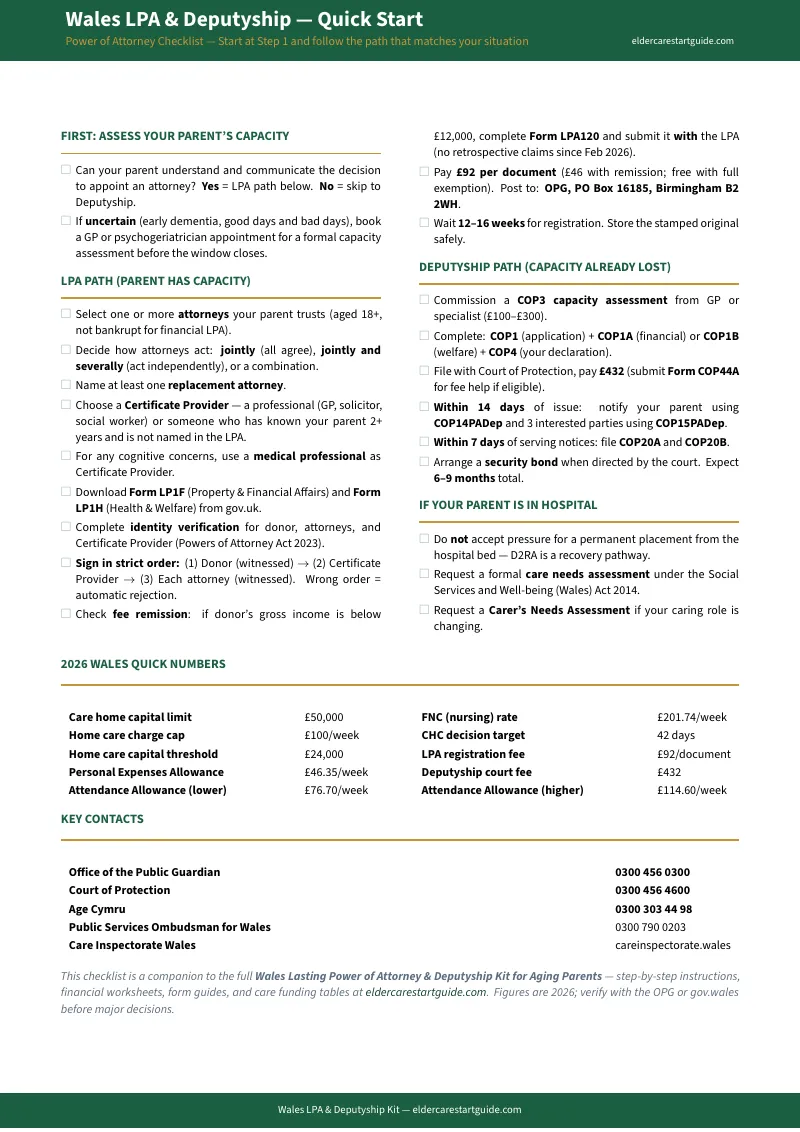
A 15-chapter guide covering both LPA types, deputyship, care funding, asset protection, and hospital discharge — plus a 20-item quick-start checklist:
Both LPA Types — Property & Financial Affairs and Health & Welfare
The Property and Financial Affairs LPA (Form LP1F) lets you manage your parent's bank accounts, pay bills, handle pension income, and sell property. Crucially, it can be used with the donor's consent while they still have capacity — essential for parents who are physically frail but mentally alert. The Health and Welfare LPA (Form LP1H) only activates once capacity is lost, but it gives you authority over medical treatment, care home placements, and daily care decisions including interaction with the All Wales DNACPR policy. The guide covers both forms end-to-end, including the specific situations where you need one, the other, or both.
OPG Registration — The Exact Signing Order and Every 2026 Fee Trap
The single most common reason the OPG rejects applications: signing in the wrong sequence. Donor first, then certificate provider, then attorneys — get it backwards and you lose weeks plus £46 per document. The guide walks through each step with annotated examples. It covers the £92 registration fee, the £46 rejection resubmission penalty, and three 2026 rule changes that cost families hundreds of pounds: Universal Credit no longer qualifies for automatic fee exemption (you must also prove gross annual income under £12,000), retrospective fee remission claims using Form LPA120 are now banned, and the timing window for the LPA120 submission is the same day as the registration application — miss it and you lose up to £184 with no recourse.
Certificate Providers and Witnesses — The Requirements That Invalidate Applications
Your certificate provider cannot be a family member, cannot be an attorney named in the LPA, and must have known the donor personally for at least two years or hold a professional qualification (solicitor, GP, registered social worker). The witness cannot be the donor or any named attorney. Using the wrong person invalidates the entire application. The guide lists every qualification requirement, every disqualification, and what to do when you cannot find a valid certificate provider locally.
Court of Protection Deputyship — When the LPA Window Has Closed
If your parent can no longer understand, retain, or weigh information about what an LPA grants, the standard route is closed. The only remaining path is a Court of Protection deputyship. The guide covers the full application: Form COP1 (application), Form COP3 (medical capacity assessment — who in Wales can complete it: GPs, psychiatrists, approved mental health professionals), the July 2026 fee increase to £432, security bonds, annual OPG supervision fees, notification requirements with strict deadlines, and emergency applications when funds are urgently needed for care. It includes a direct cost comparison: an LPA costs £92 and takes 8 to 12 weeks; a deputyship typically costs thousands of pounds, takes 6 to 12 months, and requires ongoing annual reporting.
Wales Care Funding — The Thresholds England Does Not Share
Wales has its own capital limits for care. Residential care: above £50,000 in capital, your parent is a self-funder paying the full cost (£978 to £1,094 per week on average). Between £24,000 and £50,000, the local authority contributes but charges tariff income. Below £24,000, the authority pays in full. Non-residential care (homecare, day centres, short-term respite under eight weeks): Wales caps charges at £100 per week regardless of capital — a protection England does not have. The guide maps every threshold, explains the financial assessment process, and covers how the capital limits interact with the attorney's duties under an LPA.
Deferred Payment Agreements — The Compound Interest Nobody Mentions
A DPA lets your parent defer care home fees against their property value instead of selling immediately. Sounds protective — until you see the numbers. Welsh local authorities charge compound interest from day one (currently 4.65% per annum), plus setup fees, land registry charges, and annual administration costs. Cardiff Council alone charges over £600 in upfront costs before the first care fee is deferred. The guide covers when a DPA genuinely protects the family, when the compound interest makes it more expensive than selling early, and the mandatory property disregards (spouse, relative over 60, disabled relative in the home) that may mean the property cannot be counted at all.
Deprivation of Assets — Where the Line Is
Transferring the family home into your name, gifting large sums, or moving savings into a trust to avoid the means test are all treated as deliberate deprivation of assets under the Social Services and Well-being (Wales) Act 2014. The local authority can assess your parent as if they still own the transferred asset — with no time limit on looking back. The guide explains the legal test, the common triggers that prompt an investigation, and the legitimate planning steps that an attorney can take without crossing the line.
NHS Continuing Healthcare and Funded Nursing Care
If your parent's primary need is a health need rather than a social care need, they may qualify for NHS Continuing Healthcare — fully funded by the NHS with no means test. The guide covers the CHC Checklist, the Decision Support Tool assessment, how to request a review through the Welsh Local Health Boards (Betsi Cadwaladr, Hywel Dda, Swansea Bay, Cwm Taf Morgannwg, Aneurin Bevan, Cardiff & Vale, Powys), and the appeal process when eligibility is denied. It also covers Funded Nursing Care — the NHS contribution toward nursing costs for residents who don't qualify for full CHC.
Hospital Discharge — The D2RA Pathway and Your Parent's Rights
Wales uses Discharge to Recover then Assess (D2RA) to move patients out of acute beds quickly. The guide explains what D2RA means for your family: you cannot be forced to accept a permanent care home placement directly from hospital, the local authority must complete a care needs assessment before any long-term decision, and the 12-week property disregard protects the home's value for the first 12 weeks of a permanent placement. It covers the attorney's role in challenging unsafe discharge decisions and what to do when the hospital pushes for immediate placement.
Who This Guide Is For
- Your parent is still mentally capable — and you want to execute both LPA types correctly before a crisis forces you into a deputyship that costs thousands and takes months
- Your parent has a dementia diagnosis — and you need to know whether a capacity assessment at the moment of signing could still get you through the LPA route
- Your parent is in hospital — and the D2RA discharge team is pushing for a care home placement while nobody in the family has legal authority to sign contracts or access funds
- Your parent is already in residential care — and you need to manage their finances, evaluate whether a Deferred Payment Agreement is actually in their interest, or challenge a CHC eligibility denial
- You are trying to protect the family home — and you need to know the difference between legitimate planning and deliberate deprivation of assets
Why Free GOV.UK Forms Will Not Get You Through This
The OPG provides blank LPA forms at no charge. Age Cymru publishes detailed factsheets. Care Inspectorate Wales rates care homes. Here is what happens when you try to navigate legal authority in Wales using free sources alone:
- GOV.UK publishes the forms without the process that surrounds them. Signing order, certificate provider qualifications, witness restrictions, identity verification requirements — none of it is on the form itself. Get any of it wrong and the OPG returns the packet with a £46 resubmission fee per document.
- Age Cymru publishes excellent factsheets split across dozens of multi-page PDFs. The information is accurate and Wales-specific. It is also impossible to follow as a linear process — you would need to download and cross-reference eight separate factsheets to cover what one chapter of this guide does, and none of them include editable checklists or decision flowcharts.
- Welsh solicitors provide the same service for £350 to £600 plus VAT per LPA. Deputyship work bills at £250 per hour or more. The content you receive is accurate but the fee structure assumes you need someone else to fill in the forms — when what most families actually need is someone to explain which forms to fill in, in which order, and how the care funding system connects to the legal authority you are trying to establish.
- National digital platforms (Co-op Legal, Farewill) produce standardized LPA documents starting at £120. Their templates do not address Welsh care funding thresholds, do not cover the D2RA hospital discharge process, do not explain CHC eligibility through Welsh Local Health Boards, and do not include the deputyship route. You still need to print, sign, and mail the forms yourself — and if you get the execution wrong, you absorb the rejection cost.
Free sources give you fragments — accurate fragments from different organizations, each covering one piece of the system. The Wales Legal Authority System puts every OPG requirement, every Welsh care funding threshold, every institutional process, and every financial trap into one document, in the order you actually encounter them.
— Less Than One Rejected LPA Resubmission
A single OPG rejection costs £46 per document. A full solicitor-assisted LPA package runs £350 to £600 plus VAT. A Court of Protection deputyship — the route you are forced into when you miss the LPA window — costs thousands of pounds and takes up to a year while care fees accumulate. This guide costs less than one resubmission and gives you the complete Wales legal authority roadmap.
Your download includes 10 PDFs — the 15-chapter guide, the 20-item quick-start checklist, and 8 standalone worksheets and reference sheets you can print and use independently:
- LPA Signing Sequence — the exact execution order that prevents OPG rejections, with certificate provider requirements and 2026 fee traps
- Forms Directory — every LPA and deputyship form, fee, deadline, and download link on one page
- Care Funding Worksheet — fillable means-test calculator for home care and residential care under Welsh thresholds
- DPA Evaluation Worksheet — compound interest modelling to determine whether a Deferred Payment Agreement is in your parent's best interest
- Decision Flowchart — LPA vs deputyship decision tree plus care funding pathway, with a side-by-side cost comparison
- Key Contacts Fridge Sheet — every organisation, phone number, and Welsh Local Health Board in one printable page
- Deprivation of Assets Reference — what triggers an investigation, the no-time-limit rule, and what an attorney can and cannot do
- CHC Assessment Prep Sheet — prepare evidence for the NHS Continuing Healthcare eligibility assessment, with the 12 DST domains and appeal process
30-day money-back guarantee. If the guide does not give you clarity on which legal authority path applies to your family, how to execute the documents correctly under 2026 rules, and how to navigate every Welsh institution standing between you and your parent's care — email us for a full refund.
Not ready for the full guide? Download the free Wales — Power of Attorney Quick-Start Checklist — a step-by-step overview covering capacity assessment, the two LPA types, execution requirements, and what to do if capacity is already lost. Enough to understand which path you are on and what comes next.
You did not choose this responsibility. But your parent needs someone who understands Welsh law, OPG registration rules, and the care funding system — and the system is not going to explain itself. This guide does.