You just became your parent's care coordinator in Scotland. Nobody handed you the manual. This is the manual.
It usually starts without warning: a fall, a hospital admission, a GP who mentions "we should think about a care assessment." Within days you're fielding calls from the Health and Social Care Partnership, trying to decode Self-Directed Support options, and wondering why your colleague's English care advice doesn't match anything the social worker is telling you.
Scotland's care system runs on its own legislation — the Community Care and Health (Scotland) Act 2002, the Adults with Incapacity Act 2000, the Carers (Scotland) Act 2016 — with its own capital thresholds, its own Free Personal Care entitlement, and its own OPG registration process. Most families learn the rules too late, in the wrong order, and from English advice sites that don't apply. By then the expensive mistakes are already locked in.
The Scotland Care Decision System
This guide works the way the system actually works: assessment first, funding second, care decisions last. It's not a stack of information — it's a sequenced playbook, current to Scotland's 2026/27 rules, that tells you what to do this week, what to demand in writing, and what to check before you sign anything.
What's Inside
- The Care Needs Assessment Navigator — how to request a free assessment from your local Health and Social Care Partnership, what the four risk levels mean (Low, Moderate, Substantial, Critical), and how to prepare a 7-day evidence diary so the assessor sees the real situation — not the rehearsed performance your parent delivers for visitors.
- The Free Personal Care Decoder — Scotland's single most valuable provision for older adults, and the one families misunderstand most. Personal care at home is entirely free, regardless of savings. In a care home, the council pays £260.30/week for personal care and £117.10/week for nursing care (2026/27) directly to the provider — even for self-funders. You'll learn exactly what qualifies as "personal care," what doesn't, and how to claim every offset you're entitled to.
- The Financial Means-Test Decoder — the £36,750 upper and £22,750 lower capital limits, tariff income (£1/week per £250 between thresholds), the £37.65/week Personal Expenses Allowance, and what the means test actually counts. Because the English limits you Googled — £23,250 and £14,250 — don't apply here.
- Self-Directed Support (SDS) Explained — the four options the council must offer (Direct Payment, Individual Service Fund, council-arranged, or a mix), how to evaluate each one, and the employment responsibilities that come with Option 1 if you hire a personal assistant directly.
- The Hospital Discharge Playbook — the Discharge to Assess model, your right to a Community Care Assessment before your parent leaves the ward, the free reablement care that buys up to six weeks of breathing room, and the scripts to use when the ward is pressuring you to accept a plan that isn't safe.
- Family Home Protection — mandatory property disregards, the 12-week disregard, Deferred Payment Agreements, and the deprivation-of-assets rules that catch families who transfer property too late. A care crisis does not have to mean a forced sale.
- The PoA & Guardianship Module — Continuing and Welfare Power of Attorney through the Office of the Public Guardian, current registration backlogs (often six months or longer), the plea-for-expedition process that can cut the wait to two weeks, and when Section 13ZA lets the council arrange care without a guardianship order.
- Carer Rights — the Adult Carer Support Plan you're legally entitled to under the Carers (Scotland) Act 2016, the support it can unlock (respite, equipment, emotional support), and how to use it to prove that informal care is unsustainable.
- The Complaints & Appeals System — the formal two-stage complaints procedure, when to escalate directly to the Care Inspectorate, and the SPSO's unique power to review the merits of a social work decision — not just the process.
Plus 7 printable standalone worksheets — the Assessment Prep Diary (7-day evidence log), the Financial Means-Test Calculator, the Care Home Contract Audit Checklist, the PoA Action Tracker, the Carer Support Plan Request Template, the Hospital Discharge Question Card, and the Complaints Escalation Log. Print them, fill them in, and bring them to assessments, ward meetings, and care home visits.
Who It's For
Adult children in Scotland who've just realised a parent can't safely manage alone. The daughter coordinating remotely from London who keeps running into rules that don't match the English system. The son staring at a hospital discharge notice who needs the first 72 hours mapped out under Scottish rules. The self-funding family above £36,750 who want to claim every Free Personal Care offset and avoid signing a care home contract with hidden top-ups.
Why Not Just Use Free Information?
Care Information Scotland and Age Scotland explain each rule well — in isolation, across dozens of pages, in the order the legislation is structured rather than the order events actually happen to your family. None of them hand you the assessment evidence diary, the means-test calculator, the discharge objection script, or the care home contract audit checklist. This guide closes that gap: every chapter ends in something you can send, print, or tick off.
And it's honest about the things free sources tiptoe around — the self-funder premium, the OPG backlogs that leave families without legal authority for half a year, and the contract clauses care homes hope you won't question.
One wrong assumption — that English capital limits apply, that you can't claim Free Personal Care as a self-funder, that a top-up fee is standard — costs families thousands. The guide costs , less than a single hour of the home care it's about to help you arrange properly.
Start With the Free Checklist
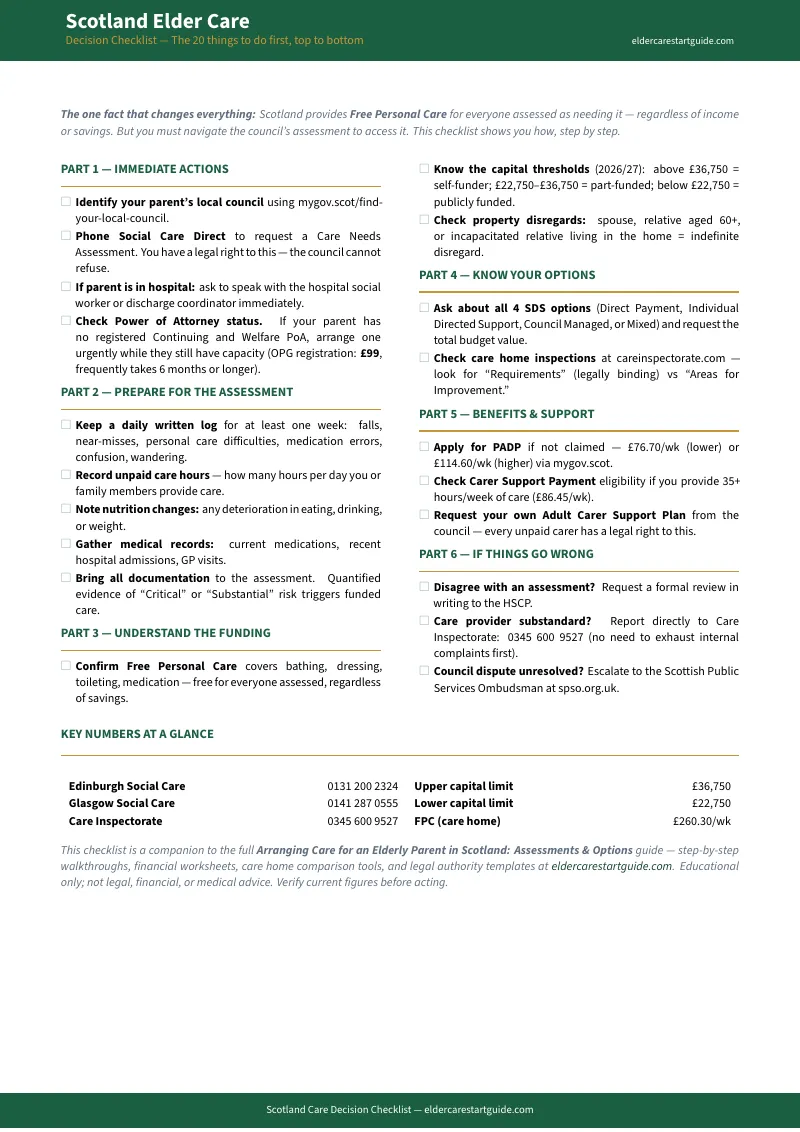
Not sure yet? Download the free Scotland — Care Needs Assessment Checklist — 20 items covering the first assessments to request, the 2026/27 funding rules, the legal authority steps, and the critical missteps to avoid. It's the fast version of the same system. When you're ready for the full playbook — templates, scripts, calculators, and the complete 18-chapter guide — the full toolkit is waiting.
Get the complete Scotland Care Decision guide now — instant download, printable worksheets, and a plan you can act on this week.