Your parent is having a medical episode. You have 60 seconds to decide what to do.
It's 11 p.m. Your mother is slurring her words. Or your father fell in the bathroom and can't get up. Or your parent's new confusion could be a stroke — or could be a urinary tract infection that looks exactly like one.
You're not a nurse. Google gives you seventeen contradictory answers. Calling 911 might mean a $3,000 ambulance ride for something urgent care could handle. Waiting until morning might mean permanent brain damage from a stroke you dismissed as fatigue.
The gap between "should I call?" and "I know what to do" is where preventable harm happens — and where caregivers carry guilt for years.
The Caregiver Triage System
The When to Call 911 vs the Doctor toolkit is a clinical decision framework built for people without medical training. It replaces panic-driven guessing with structured flowcharts that walk you through symptoms step by step — and tell you exactly who to call, what to say, and what to document.
This isn't a list of symptoms to Google. It's a triage system: a sequence of yes/no checkpoints that route you to the right response in under two minutes, whether that's 911, urgent care, Poison Control, or a next-day doctor appointment.
What's Inside
- Emergency triage flowcharts — clinical decision trees for the seven most common caregiver emergencies: falls, sudden confusion, chest pain, breathing changes, medication errors, unresponsiveness, and suspected stroke. Each flowchart routes you to 911, urgent care, or the doctor's office based on observable symptoms — no medical degree required.
- Geriatric red-flag reference — the silent presentations that kill because caregivers don't recognize them: heart attacks without chest pain in women and diabetics, UTIs that mimic dementia, slow subdural bleeds that show no symptoms for days after a minor fall, and sepsis that starts as "she's just not herself today."
- 911 call script — the exact words to give dispatchers so the right resources arrive fast. Covers address, cross streets, baseline cognitive state, active diagnoses, current medications, and what changed — structured so you read it under pressure instead of trying to remember.
- Medication safety system — a reconciliation log, high-risk drug warnings for anticoagulants and insulin, and a polypharmacy tracker. Nearly 100,000 seniors are admitted to emergency rooms each year for preventable medication errors — double-dosing, missed interactions, and wrong-pill mistakes that a simple tracking sheet catches.
- Hospice and palliative exception protocols — when a Do Not Hospitalize directive changes the 911 equation, when to call hospice instead of an ambulance, and how to document your parent's wishes so first responders follow them without delay or confusion.
- Hospital discharge defense — CARE Act advocacy scripts, Medicare appeal timelines, and the specific language that triggers a mandatory safety review when a hospital pushes discharge before your parent is medically ready to go home.
- Emergency preparedness kit — a Go-Bag packing checklist, a refrigerator-ready emergency information sheet, and a pre-filled contact card so the next crisis doesn't begin with twenty minutes of searching for insurance cards and medication lists.
- Advance directive organizer — a single-page registry for locating your parent's healthcare proxy, living will, POLST/MOLST, and financial power of attorney when every minute counts.
Who This Is For
- The primary caregiver making medical decisions alone — you're the one fielding the 2 a.m. symptoms, and you need a system that tells you what to do when you can't think straight.
- The long-distance child coordinating care remotely — you need a protocol that siblings, paid aides, or a visiting nurse can follow without calling you for every decision.
- The sandwich-generation caregiver — you're juggling a career and young children while monitoring a parent whose health changes faster than you can track.
- The spousal caregiver managing your own health — you're balancing your own chronic conditions with assessing whether your partner's new symptoms need an ambulance or a phone call.
Why Free Resources Fall Short
AARP covers stroke signs. WebMD lists chest pain symptoms. Medicare.gov explains observation status. But none of them connect the dots into a single triage decision you can execute at 3 a.m.
Forum posts on AgingCare and Reddit give you raw stories from other caregivers — emotionally validating, but unstructured and unverified. You're piecing together medical advice from strangers while your parent's symptoms are changing.
Geriatric care managers cost $100–$250 per hour. Elder law attorneys charge $300 or more per hour. This toolkit doesn't replace them — it prepares you so your first paid consultation isn't wasted on intake paperwork and basic terminology. Families who arrive with an organized medical binder and clear questions get more value from every billable hour.
The gap this fills: a structured decision system between "I should probably Google this" and "I need to hire a professional." The flowcharts, scripts, and tracking logs in this toolkit cover the space where most medical mistakes and caregiver guilt actually happen — the first five minutes of a symptom you weren't expecting.
Satisfaction Guarantee
Full refund, no questions asked. If the toolkit doesn't give you a clear action plan for your next medical scare, email us and we'll return your purchase immediately.
Get Started
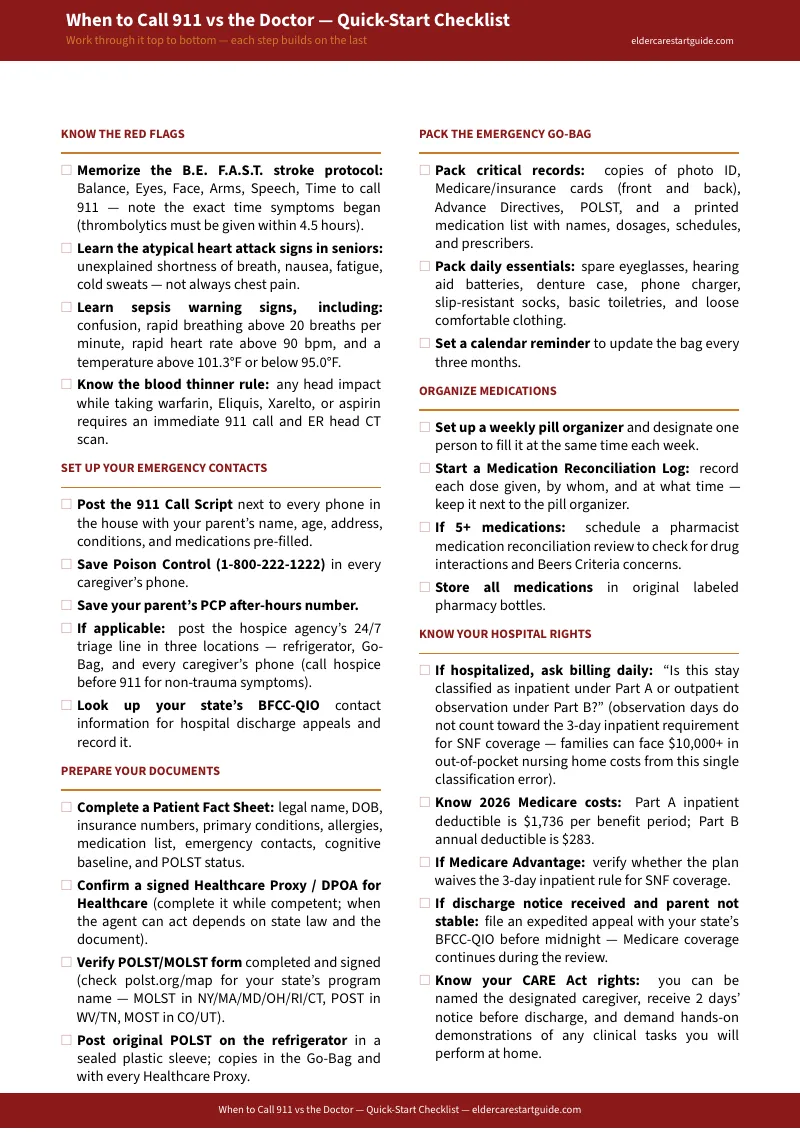
Download the free Quick-Start Checklist to see the triage approach in action — 25 yes/no checkpoints covering the most common caregiver emergencies.
Ready for the full system? The complete toolkit — with flowcharts, call scripts, medication logs, discharge defense protocols, and emergency preparedness templates — is available for .