They Keep Saying "I'm Fine." You Keep Finding Evidence They're Not.
The burned pot in the sink. The medications still in the blister pack three days past. The stack of unopened mail that now includes a utility shutoff notice. You can see the decline — and every time you try to help, your parent shuts you down.
"I don't need anyone's help." "Stop treating me like a child." "I've been taking care of myself for 70 years."
You've tried the gentle approach. You've tried the direct approach. You've tried having your brother call because maybe they'll listen to him. Nothing works. And every week, the gap between what your parent says and what you observe gets wider.
Meanwhile, you're Googling "can I force my parent to accept help" at 1 a.m. — reading contradictory forum posts, government pages that end with "consult an attorney," and articles that tell you to "just have a conversation" as if you haven't already had that conversation forty times.
The Care Resistance Roadmap
This is not another article about "tips for talking to your aging parent." It is the structured escalation system — the complete path from the first conversation through legal intervention, organized in the order families actually move through the problem.
The guide starts with why your parent refuses help (it's almost never stubbornness — it's fear, neurological deficit, or both), moves through clinical risk assessment so you know whether you have weeks or hours, gives you the specific communication scripts that therapists and geriatric care managers use with resistant clients, and maps the full legal path from voluntary Power of Attorney through Adult Protective Services and court-ordered guardianship.
Most free resources stop at "have a family meeting." This guide starts there and keeps going — through the doctor visit you need to engineer, the home safety changes your parent will actually accept, the professional interventions that break impasses families cannot break alone, and the financial planning that makes any of it affordable.
What's Inside
- The Psychology of Refusal — Why "I'm fine" really means "I'm terrified of losing who I am." The three clinical drivers of resistance — fear of lost independence, anosognosia (the neurological inability to recognize cognitive decline, present in up to 80% of moderate-to-severe dementia cases), and the paradox of not wanting to be a burden. You can't change the conversation until you understand what's actually driving it.
- Clinical Risk Assessment Framework — A structured ADL/IADL evaluation so you stop guessing whether the situation is concerning or dangerous. The specific markers that distinguish normal aging from active self-neglect, the environmental red flags clinicians look for, and the screening tools (PHQ-2, Mini-Cog, MoCA) you can ask your parent's doctor to administer.
- OARS Communication Scripts — Open-ended questions, affirmations, reflective listening, and summaries — the motivational interviewing framework therapists use with resistant clients. Word-for-word scripts for the ten most common refusal scenarios: "I don't need a caregiver," "I'm not going to a home," "Stop checking up on me," "There's nothing wrong with my driving." Each script designed to lower defensiveness rather than raise it.
- Doctor Visit Engineering — How to contact your parent's physician in advance within HIPAA limits (you can always send information to a doctor — you just can't receive it without consent), how to frame the visit so your parent actually goes, and the specific assessments to request. Your parent's doctor can be your most powerful ally — but only if you prepare the visit correctly.
- Home Safety Without a Fight — Environmental modifications your parent will accept because they're framed as convenience, not concession. Grab bars presented as "the contractor was already here." Medication management introduced through a pill organizer that solves the "wait, did I take that?" problem. Changes that reduce risk without triggering the independence alarm.
- Family Meeting Agenda and Role Assignments — A structured meeting framework for the real-world situation where one sibling sees the decline up close and others minimize it from 800 miles away. Rotating primary contact schedules, a formal caregiver agreement template that protects Medicaid eligibility, and the documentation framework that makes the situation visible to everyone on the family team.
- Professional Engagement Playbook — When to hire a Geriatric Care Manager ($100–$250/hour), an elder-law attorney ($300–$500/hour), or a benefits counselor — what to ask each one, what each one costs, and how to find them. The professionals who break impasses that families cannot break alone.
- The Legal Escalation Path — The full sequence from cooperative negotiation through voluntary Power of Attorney, physician-facilitated intervention, Adult Protective Services reporting, and court-ordered guardianship. Each step with its legal requirements, its emotional cost, and the specific circumstances where it becomes necessary. Not because you want to use this chapter — because you need to know the path exists before you need to walk it.
- Financial Planning Across Every Option — The real cost of every care arrangement (private home care at $30–$40/hour, assisted living at $5,400–$5,900/month median, nursing facility care at $9,700+/month), plus the funding sources most families don't find until the savings are gone: VA Aid and Attendance benefits, Medicaid long-term care eligibility, state Structured Family Caregiving programs, and the look-back period rules that can disqualify you retroactively if you don't plan ahead.
- Daily Tracking and Communication Templates — Incident logs, medication trackers, care conference agendas, and the communication checklist that keeps the whole care team — family, physicians, hired caregivers, attorneys — aligned and documented.
12 Printable PDFs — Including 10 Standalone Tools
Every major tool in the guide is also a standalone, print-ready PDF you can take to appointments, distribute to siblings, or post on the fridge: Risk Assessment Worksheet, OARS Communication Scripts, Doctor Visit Preparation Kit, Home Safety Checklist, Family Meeting Agenda, Personal Care Agreement, Legal Escalation Path, Care Cost Comparison, Caregiver Communication Checklist, and Caregiver Daily Log.
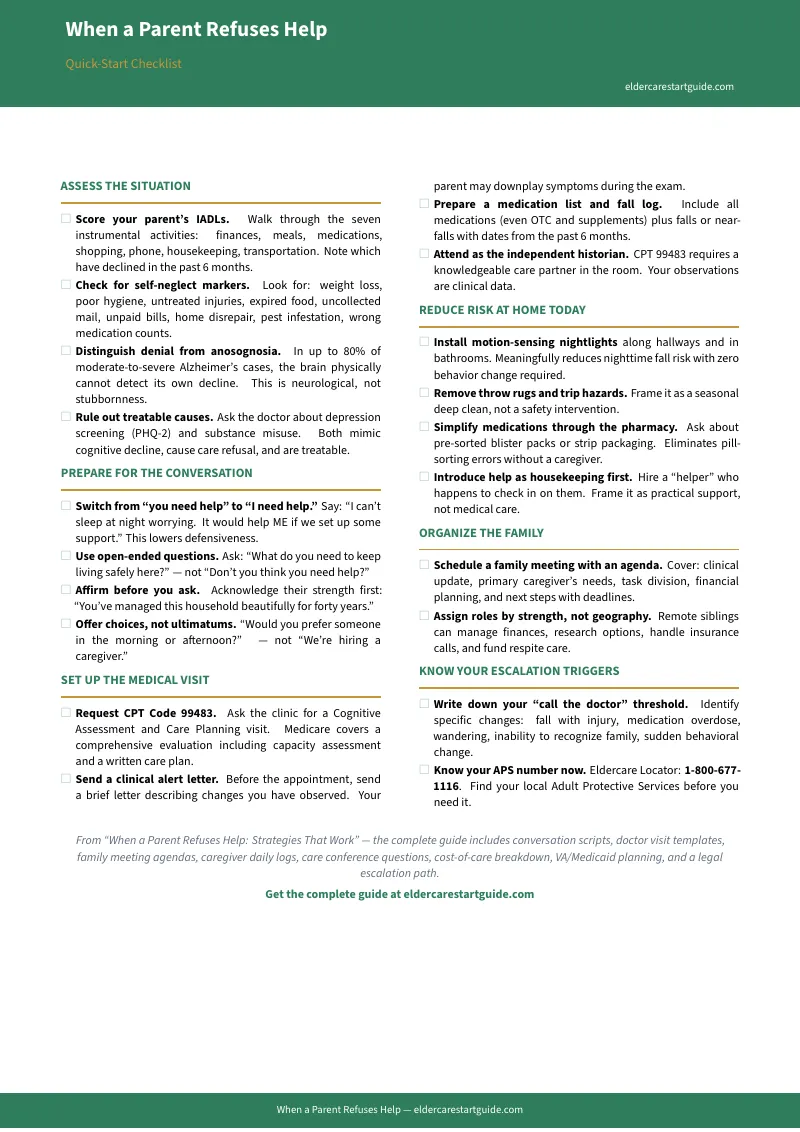
Plus: The Free Quick-Start Checklist
The 20 highest-impact action items from the full guide — what to assess, who to call, and what to document — so you can start moving tonight even before you open the full guide.
Who This Is For
- Adult children who have tried reasoning with a resistant parent and hit the same wall repeatedly — and who need a structured path forward, not another article telling them to "just communicate"
- Sandwich generation caregivers juggling work, their own kids, and a parent who insists nothing is wrong while burned pots accumulate in the kitchen
- Long-distance caregivers who see decline during visits but can't be there daily — and who need a documentation and communication system that works across distance
- Families where siblings disagree about how bad the situation is, because the local sibling sees daily decline and the distant siblings see a put-together parent during holiday visits
- Anyone whose parent has early-stage dementia and genuinely cannot perceive their own decline — where logical persuasion doesn't work because the brain's error-monitoring system is damaged
- Adult children who know guardianship exists but have no idea when it's warranted, what it costs, or whether there's anything less drastic that would work first
Why Not Free Online Resources?
The Eldercare Locator will give you your local Area Agency on Aging phone number. AARP has a fact sheet on caregiver burnout. The National Institute on Aging explains what dementia is. None of them are wrong.
Here is what none of them provide:
- A structured escalation framework that maps the sequence — what to try first, what to try when that fails, and the specific clinical and legal thresholds that determine when you move to the next step
- Word-for-word communication scripts for the actual conversations you're dreading — not "use I-statements" advice, but the specific sentences that geriatric care managers use when they walk into a resistant client's home
- A risk assessment tool you can use today to determine whether your parent's situation is "keep watching" or "act now" — because the difference between early intervention and a crisis call is documentation you didn't know you needed
- A family meeting agenda that works when siblings don't agree — with role assignments, rotating schedules, and a formal caregiver agreement that prevents Medicaid complications later
- A legal escalation path in plain language that covers POA, APS reporting, and guardianship — not "consult an attorney" as the entire answer
Free resources tell you what the options are. This guide tells you which option to use, when, and exactly how to execute it — organized in the order you'll actually need them.
Satisfaction Guarantee
If the guide doesn't give you a clearer path forward within a week of downloading it, email us and we'll refund your purchase. No forms, no justification needed.
Start Moving Tonight
Download the free Quick-Start Checklist to see the 20 actions that matter most. When you're ready for the communication scripts, risk assessment tools, legal escalation path, and family meeting templates behind each item — the full guide is waiting.