You already know something is wrong. You just don't know what to do about it.
The dented fender. The close call at the intersection. The phone call from a neighbor who watched your parent drift into oncoming traffic. You know the driving needs to stop — but every time you try to bring it up, the conversation ends in anger, tears, or flat-out denial.
So you lie awake calculating the odds. Another week, another month, another season of hoping nothing happens. Meanwhile, the liability exposure grows — because under the doctrine of negligent entrustment, anyone who knowingly allows an unfit person to operate a vehicle they own or control can be held personally liable for the resulting injuries. That includes adult children whose name appears on the insurance policy.
The Driving Retirement System — stop being the bad guy
Most families treat this as a single conversation: sit down, make your case, take the keys. But a conversation is the weakest tool in your kit — especially when your parent believes they're driving fine (a neurological condition called anosognosia literally prevents some older adults from recognizing their own impairment).
The Driving Retirement System replaces that losing battle with a structured, multi-channel process that shifts the weight of the decision to objective third parties — physicians, state licensing boards, certified driving evaluators — so you can step out of the "bad cop" role entirely. The state or the medical diagnosis takes the blame. You remain the supportive, loving family member.
What's inside
- Driving Behavior Observation Log — a structured documentation system with four categories (cognitive, motor, visual, operational) and immediate-stop triggers. Two to three weeks of entries builds the objective case that emotional arguments never can.
- Non-destructive vehicle disabling methods — key-fob battery removal, fuel pump fuse pull, starter relay disconnect, and battery terminal cover techniques that make the car inoperable without permanent damage or dramatic confrontation.
- Word-for-word conversation scripts — reflective listening scripts that reframe the transition from "losing independence" to "entering a well-earned retirement from driving." Includes objection-handling for every common response, from "I've been driving for 50 years" to "you just want to control me."
- Medical evaluation playbook — how to brief your parent's primary care physician before the appointment, request a formal "retire from driving" prescription, and secure a referral to a Certified Driver Rehabilitation Specialist (CDRS) for a clinical and behind-the-wheel assessment ($300–$600, often the most effective path when voluntary cooperation fails).
- DMV administrative channels — the exact reporting forms, filing routes, and timelines for major states (California DS 699, Wisconsin MV3141, New York DS-7, Florida HSMV 72190), with critical warnings about confidentiality vs. anonymity protections.
- Power of Attorney reality check — a clear explanation of what a durable POA actually authorizes (it does not give you the right to confiscate keys or sell a vehicle against a competent parent's will), when guardianship becomes necessary, and the administrative alternatives that avoid guardianship entirely.
- Medicaid-compliant vehicle sale guidance — how to handle the vehicle after driving cessation without jeopardizing your parent's Medicaid eligibility, including the exempt-asset rules and lookback period considerations.
- Complete transportation replacement plan — GoGoGrandparent (phone-call interface for Uber/Lyft), ITNAmerica, volunteer driver networks, paratransit eligibility, Area Agency on Aging programs, and a family driving schedule template. Because taking away the keys only works when you replace the mobility.
- Sibling alignment framework — a structured family meeting agenda, evidence-sharing protocol for distant siblings, and the case for engaging a geriatric care manager as a neutral mediator when the family is divided.
Who this is for
- Adult children who've noticed warning signs — close calls, new dents, getting lost on familiar routes — and need a plan, not just a conversation
- Families in crisis after an accident, a diagnosis, or a hospital discharge, who need to act now and figure out the process as they go
- The sibling who lives closest and sees the problem firsthand, but can't get the rest of the family to take it seriously
- Spouses of aging drivers who need to navigate this transition without destroying the relationship
- Anyone holding Power of Attorney who assumed it gave them the authority to handle this — and just discovered it doesn't
Why free guides fall short
Organizations like AARP, AAA, and the Alzheimer's Association publish free resources on this topic. They're well-intentioned and their conversational advice is solid — for cooperative parents who are willing to talk.
But they're written by risk-averse institutions that cannot tell you how to physically disable a car, which DMV forms to file when your parent refuses to cooperate, or what to do when the conversation fails completely. Their content is theory. It tells you what to think about. It does not tell you what to do at 10 PM when your father just drove home from the pharmacy and couldn't find his way back from a store he's visited weekly for thirty years.
The Hartford's "At the Crossroads" program, developed with the MIT AgeLab, is the best free resource available — and it focuses almost entirely on the early, cooperative planning stage. It does not cover the administrative enforcement channels, the vehicle disabling procedures, or the legal authority questions that families face when the cooperative stage has passed.
Full refund, no time limit
If the guide doesn't give you the structure and clarity you need, email [email protected] for a full refund. No time limit, no questions.
What you get
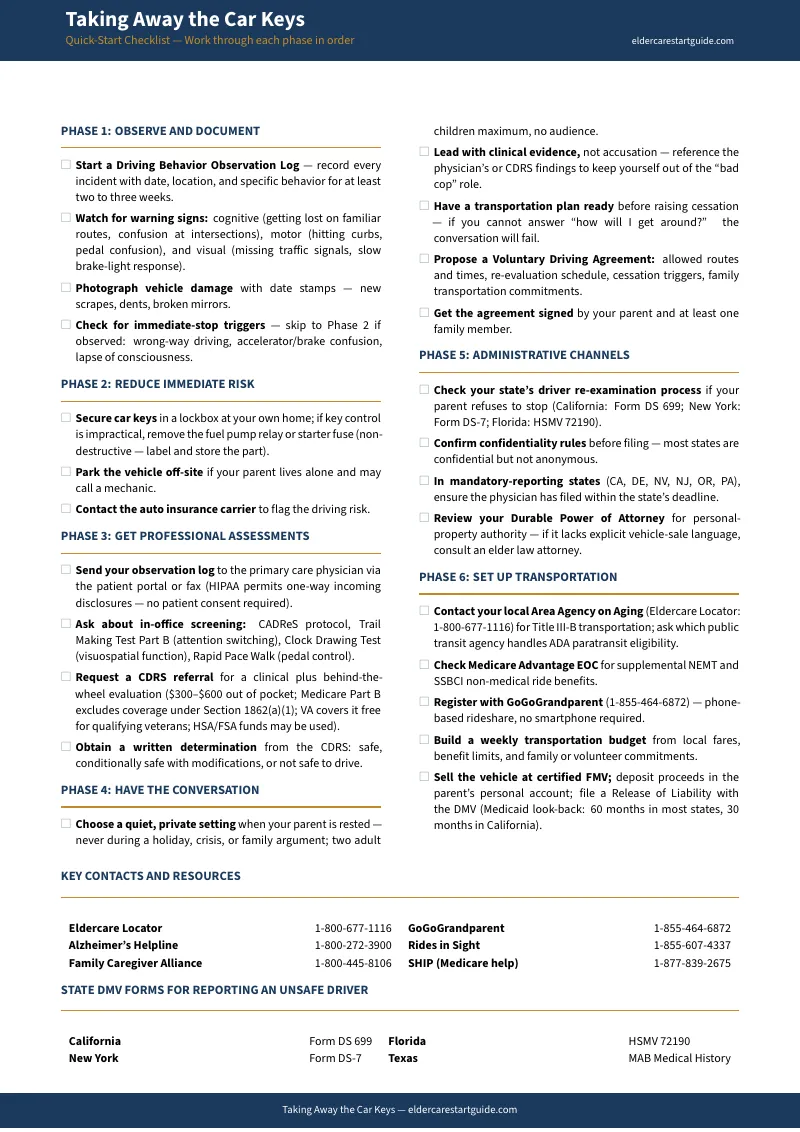
A 47-page guide covering the complete process from first warning signs through transportation replacement, a quick-start checklist that sequences the critical steps, and 8 standalone printable worksheets — including a 3-week Driving Behavior Observation Log, a Family Conversation Planner with objection-handling prep, a signable Voluntary Driving Agreement, a DMV Reporting Quick Reference, a CarFit Vehicle Safety Checklist, a Medicaid-compliant Vehicle Sale Checklist, a Weekly Transportation Planner, and a Professional Consultation Tracker. All 10 PDFs are instant downloads — no waiting, no shipping, no subscription.
Download the free checklist to see the sequence. When you're ready for the scripts, forms, clinical playbooks, and legal boundaries that make each step actually work, the full guide is here.