
Your parent is withdrawing — and you cannot tell if it is aging or something treatable
The phone calls have gotten shorter. The garden is overgrown. Your mother, who used to host neighbors every Thursday, now cancels plans and stops answering the door. When you bring it up, she says she is "just tired."
You have Googled the symptoms. You have read the AARP articles. But every source tells you something different about what is normal and what is not — and none of them give you a system to actually figure it out.
Meanwhile, the window for early intervention is closing. Late-life depression doubles the risk of hospitalization, accelerates cognitive decline, and quadruples the lethality of suicide attempts in older adults compared to younger populations. Every week without a clear clinical picture is another week where a treatable condition compounds into a crisis.
The Clinical Screening and Action System
This is not another article about "signs of depression in seniors." It is a structured toolkit — the same clinical instruments, medication audit protocols, and care-coordination frameworks that geriatric care professionals use, organized into a step-by-step system that a family caregiver can execute without a clinical degree.
The toolkit replaces scattered Googling with a validated process: screen with the right instrument, audit the medications that could be causing the symptoms, have the conversation without triggering defensiveness, coordinate the family response, and navigate the legal and financial systems that fund treatment. One system, from first suspicion through ongoing monitoring.
What you get
- GDS-15 and Cornell Scale Scoring Guides — the two validated screening instruments for geriatric depression, with clear thresholds so you know whether the score means "watch and wait" or "book an appointment this week"
- Seven-Class Medication Audit — a structured worksheet covering corticosteroids, benzodiazepines, antihistamines, beta-blockers, central alpha-agonists, PPIs, and anticonvulsants, built on the AGS Beers Criteria. Some parents are not depressed — their pill bottle is the problem
- Grief vs. Depression Decision Framework — the clinical distinction between normal bereavement, Prolonged Grief Disorder, and Major Depressive Disorder, translated into observable daily behaviors so you can tell the difference without guessing
- Conversation Scripts for Resistant Parents — word-for-word approaches that reframe "I think you're depressed" into a discussion about sleep, energy, and physical comfort. Includes scripts for involving a trusted intermediary like a primary care physician
- 72-Hour Post-Hospital Transition Plan — the discharge window where mood-related medication errors and untreated depression most often escalate. Covers the AHRQ IDEAL framework, medication reconciliation, and home safety verification
- Five-Phase Caregiver Action Plan — a day-by-day timeline from initial risk assessment through ongoing monitoring, with escalation triggers at every phase so you never have to guess when the situation warrants a higher level of response
- Behavioral Activation Templates — evidence-based daily and weekly activity schedules that use temptation bundling and graded engagement to rebuild routine and reduce isolation, without requiring your parent to "try harder"
- Sibling Task-Allocation Framework — a scoring model that divides responsibilities by proximity, availability, and skill. Includes family meeting agendas and ground rules so the discussion stays on the care plan instead of old grievances
- Legal Authority Checklists — US, UK, Australia, Canada — the healthcare proxies, financial powers of attorney, and capacity documentation you need in place before a crisis removes your parent's ability to grant them
- Funding Navigator — what Medicare Part B, the NHS, Australia's Medicare Benefits Schedule, and Canadian provincial health plans cover for geriatric mental health services, with step-by-step access instructions
Who this is for
- Adult children who have noticed a change and need a structured way to assess whether it is depression, grief, medication side effects, or normal aging — instead of hoping it resolves on its own
- Remote caregivers who cannot observe their parent daily and need validated tools that produce an objective score they can share with siblings and clinicians
- Families in the post-hospital window where a parent's mood has dropped and nobody at the hospital explained what to monitor or when to escalate
- Anyone whose parent refuses to discuss their mental health — the scripts bypass diagnostic labels entirely and approach through the door your parent is willing to open: physical health
Why free online resources leave you stuck
Government health sites give you clinical definitions. Caregiver blogs give you emotional support. Neither gives you a sequential system you can execute.
The National Institute on Aging explains what late-life depression is. It does not hand you a medication audit worksheet, a screening score sheet with action thresholds, or a conversation script for a parent who gets angry when you suggest something might be wrong. AARP's articles are helpful overviews — but they stop at awareness and direct you to professionals who charge $125 to $500 per hour.
This toolkit sits in the gap between awareness and professional intervention. It gives you the same structured assessment tools professionals use, in a format that does not require a clinical appointment, a referral, or a billable hour to start using tonight.
Satisfaction guarantee
If the toolkit does not give you a clear, actionable path forward for your parent's situation, email [email protected] for a full refund — no time limit, no questions.
The full toolkit costs less than 15 minutes of a geriatric care manager's time. Get the Spotting Elder Depression Toolkit →
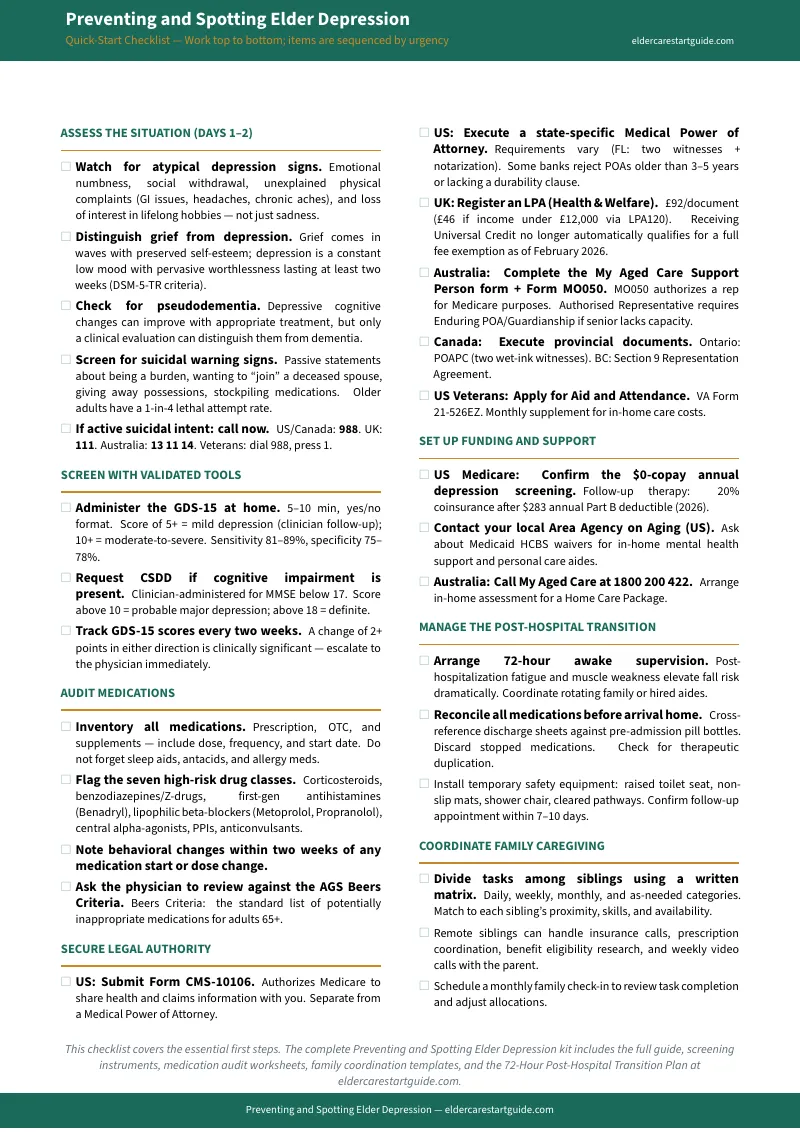
Not ready for the full toolkit? Download the free quick-start checklist — it covers the key warning signs and gives you one concrete action for tonight.