
Your Family Is Stuck. The Care Isn't.
Your parent needs more help every week — medication management, doctor visits, daily safety decisions, financial oversight — and the family conversation about who does what has stalled somewhere between guilt, silence, and accusations.
Maybe you're the one handling everything while your siblings offer opinions from three states away. Maybe you're the distant sibling who keeps getting shut out of decisions. Maybe the last family meeting ended in a shouting match and nobody has spoken since.
Whatever the configuration, the pattern is the same: the care is urgent, the communication is broken, and every week without a plan makes both problems worse.
The Care Resolution System
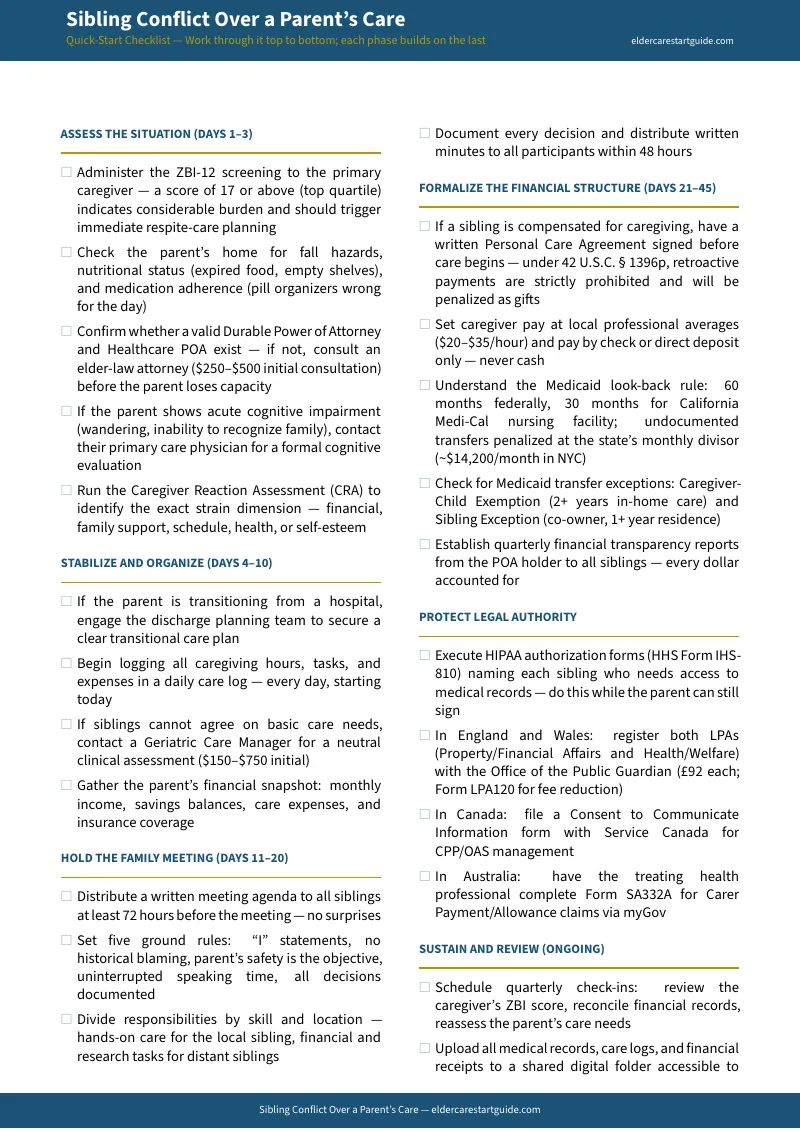
This is not a collection of tips about "communicating better." It's a sequenced system — assessment, meeting, allocation, agreement, monitoring — designed so each step produces a concrete output that feeds the next. Families who use it don't just talk about dividing responsibilities. They leave with a written plan that holds up under stress and, when necessary, under legal scrutiny.
Free caregiving articles tell you what to do (get a Power of Attorney, hold a family meeting, divide the tasks). This toolkit shows you how — with clinical tools that measure caregiver strain objectively, a meeting framework that prevents childhood dynamics from hijacking the conversation, and financial agreement templates that survive a Medicaid audit.
What's Inside
Clinical Assessment Instruments
The validated tools professionals use to measure caregiver burden and care quality — the Zarit Burden Interview, the Caregiver Reaction Assessment, the Care Adequacy Scale, and the Family Caregiving Capacity Tool. When a sibling dismisses your exhaustion as drama, these replace anecdote with scores that a mediator, attorney, or physician will take seriously.
Five-Stage Resolution Workflow
A sequenced process that moves from assessing current care gaps through structured role allocation, financial planning, formal agreements, and long-term monitoring. Each stage produces a defined output — a completed assessment, a signed allocation matrix, a draft care agreement — so the family knows exactly what's decided and what remains open.
Family Meeting Framework
A 90-minute agenda with time-boxed discussion blocks, non-negotiable ground rules, and de-escalation scripts for the moments when old family patterns surface. Designed so the controlling eldest doesn't dominate, the avoidant sibling can't deflect, and the parent's actual needs stay at the center. Includes guidance on whether the parent should attend based on their cognitive capacity.
Unilateral Action Protocol
For primary caregivers whose siblings refuse to engage. A step-by-step strategy for making care decisions alone that are documented, defensible, and communicated in writing — so you're protected regardless of whether anyone responds. You don't need their cooperation to protect your parent's safety or your own wellbeing.
Care Responsibility Matrix
A framework that divides caregiving labor by category — medical, financial, logistical, emotional, administrative — and matches each task to the sibling with the capacity to do it. Factors in geography, work schedules, skills, and financial resources instead of defaulting everything to whoever lives closest.
Medicaid-Compliant Financial Structures
Personal Care Agreement templates that formalize caregiver compensation and protect the family during Medicaid's 60-month lookback period. Expense-sharing models (equal, proportional to income, proportional to involvement). Quarterly financial disclosure templates that prevent the slow suspicion that someone is mismanaging the money — the argument that destroys more caregiving families than any medical crisis.
Legal Authority Roadmap
Plain-language guidance on when you need a Durable Power of Attorney, a Healthcare Proxy, a HIPAA authorization, or a guardianship petition — and the specific situations where each applies. Covers US state-by-state rules, UK Lasting Powers of Attorney and the Mental Capacity Act, Canadian provincial frameworks, and Australian enduring guardianship.
Communication Templates and Scripts
Ready-to-adapt language for the conversations that keep stalling: asking a distant sibling for financial help, telling a sibling that their behavior is harming the parent's care, raising facility placement for the first time, and setting firm boundaries without inviting a negotiation.
Special Situations
Dedicated sections for dementia-specific conflict (when siblings disagree about diagnosis severity), VA benefits coordination for veteran parents, cross-border families navigating multiple legal systems, and only children managing care alone.
Who This Is For
- Primary caregivers running on empty — you're doing most or all of the daily work and need both a practical system for distributing the load and a legal framework for protecting yourself if redistribution fails
- Distant siblings who want to help — you can't be there daily, but you're not absent by choice, and you need a structured way to contribute from wherever you are
- Families in a care transition crisis — a hospital discharge, a dementia diagnosis, a safety incident — where the disagreement about what happens next is burning time your parent doesn't have
- Planners who want to prevent the fight — your parent's needs are growing, the family hasn't talked about it, and you'd rather have a plan than a crisis
Why Free Resources Won't Get You There
AARP has solid articles on sibling dynamics. The National Institute on Aging publishes trustworthy clinical information. State Medicaid websites explain eligibility rules. None of them give you a sequenced system that connects the family meeting to the financial agreement to the legal authority to the monitoring schedule.
Free advice tells you to "get a care agreement" — but doesn't show you how to structure one so it isn't classified as a gift during a Medicaid lookback audit. It tells you to "hold a family meeting" — but doesn't give you the 90-minute agenda with de-escalation scripts that keeps childhood roles from running the session. It tells you to "divide responsibilities fairly" — but doesn't provide the capacity-based matrix that accounts for geography, income, availability, and skill.
The gap between knowing what you need and knowing how to execute it is where families get stuck. This toolkit closes that gap.
Referral-based placement services like A Place for Mom are free to families but earn commissions from the facilities they recommend — often 100% of the first month's rent. Their incentive is a fast, expensive placement. This guide has no referral relationships with any facility or service. It helps your family evaluate all the options, including the affordable ones the referral sites don't mention.
Satisfaction Guarantee
If the toolkit doesn't give your family a clearer path forward within 30 days, email us for a full refund. No forms, no questions.
Get Started
Download the free Quick-Start Checklist to identify your family's biggest care gaps tonight. When you're ready for the full system — assessments, meeting framework, agreements, templates, and the complete resolution workflow — get the toolkit for .