
You Noticed Something Was Off. Now What?
The dent on the car you hadn't seen before. Expired food in the back of the fridge. Bills still sealed in their envelopes. Your parent insists everything is fine — but your gut says otherwise.
You could spend the next three weeks Googling "signs my parent needs help" and reading 47 different AARP articles that all say "look for changes in hygiene" without telling you what to actually do about it. Or you could walk through your parent's home with a structured triage system that tells you exactly what you're looking at, how serious it is, and what step to take next.
The Weekend Visit Triage System
Most warning-sign checklists tell you what to worry about. This toolkit tells you how to act on what you find — in a specific sequence that prevents the two mistakes adult children make most often: waiting too long, or panicking and doing too much at once.
It's built around three layers that work together:
- Layer 1: The 4-Zone Home Audit — a room-by-room walk-through (driveway, kitchen, bathroom, desk) designed for a 15-minute visit. Each zone has specific indicators with clinical context — not "look for mess," but "check whether grab bars are installed, whether the water heater is set above 120°F, whether medications have been refilled on schedule."
- Layer 2: The ADL/IADL Clinical Scorecard — the same scoring framework geriatric care managers charge $150–$750 to administer. You score your parent's independence across bathing, dressing, finances, medication management, transportation, and home upkeep. The scorecard tells you whether you're looking at "keep an eye on it" or "act this month."
- Layer 3: The Action Sequencer — a chronological roadmap that turns your assessment into a plan. Confirm legal authority first (POA, healthcare proxy, HIPAA). Then clinical assessment. Then insurance gaps. Then family communication. Then care-level selection. In that order — because doing them out of sequence costs thousands in unnecessary professional fees.
What's Inside — 12 PDFs
- 12-chapter guide covering warning signs, home safety audits, clinical screening with STEADI fall-risk and ADL/IADL scoring, conversation scripts, legal authority frameworks (US, UK, Australia), financial structuring, benefit claims, care-level selection, and a 90-day action plan
- Warning Signs Observation Worksheet — document what you see across seven clinical domains during your next visit, with a 1–5 severity scale
- Home Safety Audit Checklist — room-by-room walk-through with specific hazard indicators (not "check the bathroom" — "check whether grab bars are installed, whether the water heater is above 120°F, whether medications are past expiration")
- Clinical Screening Summary — track every assessment result (ADL/IADL, STEADI fall risk, cognitive screening, medication review) in one printable sheet you bring to every appointment
- Conversation Scripts — the Zero-Defensiveness Approach with word-for-word openers, plus a structured family meeting agenda template
- Care-Sharing Ledger — the "50-50 Rule" for dividing care responsibilities when one sibling lives nearby and the other doesn't, with a sibling accountability summary
- Legal Documents Checklist — durable POA, healthcare proxy, HIPAA authorization tracker with jurisdiction-specific guidance (US, UK)
- Financial Inventory Worksheet — map income, accounts, real estate, insurance, and monthly expenses in one organized document for your attorney or financial advisor
- Care-Level Comparison — the full care continuum from companion care to skilled nursing, with the "Tipping Point" decision matrix and Medicare home health coverage rules
- Professional Team Contact Sheet — one-page directory for every provider (physician, attorney, care manager, pharmacist) plus key hotlines for the US, UK, and Australia
- 90-Day Action Plan — week-by-week milestones so you're not staring at a 200-page guide wondering where to start
Who This Is For
- The holiday visitor who just noticed something alarming during a visit and needs to assess the situation before flying home
- The local sibling who's been managing everything alone and needs objective evidence to share with distant family members
- The crisis coordinator dealing with a parent's fall, hospitalization, or sudden cognitive decline and needing a rapid-response checklist
- Any adult child who suspects their parent needs help but doesn't know whether they're overreacting or under-reacting
Why Not Just Google It?
You can find warning sign lists from AARP, the National Institute on Aging, and dozens of home care agency blogs. Here's what they don't give you:
- A clinical scoring system — free articles list signs; this toolkit scores them using the same ADL/IADL framework professionals use, so you know whether "Dad forgot to pay the electric bill" is an isolated slip or part of a pattern
- An action sequence — most articles end at "talk to your parent's doctor." This guide starts there and walks you through the next 11 steps, including legal documents, insurance verification, family coordination, and care-level selection
- Conversation scripts that actually work — the difference between "your parent refuses to listen" and "your parent agreed to a home safety check" often comes down to three words you changed in your opening sentence
- Privacy — the big elder-care websites (A Place for Mom, Caring.com) offer free checklists, then route your contact information to facility sales teams who call and email for months. This is a one-time purchase with no data sharing, no sales calls, no referral commissions
The Cost of Waiting
In elder care, waiting for the crisis means forfeiting your options. If a parent has a debilitating stroke before a durable power of attorney is signed, the family faces a court-ordered guardianship proceeding — which costs $5,000–$15,000 in legal fees, takes months, and puts private family matters into public court records.
A single fall resulting in a hip fracture averages $35,000–$45,000 in hospital and rehabilitation costs. A home safety audit that catches the loose rug, the missing grab bar, and the dim hallway lighting takes 15 minutes.
The guide costs less than a single hour with a geriatric care manager — and it prepares you to use that hour wisely if you need one.
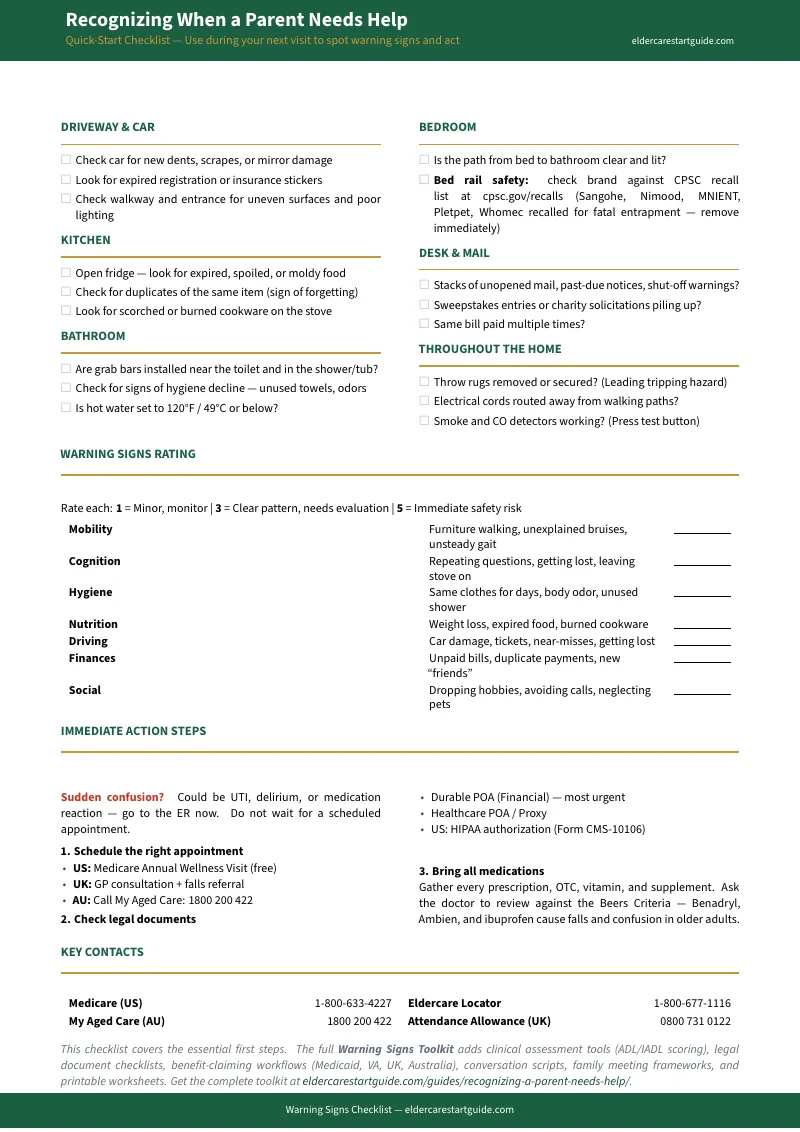
Try the Free Checklist First
Not sure you need the full guide? Download the free Quick-Start Warning Signs Checklist — a 20-item walk-through you can use during your next visit. If it confirms what you suspected, the full guide gives you the clinical tools, legal frameworks, and action sequences to do something about it.