The hospital is sending your parent home. You have 48 hours to become the safety net they no longer have.
You sit in the discharge meeting while a social worker speed-reads through a stack of papers — medication changes, follow-up appointments, activity restrictions, equipment you have never heard of. You nod because what else can you do? Then you drive your parent home and realize no one explained how to actually keep them alive for the next thirty days.
This is not a knowledge gap. It is an operational gap. The information exists — scattered across hospital handouts, AARP articles, CDC checklists, and Reddit threads from other panicking families. What does not exist is a single, sequential system that tells you what to do on day one, day three, day seven, and day fourteen, in the order it matters, with the tracking tools to prove you are doing it right.
The 30-Day Transition System
The Preventing Hospital Readmissions Toolkit is a clinical-grade transition system designed for families — not medical professionals. It takes the same frameworks that hospitals use internally (the LACE risk index, Coleman's Care Transitions, Project RED protocols) and translates them into a day-by-day operational plan with printable checklists, tracking logs, and word-for-word scripts.
Professional geriatric care managers charge $50–$250 per hour to build this kind of plan. Initial assessments alone run up to $2,000. This toolkit lets you perform the critical first-month work yourself — and if you decide to bring in a professional later, the organized documentation you build saves them hours of intake and saves you hundreds in billable time.
What's Inside the Toolkit
- LACE Risk Calculator + 8Ps Screen — because "moderate risk" and "high risk" require completely different monitoring plans, and the hospital may not tell you which one your parent falls into
- Discharge-Day Handoff Scripts — exact questions to ask the discharge planner, the attending physician, and the pharmacy so you leave with everything you need instead of a stack of generic handouts
- Brown Bag Medication Reconciliation — the 72-hour protocol for catching dangerous duplications between pre-admission and post-discharge prescriptions, including a Beers Criteria red-flag reference for high-risk drugs in older adults
- Room-by-Room Home Safety Audit — CDC STEADI-aligned modifications with exact clearance widths, lighting specifications, and grab bar installation requirements (and why suction-cup models are dangerous)
- Daily Vital Signs Log — a printable tracker for weight, blood pressure, temperature, pain, appetite, and cognitive baseline that doubles as the document you bring to every physician visit
- Symptom Traffic Light System — precise thresholds for green (monitor at home), yellow (call the physician now), and red (emergency services), including atypical presentations in older adults that look nothing like textbook symptoms
- Home Health Navigation Guide — Medicare homebound eligibility criteria, how to request services the hospital may not have arranged, and a performance audit framework so you know whether your home health agency is actually delivering
- QIO Fast-Appeal Process — the complete timeline, scripts, and escalation contacts for pausing an unsafe discharge using your Medicare appeal rights
- Family Care Coordination Templates — daily care logs designed to be shared among multiple caregivers and paid aides, so everyone is working from the same clinical data instead of guessing
- First Follow-Up Appointment Prep Kit — what to bring, what to ask, and how to verify that the hospital's discharge summary actually reached your parent's primary care physician
Who This Is For
You are the on-site caregiver managing medications, transfers, and daily monitoring. You need a structured routine that replaces the low-grade terror of wondering whether you are doing enough — or missing the one thing that sends them back.
You are coordinating from a distance through phone calls, local relatives, and paid aides. You need objective tracking protocols and audit tools so you can manage what you cannot see and verify what others report.
You are the only sibling taking action while the rest of the family argues about what to do. You need clinical-grade documentation that shifts the conversation from opinions and guilt to observable data and structured next steps.
Why You Cannot Piece This Together from Free Resources
The information is not the problem. AARP has discharge checklists. The CDC publishes fall prevention guides. Medicare.gov explains appeal rights. Reddit threads offer emotional support from families who have been through it.
What none of them give you is a sequential operational system — the specific order of actions, the tracking tools to document them, and the clinical thresholds that tell you when monitoring is enough and when something has gone wrong. Hospital discharge packets are written for insurance compliance, not home operations. Government checklists cover single topics without connecting them to the broader transition timeline. And the scattered free advice assumes you have the bandwidth to synthesize it all during the most stressful weeks of your life.
This toolkit does the synthesis. Every chapter connects to the one before it and the one after it. Every checklist feeds into the next tracking tool. You do not have to figure out the order — you follow the system.
Satisfaction Guarantee
If the toolkit does not give you a clear, actionable system for managing your parent's transition home, email us and we will refund your purchase. No time limit, no hoops.
Start With the Free Checklist — Or Get the Complete System
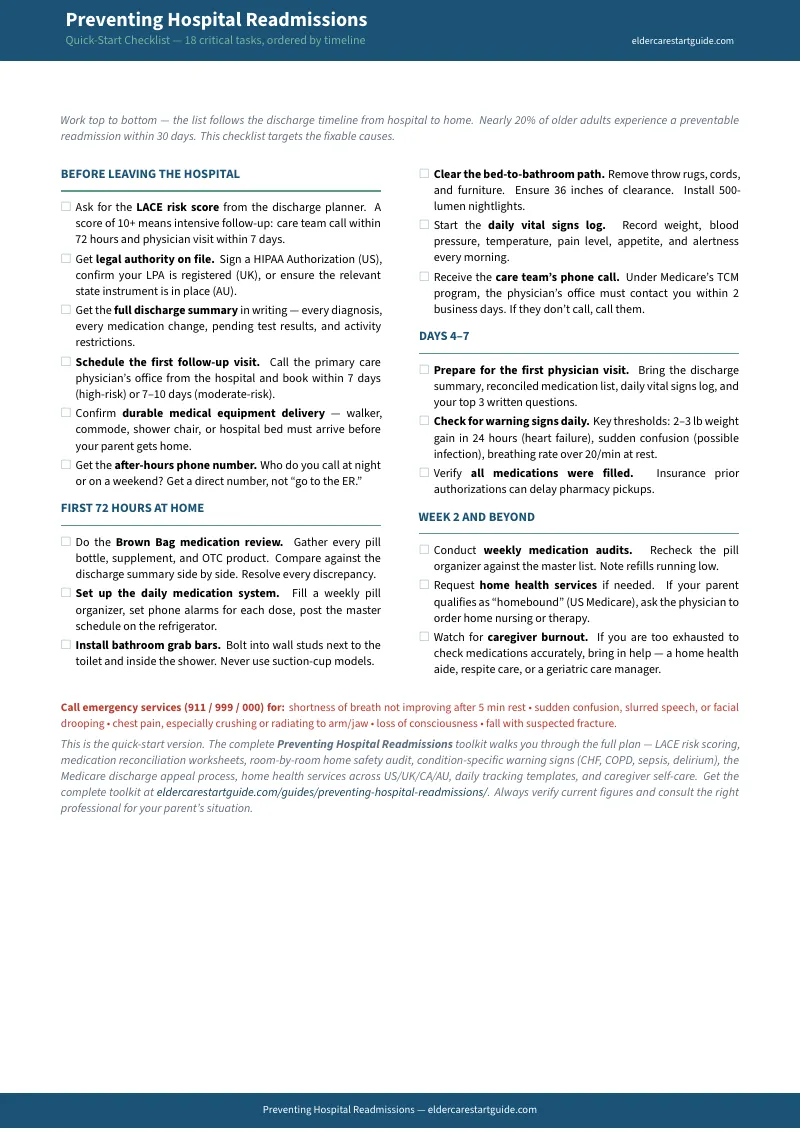
The free Quick-Start Checklist gives you eighteen critical action items across the discharge timeline. It is enough to keep you from missing the obvious steps.
The full Preventing Hospital Readmissions Toolkit gives you the complete operational system — chapter-length instructions, printable tracking templates, medication reconciliation worksheets, clinical warning sign thresholds, and scripts for every conversation you will need to have with physicians, discharge planners, pharmacists, home health agencies, and your own family.