
Your Parent's Safety Shouldn't Depend on a Referral Agency's Commission
Here's what most families don't realize until they're already mid-crisis: the "free" senior placement services that dominate Google results are paid by the facilities they recommend. Commissions run 50% to 100%+ of the first month's rent — often $3,000 to $10,000 per placement. That creates a structural incentive to steer you toward high-cost, private-pay communities while excluding non-profit facilities, independent residential homes, and Medicaid-certified beds that don't participate in referral networks.
Meanwhile, you're trying to figure out whether your parent needs the open corridors and social model of assisted living or the keypad-locked exits and 1:5 staffing ratios of a secured memory care unit — and you're doing it under a 48-to-72-hour hospital discharge deadline.
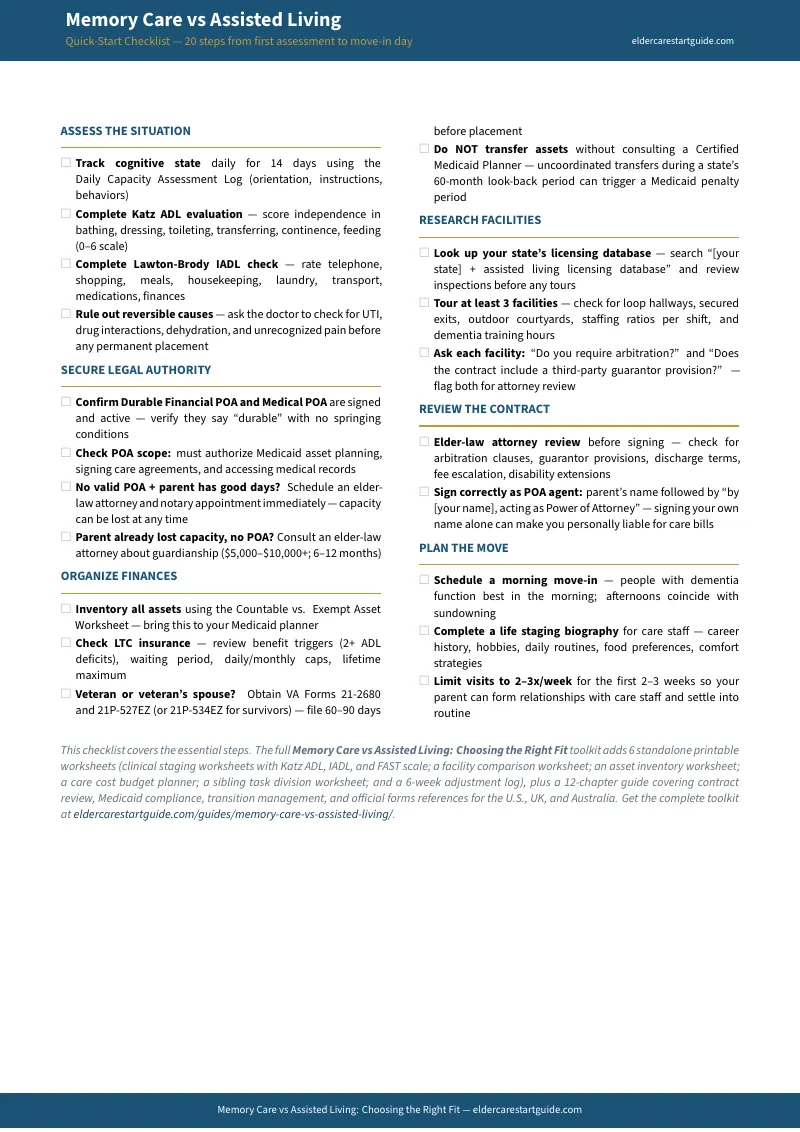
The Memory Care vs Assisted Living toolkit is the Conflict-Free Placement System — a structured decision framework built without referral fees, commission incentives, or facility partnerships. You get clinical staging tools to assess your parent's actual cognitive level, facility evaluation protocols to verify a community's claims against state inspection records, and contract review guidance that prevents the signature mistakes that make you personally liable for a parent's monthly fees.
What's Inside the Toolkit
- Clinical Staging Worksheets (MoCA, MMSE, FAST, GDS) — because "Mom seems confused sometimes" isn't a care plan. These tools translate subjective impressions into objective scores, giving you a factual baseline for the family conversation about what level of care is actually needed — not what one sibling thinks based on a holiday visit.
- The Facility Evaluation Protocol — a structured observation framework for facility tours that goes beyond the sales brochure. What to check in the hallways when no one is watching. How to verify staffing ratios against state filings. Which locked-unit consent rules apply in your jurisdiction. The specific sensory cues (odors, lighting contrast, circular hallway design) that separate well-run memory care from warehoused beds with a keypad on the door.
- Contract Review and Signature Guide — the exact protocol for signing facility contracts under Power of Attorney so you don't accidentally take on personal financial liability. Covers durable vs. springing POA, the capacity window for legal document execution, and the clauses that most families miss until the first monthly invoice arrives higher than quoted.
- Medicaid Asset Spend-Down Tracker — a logging system for compliant spend-down transactions (pre-paid funeral trusts, home mortgage payoff, accessibility modifications) that keeps you inside the 5-year look-back window. Includes the countable vs. exempt asset worksheet and spousal impoverishment protection rules that prevent a surviving spouse from losing the family home.
- Sibling Coordination Templates — task-division frameworks, meeting agendas, and financial contribution trackers for families where one child handles daily care while others criticize from a distance. Addresses the inheritance-preservation dynamic directly: what to do when a sibling blocks a necessary care transition to protect their future share of the estate.
- Transition Anxiety Management — therapeutic fibbing scripts for move-in day, a life-staging biography template so care staff know your parent as a person (career, hobbies, comfort strategies), and a 6-week adjustment log that helps you manage behavioral fallout without derailing the entire transition by visiting too early or too often.
- Direct Facility Negotiation Scripts — email and phone templates to contact facility sales directors directly. Families who bypass referral agencies can negotiate move-in fee reductions of up to $5,000 because the facility isn't paying a commission — but only if you know how to frame the conversation.
- State Licensing Portal Guide — step-by-step instructions to find your state's official facility directory (California DSS, Washington DSHS, Georgia DCH, and equivalents) so you can see every licensed community in your area — including the non-profits and independent homes that referral platforms systematically exclude.
Who This Toolkit Is For
- The Primary Crisis Coordinator — you're the one who got the call from the hospital. You're the one managing appointments, medications, and daily supervision while holding down your own job and family. You need a system, not another article telling you to "explore your options."
- The Long-Distance Manager — you live out of state and suspect your parent is "showtiming" during your visits — rallying temporarily to appear fine, then declining as soon as you leave. You need objective assessment tools and third-party documentation to establish what's actually happening, not another phone call where Dad insists everything is great.
- The Proactive Legal Guardian — you've just received an early-stage dementia diagnosis and you know the window to execute legal documents (Power of Attorney, healthcare directives) is shrinking. A durable POA costs $150–$500 and takes an afternoon. Court-ordered guardianship costs $5,000–$15,000 and takes six to twelve months. You're here because you understand the math.
Why Not Free Online Resources?
Free senior care resources fall into two categories, and neither one gives you what you actually need during a placement crisis.
Commercial referral directories (the major placement platforms) are lead-generation engines. They capture your contact information, share it with multiple facility sales representatives, and generate revenue from whichever community you select. They don't publish direct facility contact information, real-time pricing, or historical inspection records — because transparency would let you bypass their referral tracking. The "free advice" is the product's distribution channel, not its purpose.
Government resources (Area Agencies on Aging, Eldercare Locator) are genuinely unbiased and conflict-free. They're also chronically underfunded, understaffed, and unable to provide the rapid-response checklists, negotiation scripts, or step-by-step transition guides you need when a discharge planner is asking for your facility selection by end of business tomorrow.
This toolkit sits in the gap between those two categories: independent, conflict-free, immediately actionable, and priced at a fraction of a single hour with an elder law attorney or geriatric care manager.
Satisfaction Guarantee
If the toolkit doesn't help you make a more informed care decision, email us and we'll make it right. No forms, no hoops.
Get the Conflict-Free Placement System →
Already have the free checklist? Upgrade to the full toolkit →